

Why did MobiKwik jump ~8% after finally turning a profit?
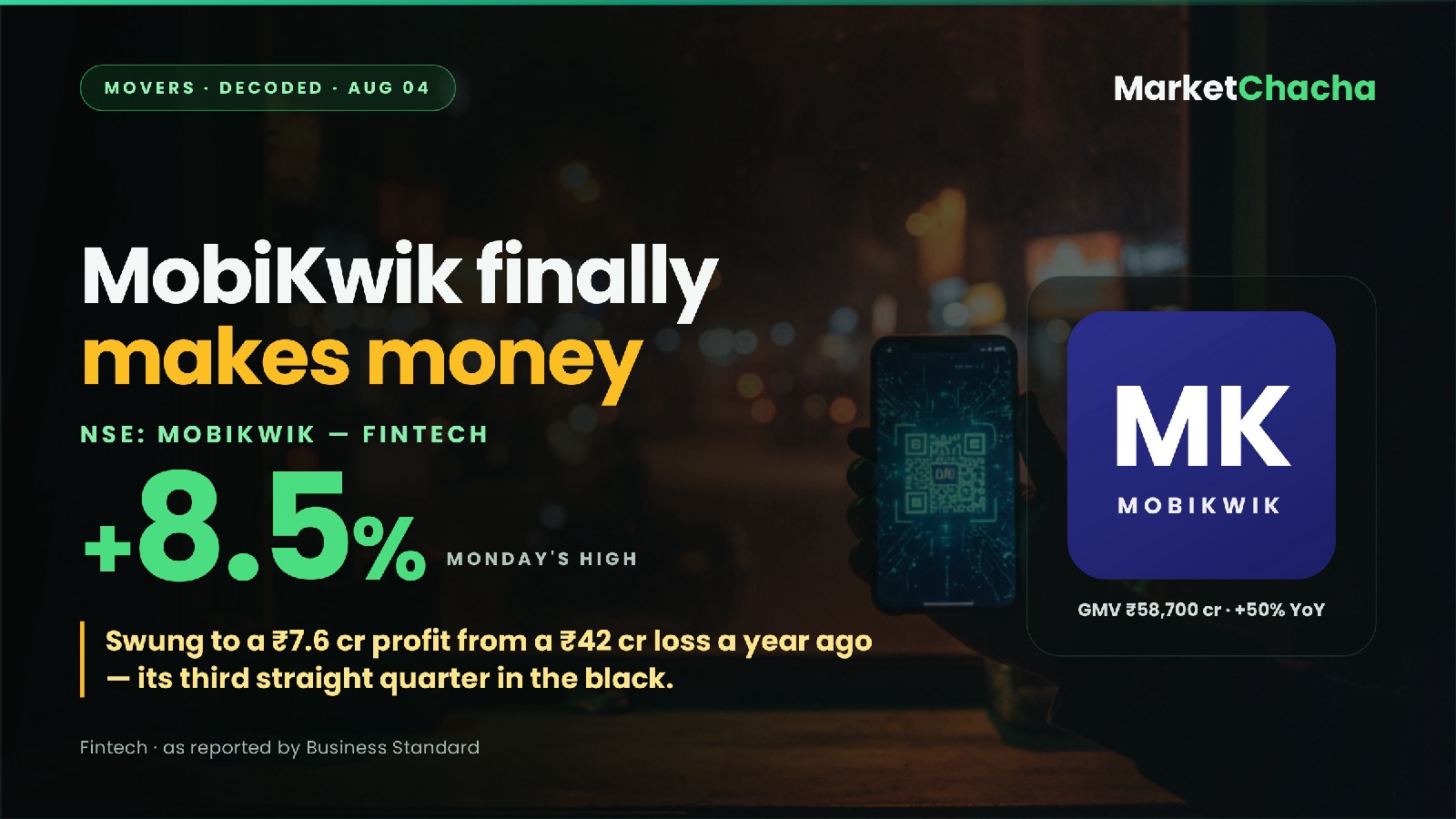
MobiKwik just did something it spent years failing to do: it made money — and the market noticed. Shares of One MobiKwik Systems (NSE: MOBIKWIK) gapped up to ₹207.95 and ran as high as ₹222.80 — up about 8.5% on Monday (Aug 3), before closing near ₹214.77, up roughly 4.7% on the day, as reported by Business Standard. Here's what actually happened, and why it's more interesting than the headline.
What happened
For the June quarter (Q1 FY27), MobiKwik reported a net profit of ₹7.62 crore — versus a net loss of ₹41.9 crore in the same quarter last year. That's a swing of about ₹49.5 crore in twelve months, and its third straight profitable quarter. Operating profit (EBITDA) flipped to ₹15.8 crore from an EBITDA loss of ~₹31 crore a year earlier.
Why it moved — and the twist
Here's the part worth understanding: this profit did not come from booming sales. Revenue from operations rose just 3.7% to ₹281.4 crore — barely moving. The money showed up because the lending business turned genuinely profitable (gross profit there grew about 5.6x year-on-year on better recoveries) while costs were held flat. In plain terms: MobiKwik didn't sell much more — it finally stopped bleeding on what it already sells. Payments volume did grow fast, though: total GMV hit an all-time-high ₹58,700 crore, up ~50% YoY, its 14th straight quarter of growth.
The business (so you don't mistake this for one thing)
MobiKwik runs on two engines. One is payments — the consumer wallet and UPI app, plus Zaakpay (its merchant payment gateway) and its soundbox devices. The other is financial services / lending — its buy-now-pay-later product (ZIP), personal-loan distribution, and newer investing and insurance add-ons. Today's profit is both engines improving together, not a single quarter's lucky break — which matters, because a payments-only fintech and a lending fintech are very different risk animals.
Is it expensive?
Honestly, you can't slap a normal P/E on it yet. Over the trailing twelve months MobiKwik still lost money, so its P/E screens as negative (around −30) — the market is paying for the turnaround, not for current earnings. Its market cap is about ₹1,600 crore. Even if you annualise this quarter's ₹7.6 crore (~₹30 crore a year), that's still north of 50x — not cheap. Compare the obvious peer, Paytm (One 97 Communications): a market cap near ₹86,000 crore and a P/E around 132, but it earned ₹220 crore in the very same quarter — roughly 29x MobiKwik's quarterly profit. So MobiKwik is the tiny challenger proving the model works; Paytm is the scaled leader already minting cash. Both are priced for growth, neither is a bargain.
Who it touches
- The "can Indian fintech actually make money" debate: another data point that the path to profit is real, after Paytm got there first.
- Merchant-payments rivals: Zaakpay and MobiKwik's soundbox push it up against Paytm and the unlisted PhonePe and BharatPe for the same shopkeeper.
- Lending partners: the NBFCs and banks whose loans MobiKwik distributes benefit as its credit engine scales — but they also share the risk if it sours.
The one risk that flips this
The profit is thin (₹7.6 crore) and leans on lending, not on selling more. If loan defaults tick up or the RBI tightens digital-lending and BNPL rules — a live theme — that slim profit can vanish fast, and the trailing number is already negative. One weak quarter and the "profitable fintech" story cracks. Growth in the core payments take-rate, not just GMV, is the thing to watch.
As of Aug 3, 2026 close (~3:30 PM IST). Sources: Business Standard, Zee Business. For discussion and education only — not investment advice. Verify before acting.
This article is for educational and informational purposes only. It is not financial advice, investment recommendation, or a solicitation to buy or sell securities. Investing involves significant risks. I am not a SEBI-registered investment advisor. Readers should consult their own financial advisor and conduct their own research before making any investment decisions.
Comments
Join the conversation
Sign in to join the conversation.
Follow replies, add your view, and take part in the discussion.
Sign in to commentLoading comments...