

T-bills vs T-notes vs T-bonds: what's the difference — and which should you buy?
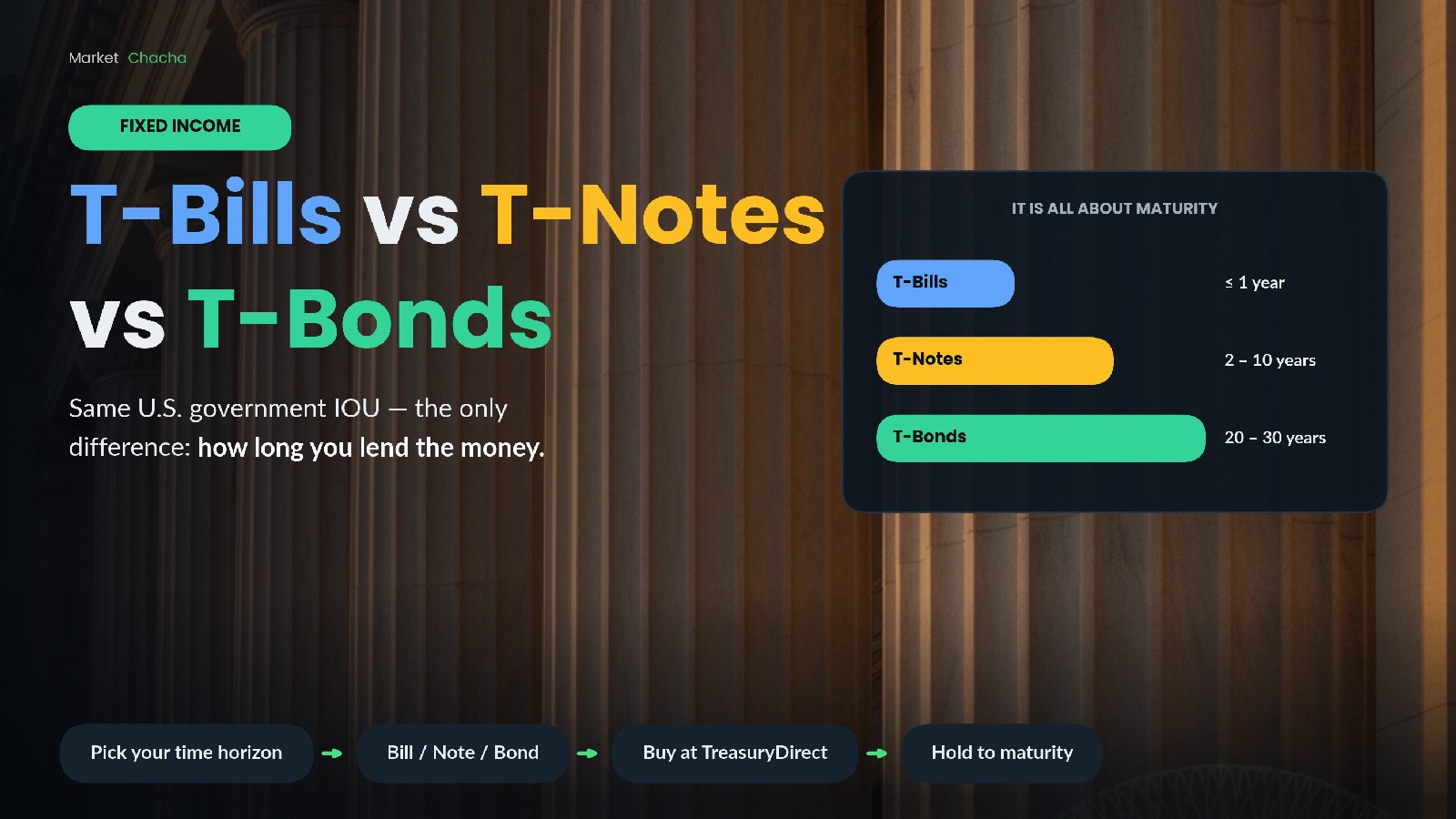
Treasury bills, notes and bonds are the same thing — a loan you make to the U.S. government — and the only real difference between them is how long the loan lasts. A T-bill matures in one year or less, a T-note in 2 to 10 years, and a T-bond in 20 or 30 years. That single difference — the maturity — changes how you get paid, how much income you earn, and how much the price bounces around if you sell early. This guide walks through each one with the actual arithmetic, how to buy them, the catches to watch, and how the same idea works in India.
The one thing that separates them: maturity
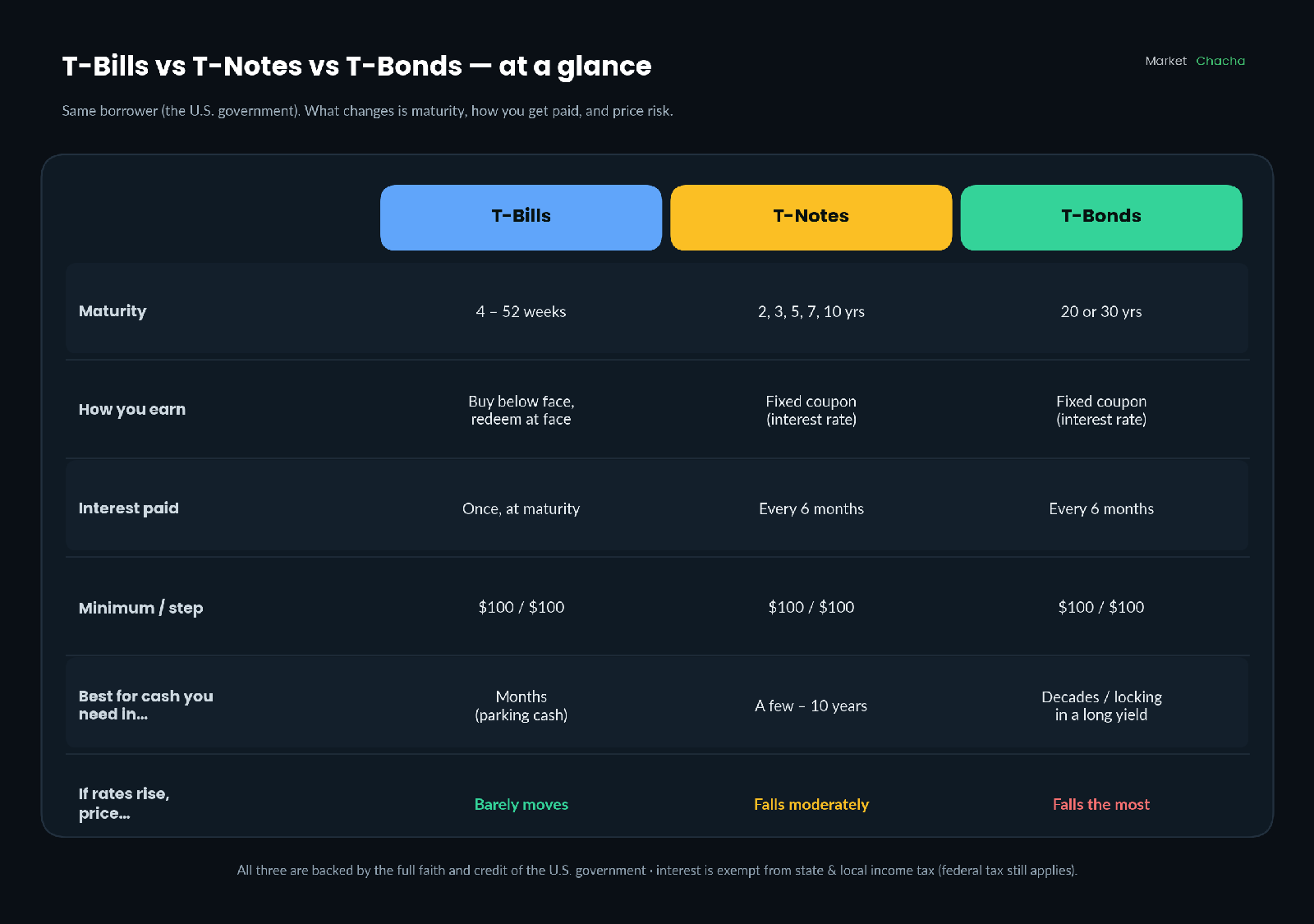
All three are “Treasurys” — IOUs issued by the U.S. Department of the Treasury and backed by the full faith and credit of the U.S. government, which is why they are treated as the benchmark for a “risk-free” return. You lend the government money today; it pays you interest and returns your principal on a set date. The label just tells you how far away that date is:
- T-bills — terms of 4, 8, 13, 17, 26 or 52 weeks (a year or less).
- T-notes — terms of 2, 3, 5, 7 or 10 years.
- T-bonds — terms of 20 or 30 years.
The minimum purchase for any of them is just $100, and you buy in $100 increments. So the choice between a bill, a note and a bond is really a choice about when you want your money back and how you want to be paid along the way.
T-bills: you make money from the discount
T-bills are the odd one out: they do not pay a coupon. Instead you buy the bill for less than its face value and get the full face value back at maturity. The gap between what you paid and what you get back is your interest. This is called buying “at a discount.”
Worked example. Say you buy a 13-week (about 3-month) T-bill with a $1,000 face value, and at the auction it is priced at $990.00. You pay $990 today. Thirteen weeks later the bill matures and the Treasury pays you the full $1,000. Your interest is:
- $1,000 − $990 = $10.00 earned over 91 days.
- As a plain return: $10 ÷ $990 = 1.01% for the quarter.
- Annualised (so you can compare it to a savings rate): 1.01% × (365 ÷ 91) ≈ 4.05% per year.
That is the whole mechanic. There are no monthly interest payments to track — you simply get more back than you put in, once, at the end. Because the term is so short, a T-bill behaves a lot like a slightly higher-yielding, government-backed alternative to a savings account for cash you will need soon.
T-notes and T-bonds: a coupon every six months
Notes and bonds work the way most people picture a bond. You typically pay around face value, and in return the Treasury pays you a fixed coupon — an interest payment — every six months until maturity, then returns your principal at the end. (The word “coupon” is a leftover from the days when bonds came with paper tabs you clipped and mailed in to collect each payment.)
Worked example. Suppose you buy a $1,000 10-year T-note with a 4.5% coupon (an illustrative rate). That 4.5% is an annual rate, split into two payments a year:
- Each payment: 4.5% ÷ 2 × $1,000 = $22.50 every six months.
- That is $45 a year, arriving as two $22.50 deposits.
- Over the full 10 years you collect $450 in coupons, and at maturity you get your $1,000 back.
A 30-year T-bond works exactly the same way — it just keeps paying that coupon twice a year for three decades. The coupon rate is set when the security is first auctioned and never changes for that security, which is why a note or bond gives you predictable income that a T-bill does not.
Why the length matters: yield, income and price risk
If bills, notes and bonds are all the same borrower, why pick one over another? Three reasons flow directly from the maturity.
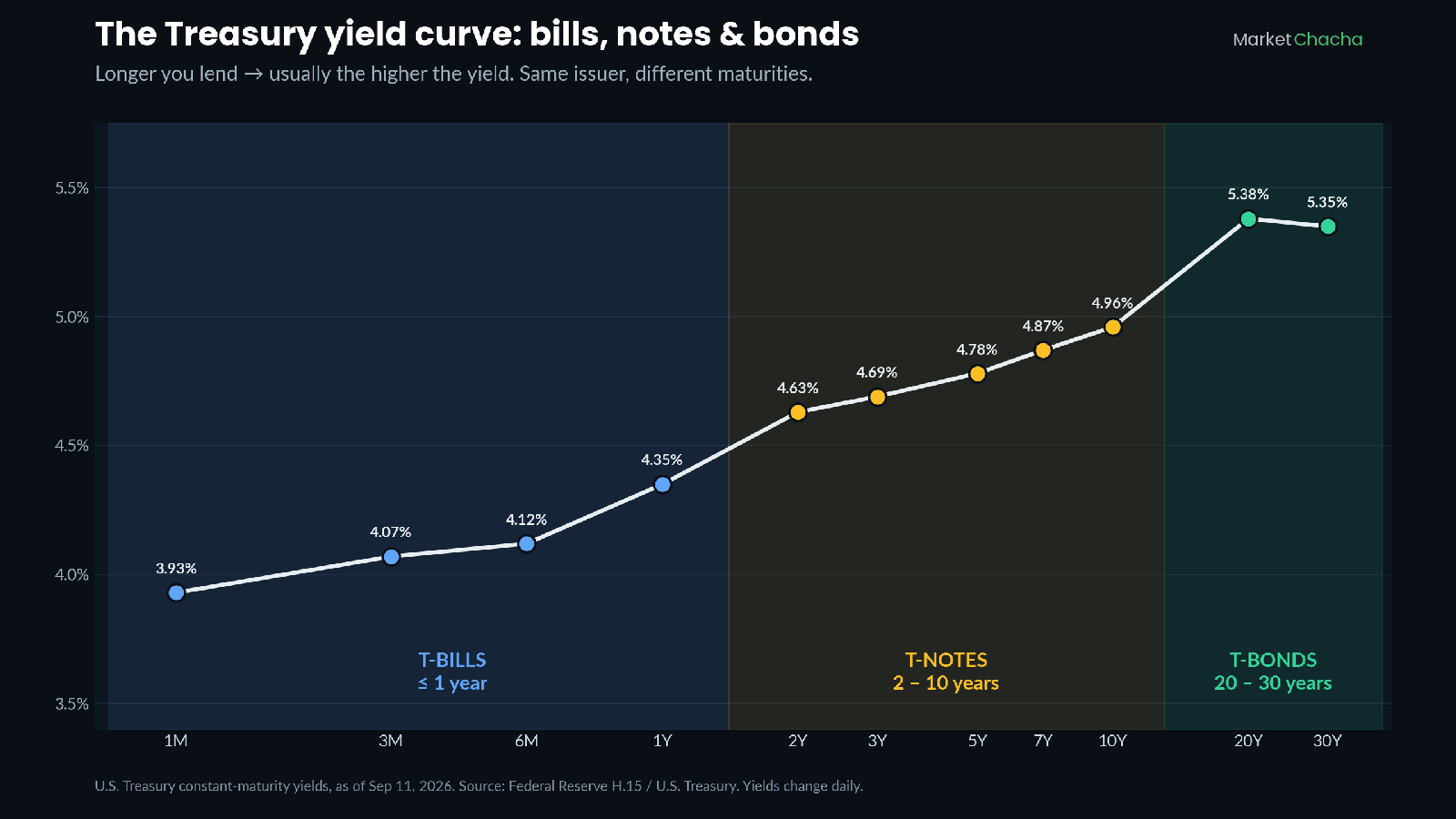
1) Yield. Normally, the longer you tie up your money, the higher the yield you demand — so bonds usually pay more than notes, which pay more than bills. Plot the yields for every maturity on one line and you get the famous Treasury yield curve:
2) Income pattern. A bill pays you nothing until it matures; a note or bond drips out cash every six months. If you want regular income, that favours notes and bonds. If you just want a safe place to park cash for a few months, a bill is simpler.
3) Price risk. This is the big one. If you hold to maturity, you get the face value back no matter what — the price along the way does not matter. But if you need to sell early, the market price moves opposite to interest rates: when rates rise, the price of an existing bond falls (because new bonds now pay more). And the longer the maturity, the more violently that price swings. A 30-year bond can lose serious value if rates jump; a 3-month bill barely flinches. That is why bonds are described as “riskier” than bills even though the government backs both — the risk is not default, it is price movement if you sell before the end.
How to actually buy them
There are three common routes, from most direct to most hands-off:
- TreasuryDirect.gov — the government’s own website. You open a free account and buy new bills, notes and bonds straight from the Treasury at auction, with no fees and no middleman. Best if you want to buy and hold to maturity.
- A brokerage account — most brokers let you buy Treasurys either at auction or on the secondary market (from other investors), often inside the same account as your stocks. Handy if you want to sell before maturity or keep everything in one place.
- Treasury ETFs and money-market funds — funds that hold a basket of Treasurys for you (for example, short-term T-bill ETFs). You get instant diversification and easy trading, but a fund never matures the way a single bill does, and it charges a small annual fee.
A simple way to decide: match the maturity to your goal. Money you need in months → a bill. Money you want safe for a few to ten years → a note. Money you want to lock a long yield on → a bond. Some investors buy several bills or notes with staggered maturity dates — a “ladder” — so cash frees up at regular intervals.
What it costs you — the catches
Treasurys are about as safe as an investment gets, but “safe” is not the same as “no downside.” Three catches:
- Selling early can mean a loss. As above, if rates have risen since you bought, an early sale of a note or bond can fetch less than you paid. Hold to maturity and this risk disappears.
- Inflation can outrun you. A fixed 4.5% coupon loses purchasing power if inflation runs hot. The longer the bond, the longer you are locked into a rate that might look low later. (Inflation-protected Treasurys, called TIPS, are a separate tool for this.)
- Tax. Treasury interest is subject to federal income tax — but it is exempt from state and local income tax, which can make Treasurys more attractive than a bank CD for someone in a high-tax state. Always confirm your own situation.
Common mistakes beginners make
- Thinking a T-bill “pays interest” monthly. It does not — the entire return shows up as the discount when it matures.
- Assuming a longer bond is always better because it yields more. The extra yield is compensation for extra price risk and inflation risk, not a free lunch.
- Panicking when a bond fund drops. If rates rise, bond prices fall — that is normal mechanics, not a sign anything is broken. It stings more with long maturities.
- Confusing yield with coupon. The coupon is fixed for the life of the security; the yield reflects the price you actually paid, which can differ on the secondary market.
How this works in India
India has the same building blocks, just with different names and one fewer category. The Reserve Bank of India (RBI) issues Treasury Bills in tenors of 91, 182 and 364 days. Like US T-bills, they pay no coupon — you buy them at a discount and receive the face value at maturity, and the difference is your return.
For anything longer than a year, India uses one broad category called dated Government Securities (G-secs), which can run from a few years out to 40 years and pay a fixed coupon twice a year — so a single “G-sec” plays the role of both the US T-note and T-bond. India does not split these into separate “note” and “bond” labels.
Retail investors can buy both T-bills and G-secs directly and for free through the RBI’s Retail Direct portal, or via banks, brokers and gilt (government-bond) mutual funds. One important difference from the US: interest earned on Indian government securities is generally taxable as per your income-tax slab — there is no state-tax exemption like the US one. As always, check the current rules and your own tax position.
FAQ
What is the difference between a Treasury bill, note and bond? Only the maturity. Bills mature in a year or less and pay you through a discount; notes mature in 2–10 years and bonds in 20 or 30 years, and both pay a fixed coupon every six months.
Do Treasury bills pay interest? Yes, but not as periodic payments. You buy the bill below its face value and receive the full face value at maturity — that gap is your interest, paid all at once at the end.
Which is safer, a T-bill or a T-bond? Both carry the same U.S. government backing, so default risk is essentially the same. The T-bill is “safer” in the sense that its price barely moves if you need to sell early, whereas a long T-bond’s price can swing a lot when interest rates change.
Can I lose money on a Treasury note or bond? If you hold it to maturity, you get the full face value back. You can lose money only if you sell before maturity after interest rates have risen, or in real terms if inflation outpaces your fixed coupon.
How much money do I need to start? Just $100. Treasury bills, notes and bonds are all sold in $100 minimums and $100 increments through TreasuryDirect or a brokerage.
Are Treasury bonds and I bonds the same thing? No. T-bonds are marketable securities you can buy and sell, with a fixed coupon; I bonds are a separate savings bond whose rate adjusts with inflation and which you buy and hold differently. This guide is about bills, notes and bonds.
Educational content only — not investment or tax advice, and not a recommendation of any product. Rates, fees and rules change — always check current terms with the provider before acting. [Sources: TreasuryDirect (U.S. Treasury), Federal Reserve H.15 Selected Interest Rates, RBI Retail Direct.] Always do your own research.
This article is for educational and informational purposes only. It is not financial advice, investment recommendation, or a solicitation to buy or sell securities. Investing involves significant risks. I am not a SEBI-registered investment advisor. Readers should consult their own financial advisor and conduct their own research before making any investment decisions.
Comments
Join the conversation
Sign in to join the conversation.
Follow replies, add your view, and take part in the discussion.
Sign in to commentLoading comments...