

How does compounding actually build wealth? The simple math behind 'time in the market'
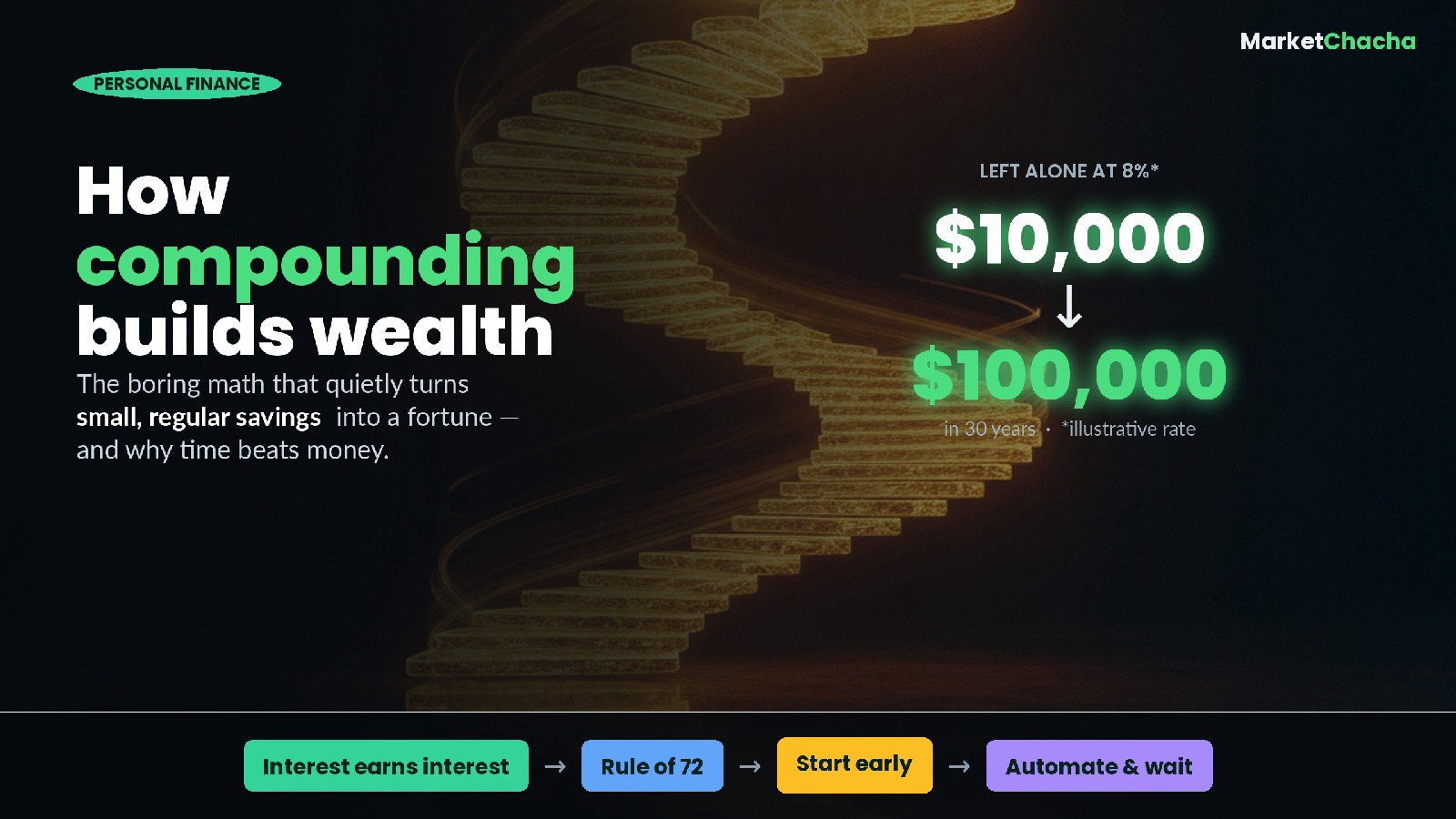
Compounding is the process where the returns your money earns start earning returns of their own. Instead of only your original savings working for you, last year's growth is added to the pile and grows too — so the balance builds slowly at first, then accelerates. Albert Einstein probably never actually called it the "eighth wonder of the world," but the math behind it is the single most important idea in personal finance, because it is what turns modest, boring, regular saving into real wealth over a lifetime. This guide explains exactly how compounding works, walks through the arithmetic step by step, shows why starting early beats investing more, and covers the fees, taxes and mistakes that quietly slow it down — with a closing section on how the same idea plays out in India.
What "compounding" actually means
Simple interest pays you only on your original amount. Compounding pays you on your original amount plus all the returns you've already earned. That second part — earning returns on your past returns — is the whole engine.
Here's the smallest possible worked example. Say you put $10,000 into an account that grows 8% a year (we'll use 8% as a round, illustrative figure throughout — not a promised or predicted return; real investment returns bounce around and can be negative in any given year).
- End of year 1: you earn 8% of $10,000 = $800. Balance: $10,800.
- End of year 2: you earn 8% of $10,800 = $864. Balance: $11,664.
Look closely at year 2. You earned $864, not $800. That extra $64 is 8% of the $800 of interest you earned last year. Your interest earned interest. It's a tiny amount in year two — but that $64 is the seed of everything. Each year the "interest on interest" slice gets bigger, and eventually it dwarfs what your original deposit contributes.
A worked example: how $10,000 becomes ~$100,000
Leave that same $10,000 alone at 8% a year and never add another cent. Using the compounding formula — Future value = Principal × (1 + rate)^years — here's what happens:
- After 10 years: about $21,600 (you've roughly doubled).
- After 20 years: about $46,600.
- After 30 years: about $100,600.
Your original deposit was $10,000. After 30 years you have roughly $100,000 — meaning about $90,000 of that is pure growth, and the large majority of that growth is returns earning returns, not your original money. Notice the shape: it took 10 years to make your first ~$11,600 of gains, but the last decade (years 20 to 30) added over $54,000. Compounding is back-loaded. This is why the curve looks flat and disappointing early on and then bends sharply upward — and why people who quit early never see the best part.
The rule of 72: how fast does money double?
You don't need a spreadsheet to estimate doubling time. Just divide 72 by your annual return:
- At 8%: 72 ÷ 8 = 9 years to double.
- At 6%: 72 ÷ 6 = 12 years.
- At 9%: 72 ÷ 9 = 8 years.
It's an approximation, but a remarkably good one for the returns most people deal with. The rule also works in reverse for things that hurt you: at 8% inflation, prices double — and your cash loses half its buying power — in about 9 years. Same math, opposite direction.
Why starting early beats investing more
This is the part almost everyone underestimates. Meet two savers, both earning 8% a year:
- Emma invests $6,000 a year from age 25 to 34 — ten years — then stops completely and never adds another rupee or dollar. Total invested: $60,000.
- Liam waits, then invests $6,000 a year from age 35 to 64 — thirty years straight. Total invested: $180,000, three times as much as Emma.
Who has more at age 65? Emma does. Her early pot grows to about $875,000. Liam's ends at about $680,000 — despite him putting in three times the money. Emma's ten-year head start gave her contributions an extra couple of decades to compound, and that head start beats Liam's twenty extra years of paying in. The chart below shows the gap.
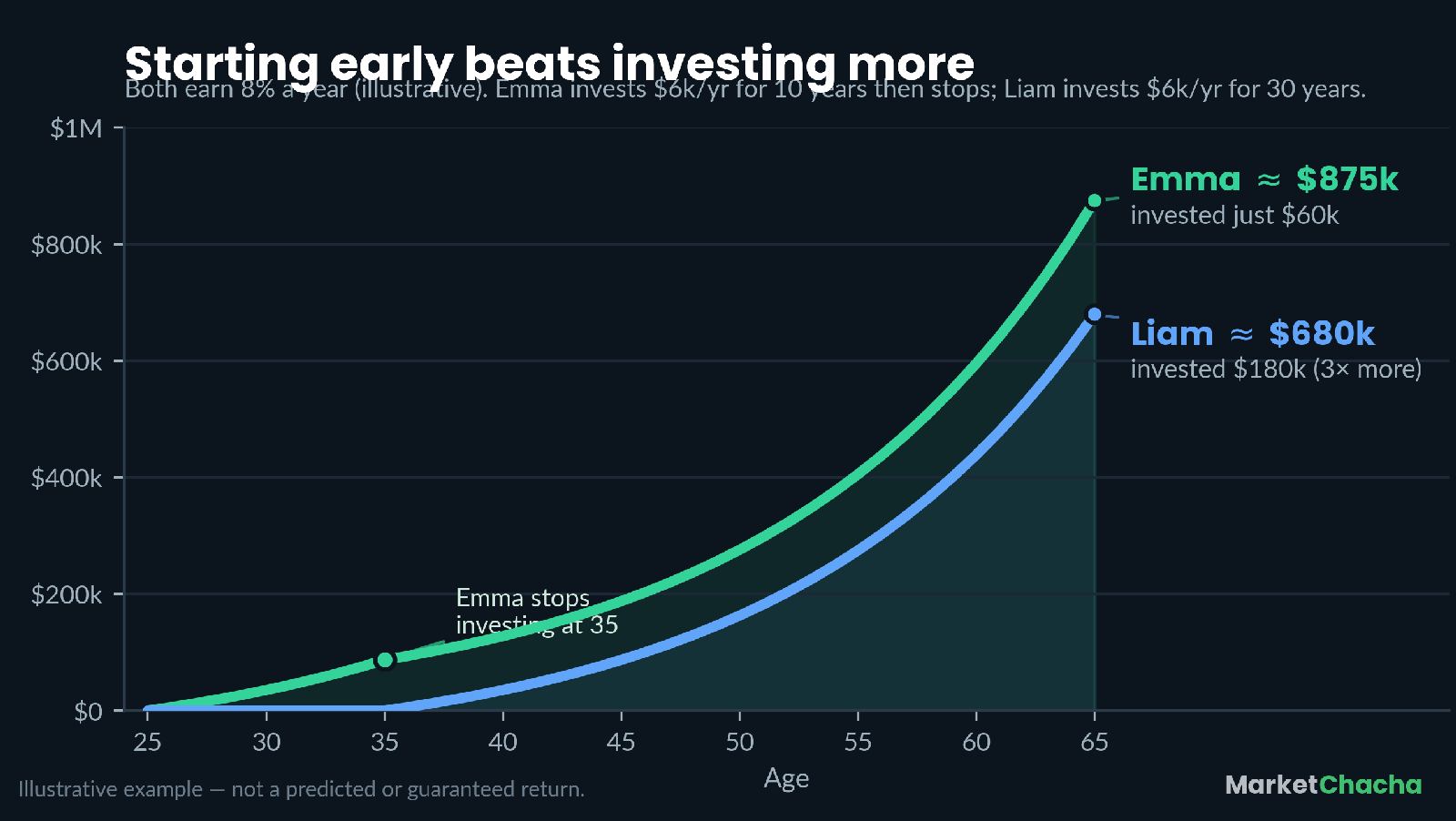
The lesson isn't "don't invest later" — Liam still built a large sum, and starting late is far better than never starting. The lesson is that time is the ingredient you can never buy back. A dollar invested at 25 is worth several times a dollar invested at 45, purely because it gets more doubling cycles.
The three levers you actually control
A compounding result depends on just three inputs, and it's worth being honest about how much control you have over each:
- Time — by far the most powerful, because it's an exponent, not a multiplier. The main way to get more of it is to start now.
- Contribution amount — fully in your control. Adding regularly (a monthly automatic transfer) matters enormously in the early years, before growth takes over. Example: just $200 a month for 40 years at 8% grows to about $698,000, from only $96,000 of your own money.
- Rate of return — the least in your control and the most dangerous to chase. Reaching for a higher return usually means taking more risk, and a bad year can wipe out several good ones. Small, sustainable differences matter, but nobody controls the market.
What it costs you: fees, taxes and inflation
Compounding cuts both ways, and three quiet forces work against your curve:
Fees compound too. A fund charging 1% a year instead of 0.05% doesn't just cost you 0.95% — it costs you 0.95% every year, on a growing balance, for decades. Over 30 years a seemingly small fee gap can quietly eat a fifth or more of your final pot. This is the single biggest argument for low-cost index funds.
Inflation is compounding in reverse. The 8% in our examples is a nominal return. If inflation runs ~3%, your real (purchasing-power) return is closer to 5%. Your money still grows, but slower than the headline number — always keep the difference between nominal and real in mind.
Debt compounds against you. The exact same machine that builds wealth on your investments builds debt on an unpaid credit-card balance — except card rates are often far higher than any return you'll reliably earn. Paying off high-interest debt is compounding working for you; carrying it is compounding working for the bank.
How to actually put compounding to work
The concept is simple; the doing is a short checklist. In the US, the tax-advantaged accounts are where compounding is most powerful because growth isn't taxed each year:
- Grab the free money first. If your employer offers a 401(k) match, contribute at least enough to get the full match — that's an instant return before compounding even starts.
- Use tax-advantaged room. For 2026 you can contribute up to $24,500 to a 401(k) and $7,500 to an IRA (Roth or Traditional) if you're under 50 — per the IRS. Inside these accounts, gains compound without a yearly tax drag.
- Keep costs low and stay diversified. A broad, low-fee index fund keeps the "fee leak" small and removes single-stock risk.
- Reinvest everything. Turn on automatic dividend reinvestment so payouts buy more shares instead of sitting idle — that's the reinvestment that makes returns compound.
- Automate and leave it alone. Set a fixed monthly transfer and resist touching it. Time in the market, not timing the market, is what the arithmetic rewards.
Common mistakes beginners make
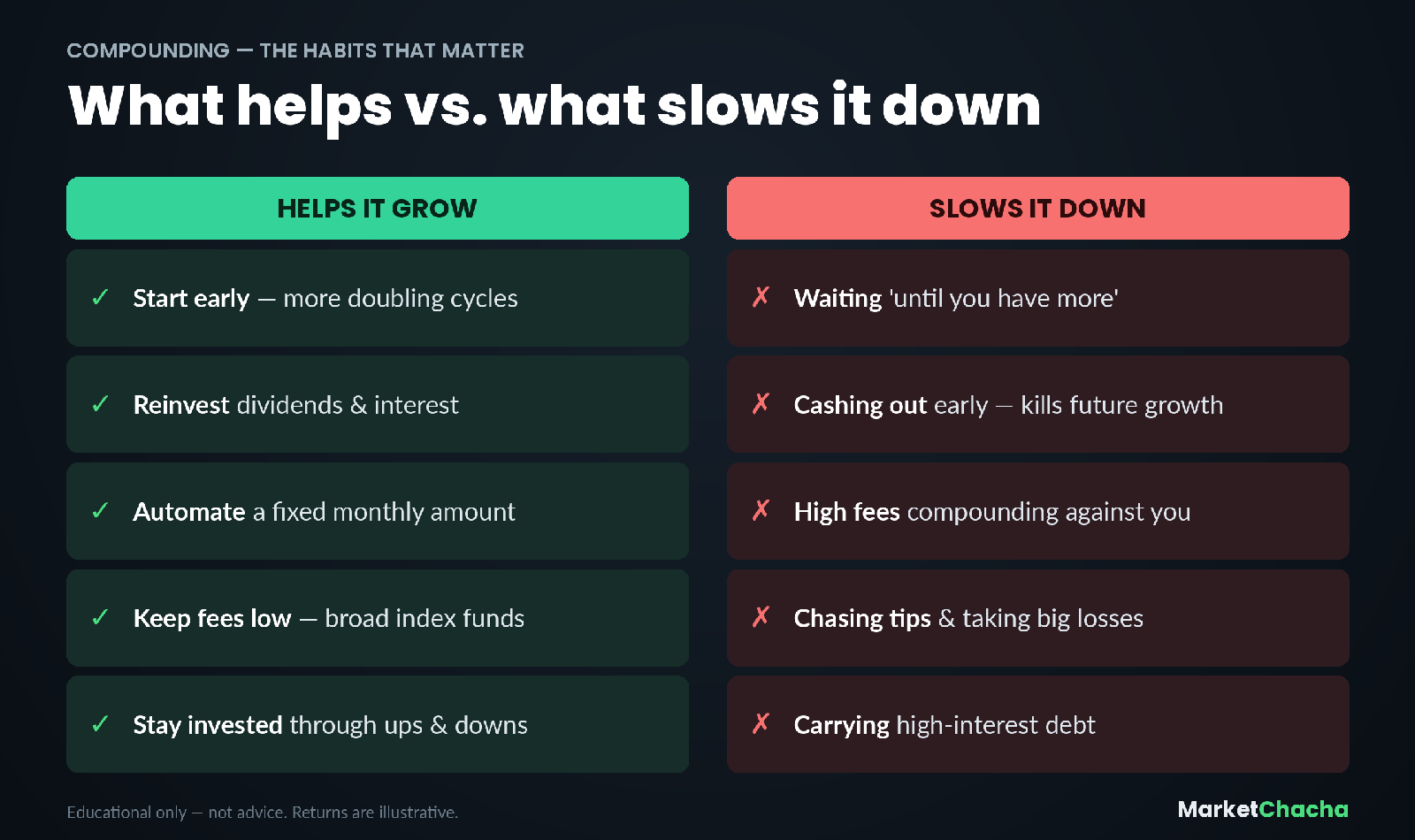
- Waiting for "enough" money to start. Because of the early-mover effect, small amounts invested now usually beat large amounts invested later. Starting is more important than the size.
- Cashing out early. Every withdrawal doesn't just remove that dollar — it removes all the future doubling that dollar would have done. This is why raiding retirement savings is so costly.
- Ignoring fees. A 1% difference sounds trivial and compounds into a fortune. Always check the expense ratio.
- Chasing high returns. Blowing up the account chasing a hot tip resets the compounding clock to zero. Boring and consistent wins.
How this works in India
The mathematics is identical — only the vehicles change. Instead of a 401(k) and IRA, the everyday compounding tools in India are:
SIPs in mutual funds. A Systematic Investment Plan is simply an automatic monthly contribution into a fund — the same "automate and let it compound" habit. Long-run equity returns are illustrative and not guaranteed, exactly as with the US example, but the compounding engine is the same, and choosing direct plans keeps fees (and the fee-compounding drag) lower.
PPF (Public Provident Fund). A government-backed scheme whose interest compounds annually and is tax-free. The rate is set by the Ministry of Finance each quarter; it was retained at 7.1% per annum for the July–September 2026 quarter. It's a clean, real-world example of guaranteed annual compounding.
EPF (Employees' Provident Fund). The salaried employee's default retirement pot, funded by you and your employer — India's closest cousin to the 401(k) match idea. The declared rate for FY 2025-26 is 8.25% per annum. Because contributions come straight from salary and stay invested for a full career, EPF is often a person's biggest compounding engine without them noticing.
Others worth knowing: NPS for retirement, and ELSS funds that combine equity compounding with a tax deduction under Section 80C. As always, rates and rules change — check the current figure before you rely on it.
FAQ
What is compounding in simple words? It's when the returns your money earns are added back to your balance and then earn returns themselves. Over time you're earning returns on your returns, which makes the balance grow faster and faster.
What is the difference between simple interest and compound interest? Simple interest is calculated only on your original amount, so it grows in a straight line. Compound interest is calculated on your original amount plus all previously earned interest, so it grows on a curve that steepens over time.
How does the rule of 72 work? Divide 72 by your annual percentage return to estimate how many years it takes your money to double. At 8% a year that's 72 ÷ 8 = about 9 years. It's an approximation but close enough for planning.
Why does starting early matter so much? Because time is an exponent in the compounding formula. Money invested in your twenties gets many more doubling cycles than money invested in your forties, so an early start can beat a much larger amount invested later — as the Emma-vs-Liam example shows.
Does compounding work against me with debt? Yes. Unpaid credit-card balances compound the same way, but usually at much higher rates than you'll reliably earn investing. Paying off high-interest debt is one of the most reliable "returns" you can get.
Is 8% a guaranteed return? No. 8% is just a round illustrative figure to show the math. Real investment returns vary year to year and can be negative; guaranteed products like PPF or bank deposits pay lower, fixed rates. Never treat an illustrative rate as a promise.
Educational content only — not investment, tax or financial advice, and not a recommendation of any product. All returns shown are illustrative, not guaranteed or predicted; real returns vary and can be negative. Rates, limits and rules change — always check current terms with the provider or a qualified adviser. Sources: IRS (2026 contribution limits), PPF rate (Ministry of Finance, Jul–Sep 2026), EPF rate (EPFO, FY 2025-26). Always do your own research.
This article is for educational and informational purposes only. It is not financial advice, investment recommendation, or a solicitation to buy or sell securities. Investing involves significant risks. I am not a SEBI-registered investment advisor. Readers should consult their own financial advisor and conduct their own research before making any investment decisions.
Comments
Join the conversation
Sign in to join the conversation.
Follow replies, add your view, and take part in the discussion.
Sign in to commentLoading comments...