

How does car insurance actually work? Liability vs collision vs comprehensive, and what a deductible really does
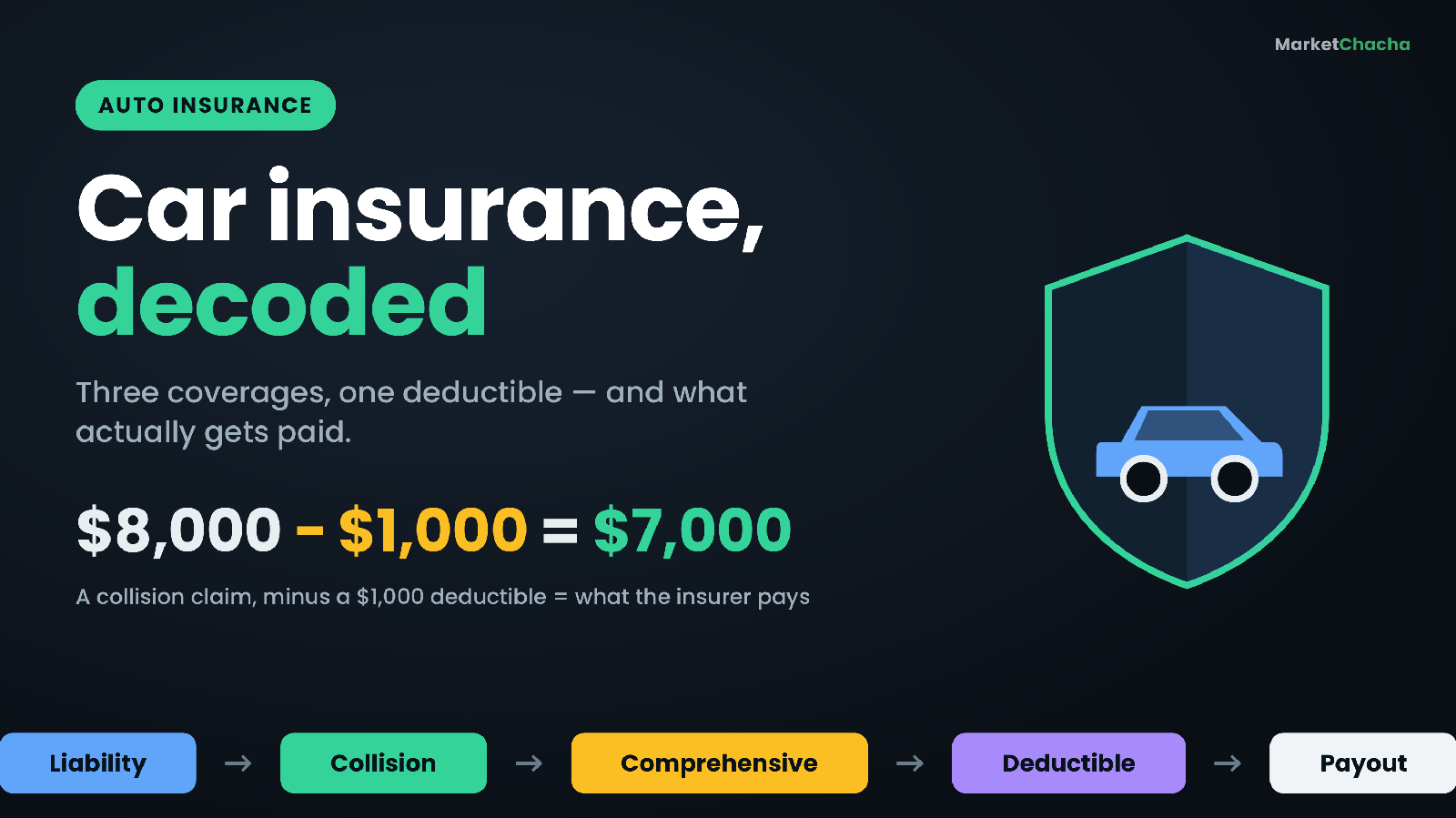
Car insurance is a contract where you pay a regular premium and, in return, the insurer agrees to pay for certain losses — damage you cause to other people, damage to your own car, or damage from events like theft and storms — minus a deductible you agree to cover yourself. The confusing part is that "car insurance" is really several separate coverages bundled together, each doing a different job. This guide breaks down what each coverage actually pays for, what a deductible really does to a claim, how insurers price your premium, and how the same ideas map to motor insurance in India.
The three coverages hiding inside "full coverage"
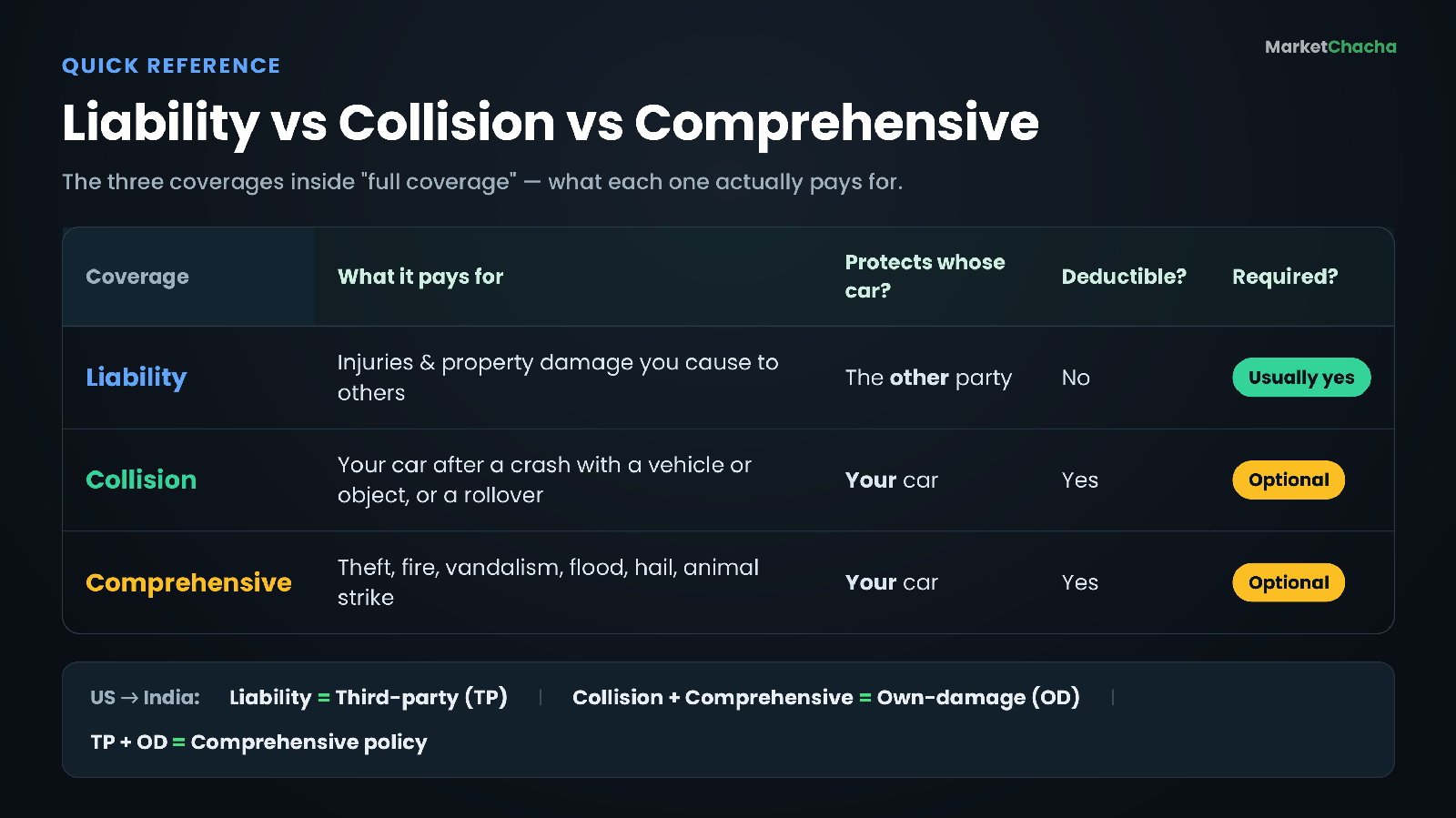
There is no official product called "full coverage." In the US it is shorthand for carrying three separate coverages at once: liability, collision, and comprehensive. Understanding them separately is the whole game.
Liability pays for harm you cause to other people — their injuries and their property — when you are at fault. It does not pay a cent toward your own car or your own injuries. Almost every US state legally requires a minimum amount of liability insurance, which is why it is the non-negotiable core of any policy.
Collision pays to repair or replace your car when it hits, or is hit by, another vehicle or object — a guardrail, a pole, another car — or rolls over, regardless of who was at fault.
Comprehensive is the "everything else" coverage for your own car: theft, fire, vandalism, flood, hail, falling trees, and hitting an animal. A useful rule of thumb — if your car is damaged while it is parked and switched off, that is almost always a comprehensive claim, not collision.
Two more coverages round out a typical policy: uninsured/underinsured motorist (protects you when the at-fault driver has no insurance or too little), and medical payments or PIP (personal injury protection), which covers your own medical bills. Which of these are required depends on your state.
What a deductible actually does (worked example)
A deductible is the amount you agree to pay out of your own pocket on a claim before the insurer pays the rest. It applies to collision and comprehensive claims — not to liability, which has no deductible.
Say you back into a concrete pole and the repair estimate is $8,000. You carry collision with a $1,000 deductible. Here is the arithmetic: the insurer pays $8,000 − $1,000 = $7,000, and you pay the $1,000 yourself. If the same dent had cost only $900 to fix, you would get nothing from the insurer, because the repair is below your deductible — and you would still have "used" a claim on your record. That is why filing tiny claims often backfires.
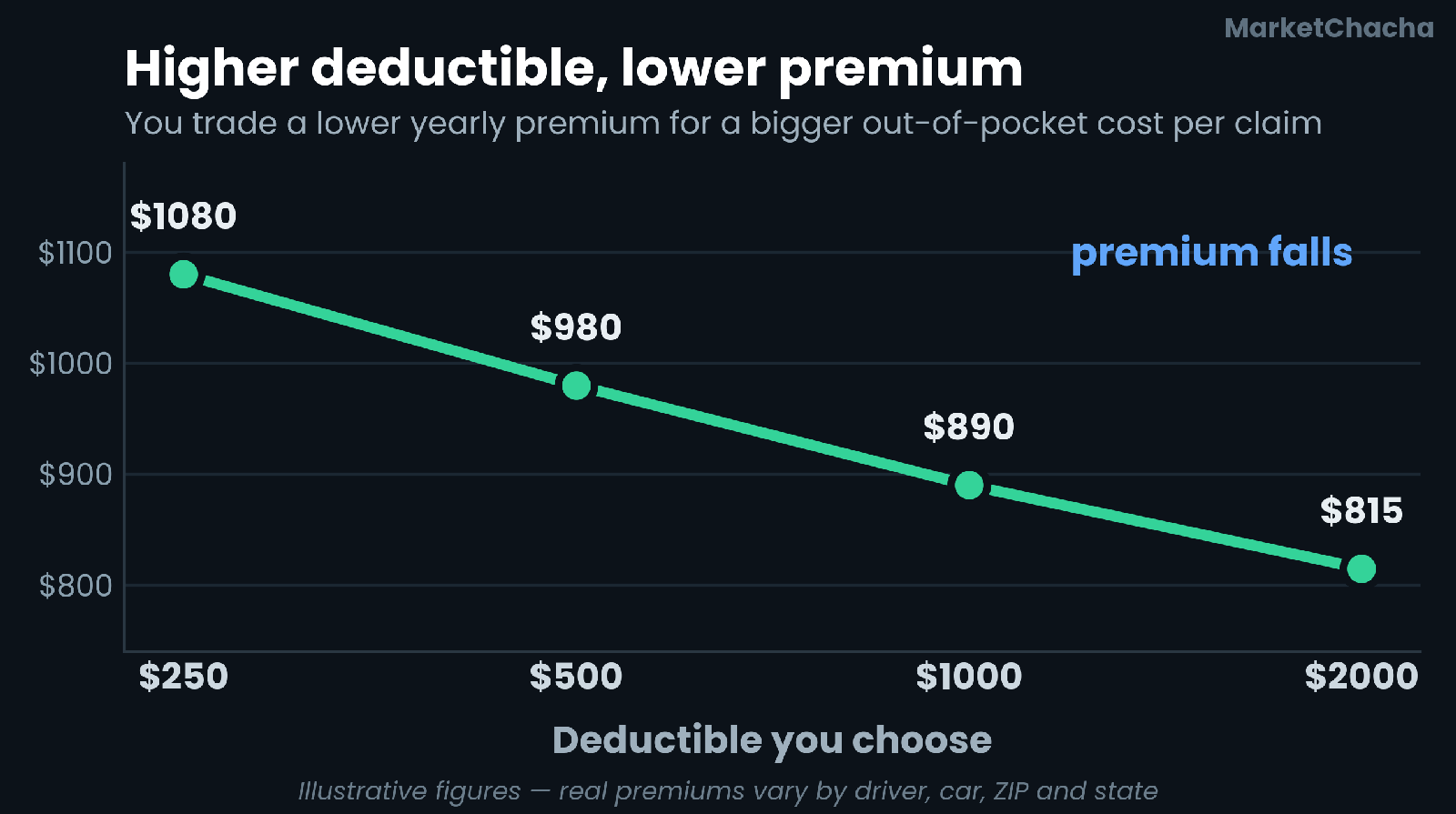
The deductible is a lever you control. A higher deductible ($1,000 instead of $500) lowers your premium, because you are agreeing to absorb more of each loss yourself; a lower deductible raises your premium but shrinks your out-of-pocket cost when something happens. The right level is the largest deductible you could comfortably pay on short notice.
How liability limits work — reading "100/300/100"
Liability is written as three numbers, like 100/300/100 (in thousands of dollars). The first is the most the insurer pays for bodily injury per person ($100,000), the second is the most for bodily injury per accident across everyone hurt ($300,000), and the third is the most for the other party's property damage ($100,000).
Why it matters: if you cause a crash and one person's injury bill comes to $150,000, a 100/300/100 policy pays only the $100,000 per-person cap — and you are personally on the hook for the remaining $50,000. State-minimum limits (often as low as 25/50/25) are cheap but expose you to exactly this gap. Buying higher limits is usually one of the highest-value dollars you can spend on a policy, because a serious injury claim can otherwise reach your savings.
How your premium is actually priced
Insurers estimate how likely you are to file a claim and how big it might be, then price accordingly. The biggest factors are usually your driving record (accidents and tickets), your location (claims, theft and repair costs vary sharply by ZIP code), your vehicle (a car that is expensive to repair or frequently stolen costs more to insure), your annual mileage, and the coverages, limits and deductible you choose.
In most US states, insurers also use a credit-based insurance score — a score built from your credit history that they have found statistically predicts claims. It is not your regular FICO score, and its use is controversial: as of 2025, a handful of states — California, Hawaii, Massachusetts and Michigan — prohibit using it to price auto insurance, while most states allow it. Age, marital status and a continuous history of prior coverage can also move the number.
How a claim actually pays out
When your own car is damaged, the insurer does not simply hand you the sticker price of a new one. Standard policies pay actual cash value (ACV) — what your specific car was worth the moment before the loss, i.e. replacement cost minus depreciation. If the cost to repair (plus salvage value) exceeds a set percentage of that ACV, the insurer declares a total loss, pays you the ACV minus your deductible, and keeps the wreck.
A few realities beginners miss: filing an at-fault claim commonly raises your premium at renewal, sometimes for three to five years; a not-at-fault claim usually hurts less. And when the other driver is at fault, your insurer may pay you first and then chase their insurer to recover the money — a process called subrogation — and refund your deductible if it succeeds.
How to actually choose your coverage
Work through it in this order. First, meet your state minimum for liability, then seriously consider buying higher liability limits than the minimum to protect your assets. Second, decide on collision and comprehensive: they make sense while the car is worth enough that a payout matters, but on an old car worth a few thousand dollars, paying for them can cost more over a few years than you would ever collect. Third, pick the highest deductible you can comfortably afford to keep the premium down. Finally, compare identical coverage across a few insurers — the same driver can get very different quotes, so shop the whole package, not just the headline price.
Common mistakes beginners make
Buying only the state minimum to save money, then discovering the limits are far too low after a serious crash. Confusing collision and comprehensive — a tree falling on a parked car is comprehensive, not collision. Filing tiny claims just above the deductible, which can raise the premium by more than the payout was worth. Chasing the lowest premium without checking that the coverages and limits actually match. And keeping collision on a car worth almost nothing, where the payout can never justify the premium plus the deductible.
How this works in India
India's motor insurance is built on the same ideas but with different names and rules. Under the Motor Vehicles Act, 1988, every vehicle on a public road must carry at least third-party (TP) liability cover — the direct equivalent of US liability, protecting other people and their property, with premiums set uniformly by the regulator, IRDAI. What US drivers call collision and comprehensive is bundled into own-damage (OD) cover in India, and a comprehensive policy means TP plus OD together (plus optional add-ons). TP alone is legal, but leaves your own car unprotected.
The Indian equivalent of "how much will they pay for my car" is the Insured Declared Value (IDV) — the maximum payout for theft or total loss, based on the car's current market value after age-based depreciation. Instead of America's ACV calculated at claim time, India fixes the IDV up front each year. There is also a reward for not claiming: the No Claim Bonus (NCB), an IRDAI-standardised discount on your OD premium that rises the longer you go claim-free — 20% after one claim-free year, then 25%, 35%, 45% and up to 50% after five years — but resets to zero the moment you make a single OD claim. A popular add-on, zero-depreciation cover, makes the insurer pay for replaced parts without deducting for wear, and most Indian insurers offer cashless repairs at network garages so you do not pay upfront and wait for reimbursement.
FAQ
What is the difference between collision and comprehensive coverage? Collision pays for damage to your own car from a crash with a vehicle or object, or a rollover. Comprehensive pays for non-crash damage to your car — theft, fire, vandalism, flooding, hail, or hitting an animal. A car damaged while parked is almost always a comprehensive claim.
Does raising my deductible lower my car insurance premium? Yes. A higher deductible means you absorb more of each claim yourself, so the insurer charges a lower premium. The trade-off is a bigger out-of-pocket cost when you do file a claim, so pick the highest deductible you could comfortably pay on short notice.
What do the numbers like 100/300/100 mean on my policy? They are liability limits in thousands of dollars: $100,000 for bodily injury per person, $300,000 for bodily injury per accident, and $100,000 for the other party's property damage. Anything above these limits comes out of your own pocket.
Is "full coverage" a real type of insurance? No. It is informal shorthand for carrying liability, collision and comprehensive together. There is no single policy literally labelled "full coverage," and it does not mean every possible loss is covered.
Does a car insurance claim raise my rates? An at-fault claim commonly raises your premium at renewal, sometimes for several years. A not-at-fault claim usually has a smaller effect, and a claim below your deductible pays you nothing while potentially still counting against you — which is why very small claims often are not worth filing.
Is car insurance mandatory in India, and what is the minimum? Yes. Under the Motor Vehicles Act, 1988, at least third-party liability cover is legally required for any vehicle driven on public roads. Own-damage or comprehensive cover is optional but is what protects your own car.
Educational content only — not investment, tax or insurance advice, and not a recommendation of any product or insurer. Coverages, limits, rates and rules change and vary by state, insurer and jurisdiction — always check current terms with the provider before buying. Sources: ValuePenguin, Bankrate, Experian, IRDAI, Policybazaar (IDV/NCB). Always do your own research.
This article is for educational and informational purposes only. It is not financial advice, investment recommendation, or a solicitation to buy or sell securities. Investing involves significant risks. I am not a SEBI-registered investment advisor. Readers should consult their own financial advisor and conduct their own research before making any investment decisions.
Comments
Join the conversation
Sign in to join the conversation.
Follow replies, add your view, and take part in the discussion.
Sign in to commentLoading comments...