

What is the 4% rule — and how much do you actually need to retire?

The 4% rule is a rough answer to the single hardest question in retirement planning: how much money do I need before I can stop working? It says that if you withdraw 4% of your portfolio in your first year of retirement, and then increase that same dollar amount each year only by inflation, a stock-and-bond portfolio has historically lasted about 30 years. Flip that around and you get the more famous version — the 25x rule: whatever you plan to spend from your portfolio each year, you need roughly 25 times that amount saved, because 1 ÷ 0.04 = 25.
That is the definition. The rest of this guide covers where the number came from, the exact arithmetic with a worked example, the one detail almost everyone gets wrong, why the "safe" rate is really a moving range rather than a law, how to run the calculation for yourself, and how the same idea maps onto retirement in India.
What the 4% rule actually says
The rule has three parts, and all three matter:
- A starting percentage. In year one you withdraw 4% of the portfolio's value on the day you retire.
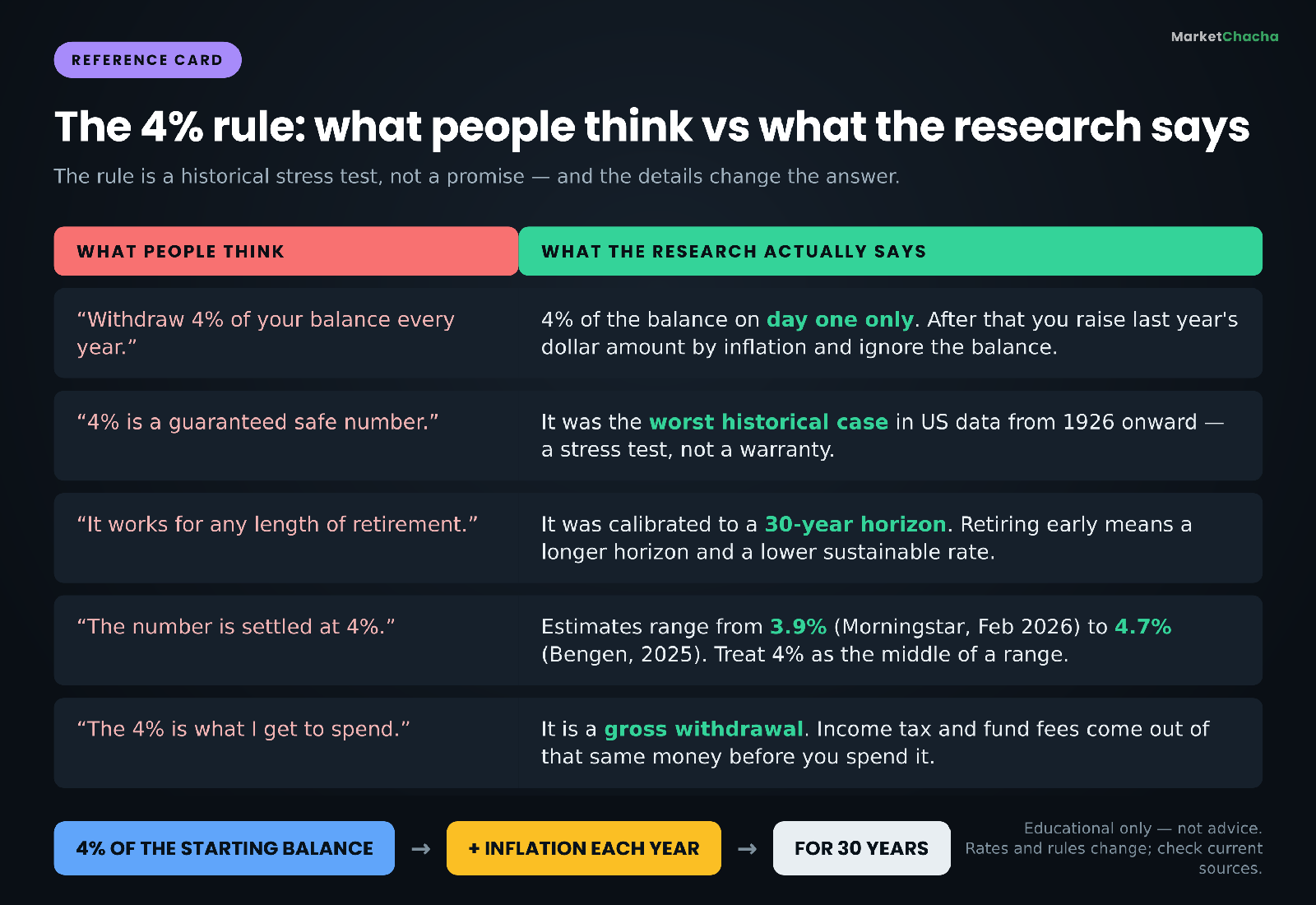
- An inflation adjustment, not a recalculation. In every year after that, you take last year's dollar amount and raise it by inflation. You do not recalculate 4% of the new balance.
- A time horizon. The test was whether the money survived 30 years — roughly a retirement from 65 to 95.
The second point is the one that trips people up, and it is the difference between a plan and a guess. Taking a fixed percentage of a fluctuating balance gives you an income that falls whenever markets fall. The 4% rule deliberately does the opposite: it holds your spending power steady and lets the portfolio absorb the volatility. That is a much more demanding test — which is precisely why the surviving number came out as low as 4%.
A worked example: from a spending number to a retirement number
Suppose you expect to spend $60,000 a year from your own savings once you retire — that is your total spending minus any Social Security, pension or rental income you will already be receiving. Only the portion your portfolio has to cover goes into this calculation.
Step 1 — find the target. $60,000 ÷ 0.04 = $1,500,000. That is 25 × $60,000.
Step 2 — year one. You withdraw 4% of $1,500,000 = $60,000.
Step 3 — year two, with 3% inflation. You withdraw $60,000 × 1.03 = $61,800. Note what you did not do: you did not look at the balance.
Step 4 — year three, another 3%. $61,800 × 1.03 = $63,654.
Now the important twist. Say markets fell in year one and the portfolio is worth $1,350,000 when year two starts. You still take $61,800 — but $61,800 is 4.58% of $1,350,000, not 4%. The rule lets your effective withdrawal rate drift upward in bad years on purpose, because that is what a retiree with real bills actually does. Testing whether a portfolio survives that behaviour is the whole exercise.
The sensitivity of the target to the assumed rate is brutal, and worth seeing plainly. For the same $60,000 of spending:
- At 5%: $60,000 ÷ 0.05 = $1,200,000 (20× spending)
- At 4%: $60,000 ÷ 0.04 = $1,500,000 (25× spending)
- At 3.9%: $60,000 ÷ 0.039 ≈ $1,538,000 (about 25.6× spending)
- At 3%: $60,000 ÷ 0.03 = $2,000,000 (33× spending)
One percentage point of assumption is worth $300,000 of savings. That is why the debate over the "right" number is not academic hair-splitting.
Where the 4% figure came from
It is not a rule of thumb someone invented over coffee. In 1994, financial planner William Bengen published a study in the Journal of Financial Planning that ran a portfolio of US large-cap stocks and intermediate-term US Treasury bonds — the headline case a 50/50 mix — through every rolling 30-year retirement in the historical record starting in 1926. For each hypothetical retirement start year he asked: what is the highest first-year withdrawal rate that would still have survived 30 years, given the actual sequence of returns and inflation that followed?
Most start years could have supported far more than 4%. But Bengen was not looking for the average — he was looking for the worst one. He named that figure SAFEMAX: the highest starting rate that survived even the unluckiest cohort in the data. It came out at 4.0%.
A 1998 study by three Trinity University professors (Cooley, Hubbard and Walz) tested the same idea with different portfolios and reached broadly the same conclusion, and the pairing of the two is where "the 4% rule" entered the mainstream. Note carefully what that means: 4% was never a promise of success. It was the survival rate of the worst historical case in one country's market history.
Why the safe rate is a range, not a law: sequence-of-returns risk
Two retirees can earn exactly the same average return over 30 years and get completely different outcomes — if one of them got their bad years first. This is sequence-of-returns risk, and it is the reason the safe rate is so much lower than the long-run average return of a balanced portfolio.
The mechanism is simple. When you are still saving, a crash is a discount: your contributions buy more shares. When you are withdrawing, a crash is permanent damage, because you sell shares at the low price to pay your bills and those shares are never there to recover. A 30% drop in year two of retirement does far more harm than the same drop in year twenty-two, even though both count the same in the average.
The chart below shows the arithmetic of withdrawal rates in isolation, holding returns constant so you can see the effect of the rate itself.
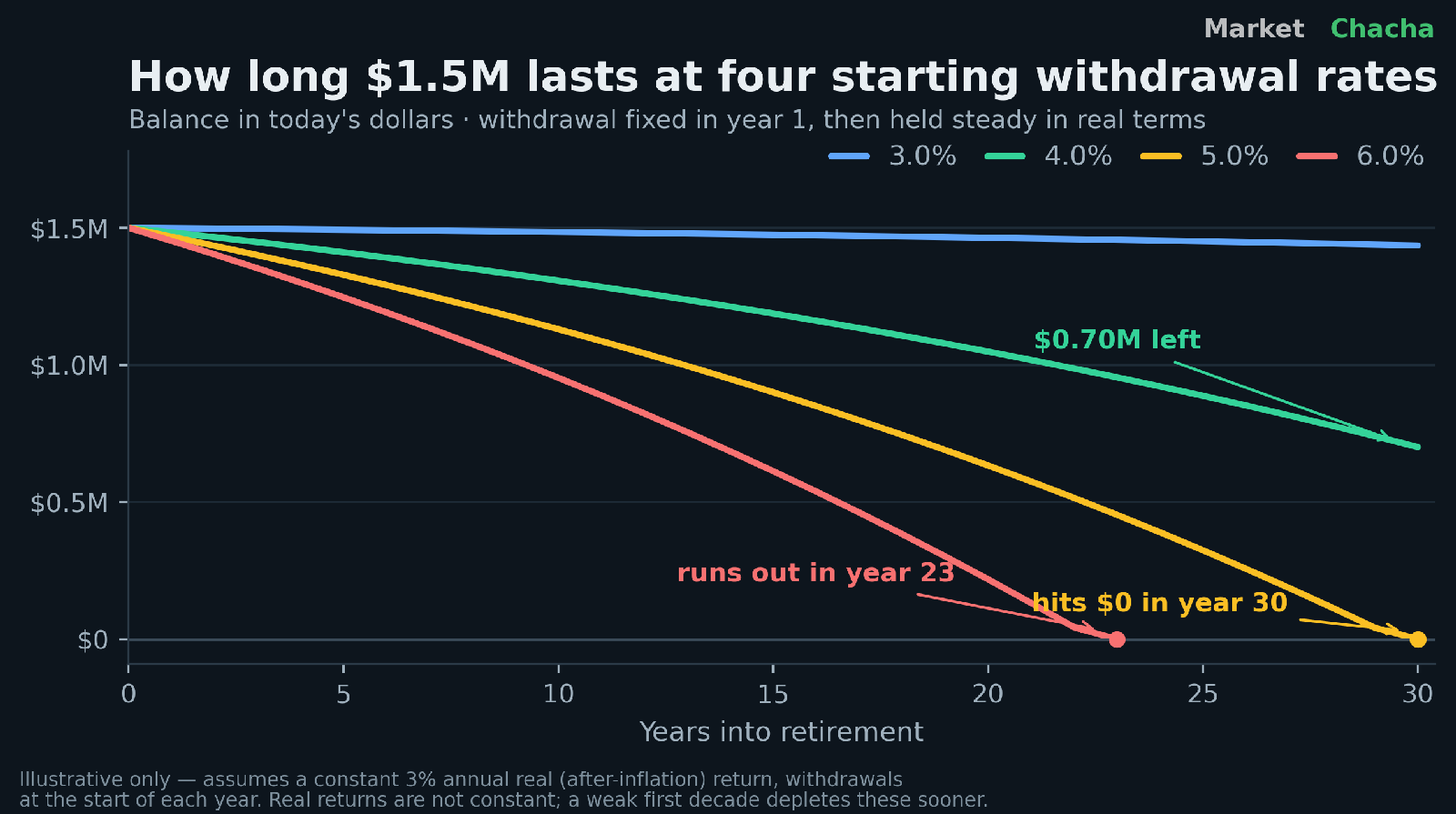
Read it as a sensitivity test, not a forecast. With a steady return, a 5% starting withdrawal only just makes it to year 30 and a 6% rate runs out in the low twenties. Real markets do not deliver steady returns — and once you add a bad first decade, the 5% and 6% lines fail considerably earlier. That gap between "works on a smooth line" and "works through a real sequence" is exactly what Bengen's worst-case test was measuring.
What current research says — and why the number keeps moving
Because the answer depends on starting valuations, bond yields and inflation, credible estimates move around. As of February 2026, Morningstar's annual retirement-income research put the safe starting withdrawal rate at 3.9%, up from 3.7% the year before, with the increase attributed largely to higher bond yields. That figure assumes a 30-year retirement, an inflation-adjusted withdrawal each year, a portfolio holding roughly 30–50% in equities with the rest in bonds and cash, and a 90% probability of the money lasting (per Financial Advisor magazine's write-up of the report).
Bengen himself has moved in the other direction. In his 2025 book A Richer Retirement he raised his own worst-case figure to 4.7%, on the basis that a genuinely diversified portfolio — US large, mid, small and micro-cap stocks, international stocks, intermediate Treasuries and T-bills — would have weathered the historical worst case better than his original two-asset mix. He still frames 4.7% as a worst-case ceiling, not a target, and has said publicly that sustained inflation, not market crashes, is the retiree's greatest enemy — because inflation raises every future withdrawal permanently, while a crash may reverse.
Meanwhile, researchers who applied the same test to other countries' market histories have found the 4% rate would have failed in a good number of them, which is a useful reminder that the rule rests on one unusually successful century of US returns.
So the honest summary is: the plausible range is roughly 3.5%–5%, depending on your horizon, your portfolio and how flexible your spending is — and anyone quoting a single decimal place with confidence is overselling it.
How to actually run the calculation, step by step
- Estimate your annual retirement spending in today's dollars. Use your current spending as the base, then adjust: subtract the mortgage if it will be paid off, subtract commuting and payroll taxes, add healthcare.
- Subtract guaranteed income. Social Security, a pension, an annuity, rent. Only the remaining gap is what your portfolio must fund. This step alone often cuts the target dramatically.
- Divide by your chosen rate. Gap ÷ 0.04 for the classic rule. Run it at 0.035 and 0.045 too, so you see the range rather than a false point estimate.
- Adjust for your horizon. The 30-year assumption is doing real work. Retiring at 50 means a 40+ year horizon and a lower sustainable rate; retiring at 70 means a shorter one and a higher rate.
- Add tax. A withdrawal from a Traditional 401(k) or IRA is taxable income. If you need $60,000 to spend and expect an effective tax rate of 15% on those withdrawals, you need to withdraw roughly $70,600 — and it is the gross figure that goes into the 4% calculation.
- Re-check every year or two against actual inflation and your actual balance — not to chase the newest published rate, but to see whether you have drifted badly off track in either direction.
What it costs you: the catch in the rule
The 4% rule buys safety with money. Because it is calibrated to the worst historical case, in most historical cases it left the retiree with a very large unspent balance after 30 years — the Trinity authors noted that stock-heavy portfolios at 4% would often have left substantial estates. That sounds like a nice problem, but it means the rule systematically tells you to work longer and spend less than you probably needed to.
It also assumes rigid spending: the same real dollars every year for 30 years, regardless of what markets do. Actual retirees do not behave that way, and research generally finds real spending tends to drift down through retirement. If you are willing to trim discretionary spending in bad years — a "flexible" or "guardrail" approach — the sustainable starting rate rises meaningfully, because the portfolio is no longer forced to sell into every downturn. Morningstar's own research notes that flexible strategies can support materially higher starting rates than the fixed inflation-adjusted approach.
And it says nothing about taxes, investment fees or long-term care. Every dollar of fund expense ratio, advisory fee and tax comes out of the same withdrawal you just calculated.
Common mistakes beginners make
- Recalculating 4% of the current balance each year. This is a different strategy entirely. It can never run out of money mathematically, but your income drops in every downturn — which is not what the 4% research tested or promised.
- Treating 4% as a guarantee. It is a historical worst case for one country over one 30-year window length. It is a stress test, not a warranty.
- Using it for a 45-year retirement. Early retirees are running a materially longer horizon than the rule was built for.
- Forgetting Social Security or a pension. Including guaranteed income in the "spending" figure inflates the target by hundreds of thousands of dollars.
- Ignoring tax. Confusing spendable cash with a pre-tax withdrawal understates the required portfolio.
- Chasing the newest published number. Resetting your withdrawal each year to whatever rate was published in January defeats the purpose. Set a rate at retirement, adjust it for inflation, and review it deliberately.
How this works in India
The arithmetic is identical — a corpus divided by a withdrawal rate — but three things about the Indian context change the answer, and none of them are cosmetic.
Inflation assumptions are higher. The 4% rule embeds the inflation history of the United States. India's monetary policy framework targets CPI inflation of 4% with a tolerance band of 2%–6%, set under the RBI Act (per the Ministry of Finance / PIB). A retirement plan built on a higher long-run inflation assumption needs either a larger corpus or a lower starting withdrawal rate, because every future withdrawal is escalated faster. Medical inflation in particular has historically run well above headline CPI, and healthcare is a rising share of a retiree's budget.
The product wrappers are different. There is no direct Indian equivalent of a portfolio you simply draw down at will if your money sits in the mandatory retirement system. Under the National Pension System (NPS) exit rules published by NPS Trust, a non-government subscriber retiring with an accumulated corpus above ₹12 lakh must use at least 20% of it to purchase an annuity, with the balance available as lump sum; a corpus of ₹8 lakh or less can be withdrawn entirely. Government-sector subscribers face a higher mandatory annuity share above ₹12 lakh. These thresholds have been revised more than once — check the current rules on the NPS Trust site before planning around them. EPF and PPF behave differently again: they are largely lump-sum at maturity, so the drawdown decision lands back in your hands.
The drawdown mechanism has a name. For money you hold in mutual funds, the Indian analogue of a 4% withdrawal is a Systematic Withdrawal Plan (SWP) — a standing instruction to redeem a fixed rupee amount each month. Structurally it is exactly the 4% rule: a fixed amount, which you would then need to step up manually for inflation, funded by selling units regardless of price. It carries the same sequence-of-returns risk, and each redemption is a capital-gains event, so the tax drag is ongoing rather than deferred.
The practical translation: run the same 25× calculation on the spending your own corpus must cover, then stress-test it at a lower withdrawal rate than the US default to reflect higher inflation, and treat any mandatory annuitised portion as guaranteed income that reduces the gap rather than as part of the drawdown pot.
FAQ
How much money do I need to retire using the 4% rule? Take the annual spending your portfolio must cover — total spending minus Social Security, pension and any other guaranteed income — and multiply it by 25. For $60,000 of portfolio-funded spending, that is $1,500,000.
Is the 4% rule still valid in 2026? It remains the standard starting framework, but credible estimates now span a range rather than a single number. Morningstar's February 2026 research put the safe starting rate at 3.9%, while William Bengen — who created the rule — raised his own worst-case figure to 4.7% in 2025 using a more diversified portfolio. Treat 4% as the middle of a range, not a fact.
Do I withdraw 4% of my balance every year, or 4% of my starting balance? Of the starting balance, once. After year one you increase the previous year's dollar amount by inflation and ignore the balance. Recalculating 4% of the current balance every year is a different strategy with different behaviour.
What is sequence-of-returns risk? It is the risk that poor returns arrive early in retirement. Selling assets at low prices to fund withdrawals permanently removes shares that would otherwise have recovered, so two retirees with identical average returns can end up with very different outcomes depending on the order those returns came in.
Does the 4% rule work for early retirement? Less well. It was calibrated to a 30-year horizon. A retirement of 40 or 50 years gives the portfolio more chances to hit a bad sequence, so a lower starting rate is generally used for longer horizons.
What is the equivalent of the 4% rule in India? The same 25× arithmetic applies, usually implemented through a Systematic Withdrawal Plan from mutual funds. Most Indian planners work with a lower starting withdrawal rate than the US default because of higher long-run inflation assumptions, and NPS money is subject to mandatory annuitisation rules above certain corpus thresholds.
Educational content only — not investment, tax or insurance advice, and not a recommendation of any product. Rates, fees and rules change — always check current terms with the provider. [Sources: Journal of Financial Planning (FPA) — Revisiting Bengen's SAFEMAX, Financial Advisor magazine — Morningstar's 2026 safe withdrawal rate, Morningstar, The Long View — Bill Bengen, NPS Trust — Normal Exit rules, PIB / Ministry of Finance — India's CPI inflation target] Always do your own research.
This article is for educational and informational purposes only. It is not financial advice, investment recommendation, or a solicitation to buy or sell securities. Investing involves significant risks. I am not a SEBI-registered investment advisor. Readers should consult their own financial advisor and conduct their own research before making any investment decisions.
Comments
Join the conversation
Sign in to join the conversation.
Follow replies, add your view, and take part in the discussion.
Sign in to commentLoading comments...