

How do you actually buy a T-bill? TreasuryDirect vs a brokerage vs T-bill ETFs
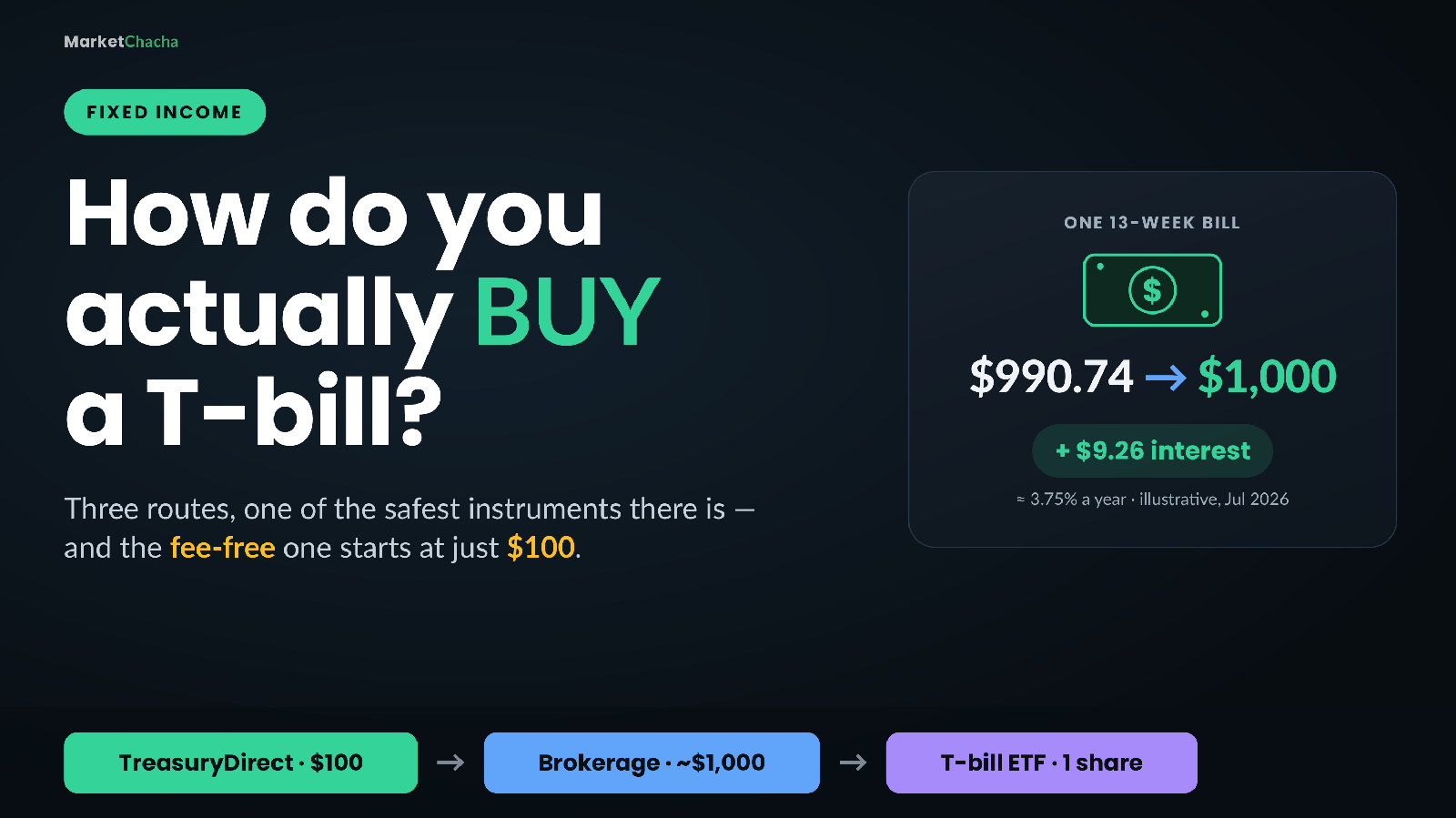
There are three practical ways to actually buy a U.S. Treasury bill: straight from the government on TreasuryDirect, through a brokerage account (Fidelity, Schwab, Vanguard and the like), or by buying a T-bill ETF such as SGOV, BIL or USFR that holds a rolling basket of bills for you. All three put your money in the safest short-term instrument the U.S. government offers; they differ in the minimum you need, how easily you can get your cash back before maturity, and whether you pay a tiny fee. This guide walks through each route with a worked example, a step-by-step of the TreasuryDirect flow, the catches to watch, the common beginner mistakes, and — near the end — how the exact same thing works in India through the RBI Retail Direct portal.
First, a 30-second refresher: what a T-bill actually is
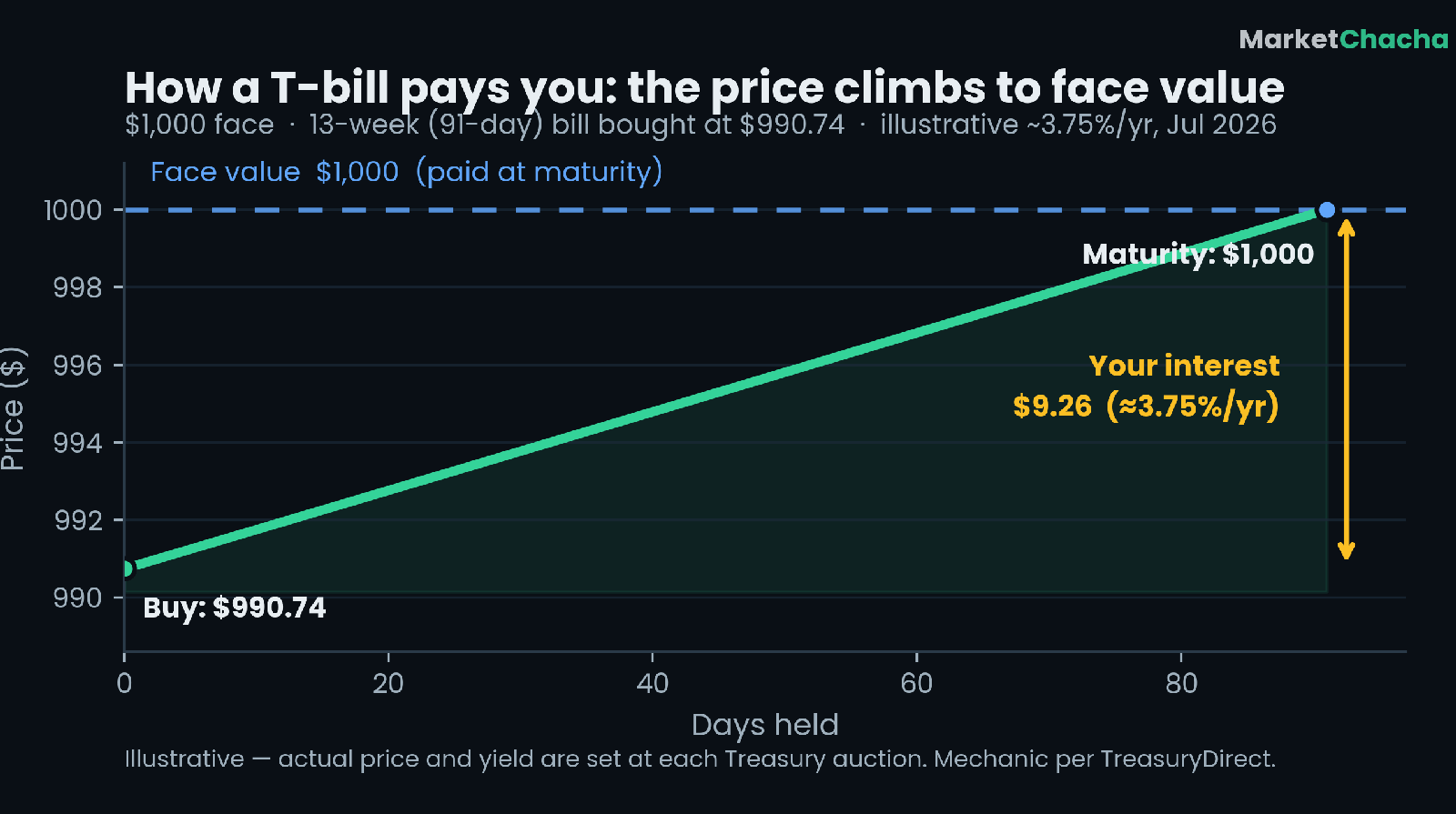
A Treasury bill is a short-term IOU from the U.S. government that matures in one year or less (the standard terms are 4, 8, 13, 17, 26 and 52 weeks). Unlike a bond, a bill pays no coupon. Instead you buy it for less than its face value and the government pays you the full face value at maturity. That gap is your interest. Buy a $1,000 bill for $990.74 and collect $1,000 thirteen weeks later, and the $9.26 difference is the interest — there is no separate cheque. Because it is backed by the U.S. Treasury, a held-to-maturity T-bill is treated as the closest thing to "risk-free" in finance. (New here? Our companion piece, "What is a T-bill and how do you actually make money from it?", explains the discount mechanic from scratch.)
A worked example: watch $990.74 turn into $1,000
Say you buy a single 13-week (91-day) bill with a $1,000 face value. At a recent auction (the 13-week bill's high rate sat in roughly the 3.5%–3.75% range as of July 2026), the price for that bill works out to about $990.74. Here is the whole life of the trade:
- Day 0: $990.74 leaves your account and the bill lands in it.
- Day 91: the bill matures and $1,000.00 is deposited automatically.
- Your interest: $1,000.00 − $990.74 = $9.26.
That $9.26 over 91 days looks small, but annualise it and it is a real yield. Because 91 days is about one-quarter of a year, you earn roughly four of those $9.26 gains per year: $9.26 × (365 ÷ 91) ≈ $37.14 on a $990.74 outlay, which is about 3.75% a year. Buy ten of these bills (a $10,000 position) and the same maths returns about $92.60 over the quarter. The number is illustrative — the actual rate is set fresh at every auction — but the mechanic never changes: price paid → face value received, and the difference, annualised, is your yield.
The three ways to actually buy a T-bill
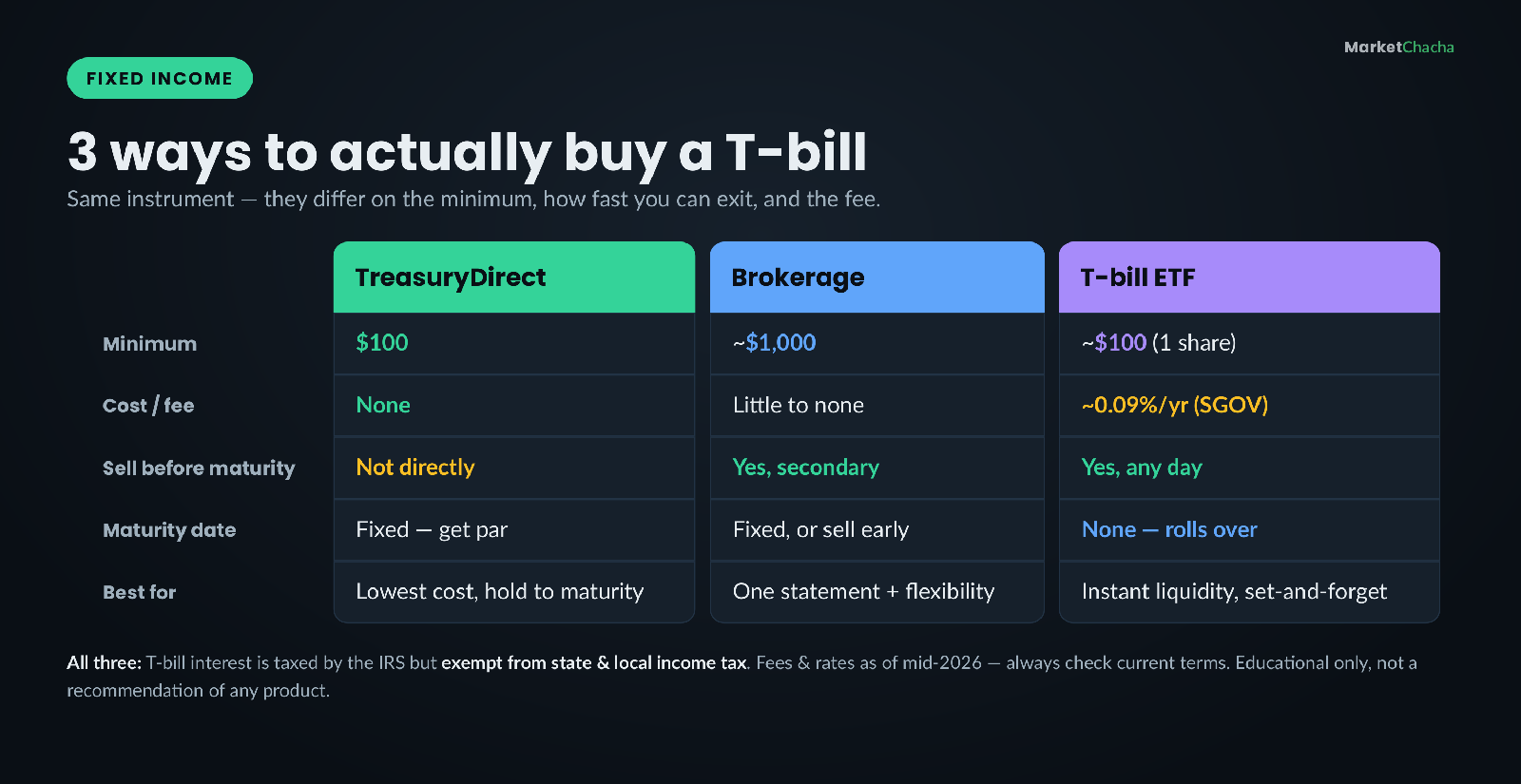
1) TreasuryDirect (straight from the government). This is the U.S. Treasury's own website, treasurydirect.gov. You link a bank account and place a noncompetitive bid at auction, which simply means "I'll take whatever rate the auction sets." The minimum is just $100 and you buy in $100 increments. There are no fees and no middleman. The trade-off: TreasuryDirect is a plain government portal, not a brokerage — you generally hold the bill to maturity, and to sell early you must transfer it out to a broker first.
2) A brokerage account (Fidelity, Schwab, Vanguard, etc.). If you already have a broker, you can buy the very same bills there — either at auction (noncompetitive, usually a $1,000 minimum) or on the secondary market any trading day, which lets you also sell early if you need the cash. New-issue Treasuries are typically commission-free. The bill sits alongside your other investments on one statement, which most people find simpler than a separate government login.
3) A T-bill ETF (SGOV, BIL, USFR and similar). These funds hold a rolling ladder of very short bills and trade like a stock. You get instant liquidity (buy or sell any market day), monthly dividends, and no maturity date to track — the fund constantly rolls maturing bills into new ones. In return you pay a small annual expense ratio: as of mid-2026, SGOV was about 0.09%, BIL about 0.135%, and USFR about 0.15%, per each fund's own disclosures. On $10,000, 0.09% is about $9 a year — the price of never having to think about auctions or maturity dates.
How to buy one on TreasuryDirect, step by step
The direct route is the cheapest, so here is the actual flow:
- Open an account at treasurydirect.gov. You'll need your Social Security number, a bank account and routing number, and an email address.
- Go to BuyDirect and choose Bills, then pick a term (4, 8, 13, 17, 26 or 52 weeks).
- Enter the amount in $100 increments and leave the bid as noncompetitive — you're agreeing to accept the auction's rate, which guarantees you get the bill in the full amount you asked for.
- Schedule and confirm. You place the order before the auction, so you won't know the exact rate yet — it's set at auction. Your bank account is debited around the issue date, and the security appears in your account, generally within a week of the auction.
- At maturity, the full face value is deposited back to your linked bank account automatically. You can also switch on auto-reinvest so a maturing bill rolls straight into a new one.
Why the "discount rate" and the "investment rate" are two different numbers
This trips up almost every beginner. A T-bill auction publishes two percentages, and they don't match. The discount rate is the old-fashioned quote based on the bill's face value and a 360-day year — it slightly understates what you actually make. The investment rate (also called the coupon-equivalent yield) is based on the price you actually paid and a 365-day year, and it is the true annual return you can compare against a savings account or CD. When you line a T-bill up against a high-yield savings rate, use the investment rate, not the discount rate, or you'll undersell the bill.
What it costs you — and the catches to know
T-bills are cheap to own, but "cheap" isn't "free of trade-offs":
- Liquidity on TreasuryDirect is limited. There's no sell button; to exit early you must transfer the bill to a broker and sell it there. If you might need the money fast, a brokerage or an ETF is friendlier.
- ETFs charge a small fee and don't "mature." You give up the certainty of getting exactly $1,000 back on a set date; instead you own a fund whose price hovers near $100 and pays monthly income. That fee (about $9 a year per $10,000 for SGOV) is the cost of instant liquidity.
- Selling a bill early means market price, not par. Held to maturity you get face value. Sold early, you get whatever the secondary market pays that day — usually close, but not guaranteed to be your purchase price.
- Tax timing. The interest is taxed in the year the bill matures, even though you "earned" it gradually.
One genuinely nice tax feature: T-bill interest is subject to federal income tax but exempt from state and local income tax. For someone in a high-tax state, that exemption can make a T-bill's after-tax yield beat a CD or savings account paying the same headline rate. (If you hold bills through an ETF, the state-exempt portion often isn't broken out on your 1099, so you may need to adjust your state return manually.)
Common mistakes beginners make
- Comparing the discount rate to a savings rate. Always compare the investment rate — the discount rate flatters no one and understates the bill.
- Parking money you'll need next week in a TreasuryDirect bill. There's no quick exit; match the bill's term to when you actually need the cash, or use an ETF.
- Buying a single long bill when a ladder fits better. Splitting money across 4-, 13- and 26-week bills (a "ladder") keeps some cash coming due regularly while you still capture the yield.
- Forgetting the state-tax exemption at filing time. People routinely overpay state tax on Treasury interest because they never claimed the exemption.
- Assuming your bank's "T-bill" product is the same. Some banks resell Treasuries with a markup; buying direct or through a low-cost broker usually keeps more of the yield in your pocket.
How this works in India
India has the same instrument and a strikingly similar direct-buy portal. The Reserve Bank of India issues Treasury bills in 91-day, 182-day and 364-day maturities, and like their U.S. cousins they are zero-coupon — sold at a discount to a ₹100 face value and redeemed at full face value, with the gap as your return.
The cleanest way for an individual to buy them is the RBI Retail Direct scheme (rbiretaildirect.org.in), the Indian equivalent of TreasuryDirect. You open a free Retail Direct Gilt (RDG) account using PAN, Aadhaar and a linked bank account; activation takes a day or two. You then place a non-competitive bid in the weekly auction, choosing the 91-, 182- or 364-day bill. The minimum is ₹10,000, in multiples of ₹10,000, and the platform charges no fees. At maturity the face value is credited straight to your bank account. You can also access T-bills through a broker or through debt/liquid mutual funds that hold them, much like a U.S. T-bill ETF. One key difference from the U.S.: in India, T-bill returns are taxable as per your income slab and there's no state-tax exemption, since income tax is levied nationally.
FAQ
What is the minimum amount of money I need to buy a T-bill? On TreasuryDirect the minimum is $100 (in $100 steps). Through a brokerage, new-issue Treasuries are usually a $1,000 minimum. A T-bill ETF like SGOV can be bought for the price of a single share, roughly $100. In India via RBI Retail Direct the minimum is ₹10,000.
Is it better to buy T-bills on TreasuryDirect or through my brokerage? TreasuryDirect is the cheapest and has the lowest minimum, but you generally must hold to maturity. A brokerage costs little to nothing, keeps everything on one statement, and lets you sell early on the secondary market. If flexibility matters, use the broker; if you'll hold to maturity, direct is fine.
What's the difference between a T-bill and a T-bill ETF? A T-bill is one security with a fixed maturity date and a guaranteed face value at the end. A T-bill ETF is a fund holding many short bills that it constantly rolls over — it never matures, pays monthly dividends, trades like a stock, and charges a small annual fee for the convenience.
Do I pay tax on T-bill interest? Yes. In the U.S., the interest is subject to federal income tax but exempt from state and local income tax, and it's taxed in the year the bill matures. In India, T-bill returns are taxed at your income-slab rate.
Can I sell a T-bill before it matures? Yes if you hold it at a brokerage — you sell it on the secondary market at the going price that day (which may be a little above or below what you paid). On TreasuryDirect there's no sell button; you'd have to transfer the bill to a broker first.
Why do the auction results show two different rates? The "discount rate" is based on face value and a 360-day year and understates your return; the "investment rate" (coupon-equivalent yield) is based on the price you paid and a 365-day year and is the true annual yield to compare against other savings options.
Educational content only — not investment, tax or insurance advice, and not a recommendation of any product. Fund names are cited only to illustrate how the ETF route works, not as recommendations. Rates, fees and rules change — always check current terms with the provider before you act. Sources: TreasuryDirect, IRS Topic 403, WisdomTree (state-tax exemption), RBI Retail Direct. Always do your own research.
This article is for educational and informational purposes only. It is not financial advice, investment recommendation, or a solicitation to buy or sell securities. Investing involves significant risks. I am not a SEBI-registered investment advisor. Readers should consult their own financial advisor and conduct their own research before making any investment decisions.
Comments
Join the conversation
Sign in to join the conversation.
Follow replies, add your view, and take part in the discussion.
Sign in to commentLoading comments...