

Why do bond prices fall when interest rates rise? (Beginner's in-depth guide)
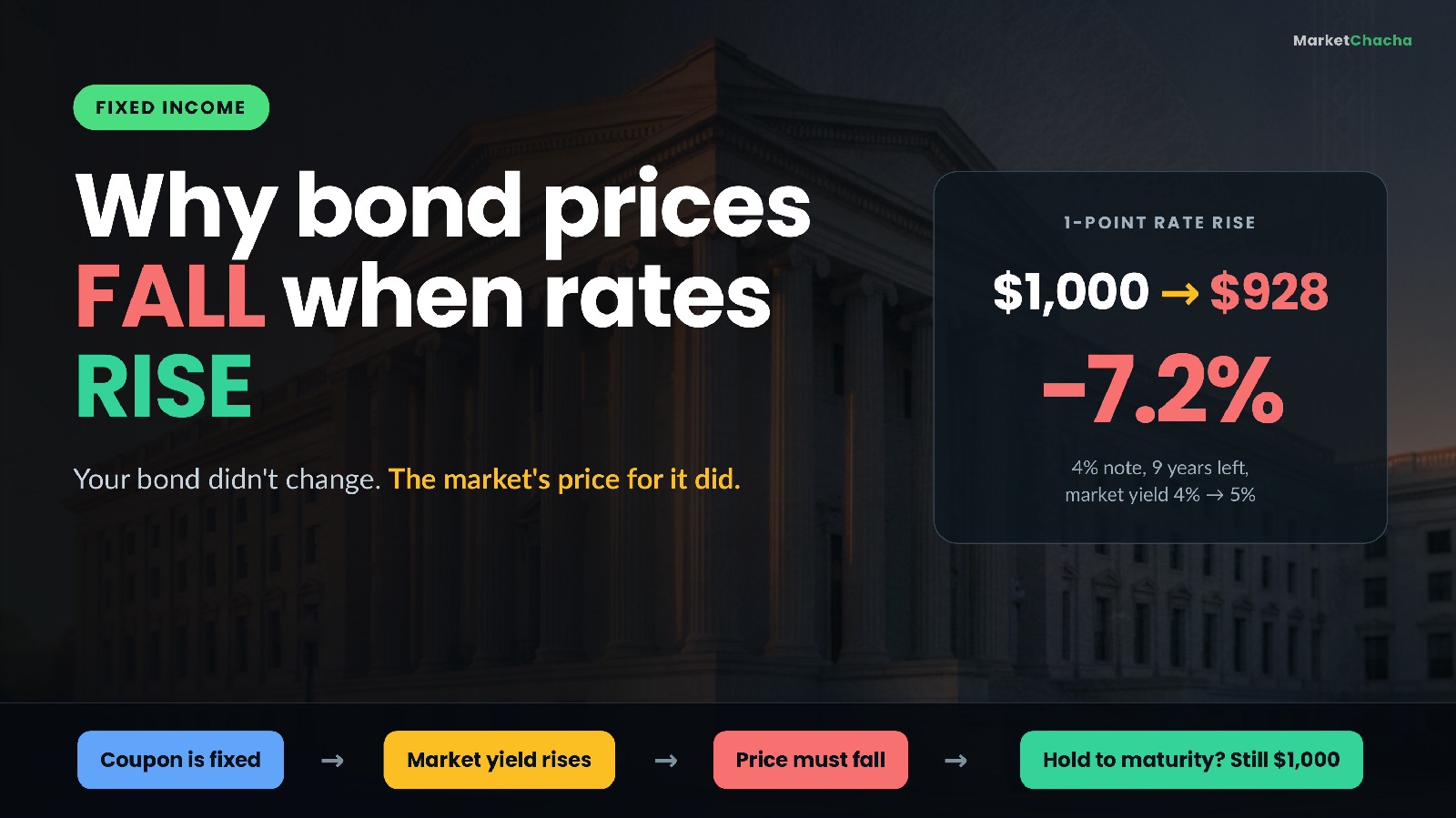
Bond prices fall when interest rates rise because a bond's interest payment is fixed at birth. If you own a bond paying 4% and new bonds start paying 5%, nobody will buy yours at full price any more. The only way your bond can compete is for its price to drop far enough that a buyer still earns 5% on the money they put in. Nothing about your bond changed — the market simply repriced it. The US Securities and Exchange Commission calls this interest rate risk, and it applies to every fixed-rate bond, including US Treasuries.
Below we walk through exactly why this happens, do the arithmetic on a real $1,000 note, explain the one number (duration) that tells you how badly a rate move will hurt, and cover why holding to maturity changes the answer completely. There is a section at the end on how the same mechanic works in India.
Why a fixed coupon forces the price to move
A plain fixed-rate bond is a contract with three fixed parts: the face value (usually $1,000, repaid at the end), the coupon rate (say 4% a year, paid in two instalments of $20), and the maturity date. Once the bond is issued, none of those three ever change.
What does change every single day is the yield the market demands for lending money for that length of time. That demanded yield moves with the Fed's policy rate, with inflation expectations, and with the supply of new government debt.
Now the squeeze. If the market demands 5% and your bond only pays $40 a year, the only free variable left is the price. Push the price down to roughly $928 and that same $40 a year, plus the $1,000 you get back at maturity, works out to 5% for whoever buys it. That is the entire mechanism: the coupon can't move, so the price must.
A worked example: the $1,000 note that becomes a $928 note
Say you buy a newly issued 10-year note at face value:
- Face value: $1,000
- Coupon: 4.00% a year, paid semi-annually ($20 every six months)
- You pay $1,000 — the coupon matches the market yield, so it's priced "at par"
One year passes. You've collected $40 in coupons and your bond now has 9 years left. But interest rates have risen: comparable 9-year paper now yields 5%. What is your bond worth?
Discount the remaining 18 coupon payments of $20 plus the $1,000 face value at 5% (2.5% per half-year), and you get $928.23. That's a 7.2% fall in the market price, caused by a one percentage-point rise in rates.
Two honest follow-ups most articles skip:
- Your actual return isn't −7.2%. You also pocketed $40 of coupons. Sell now and you have $928.23 + $40 = $968.23, a total return of −3.2% for the year.
- It works just as hard in reverse. Had yields fallen to 3% instead, the same bond would be worth $1,078.36 — a 7.8% gain. Falling rates are why bond investors sometimes make equity-like returns.
The part most people miss: you only realise the loss if you sell
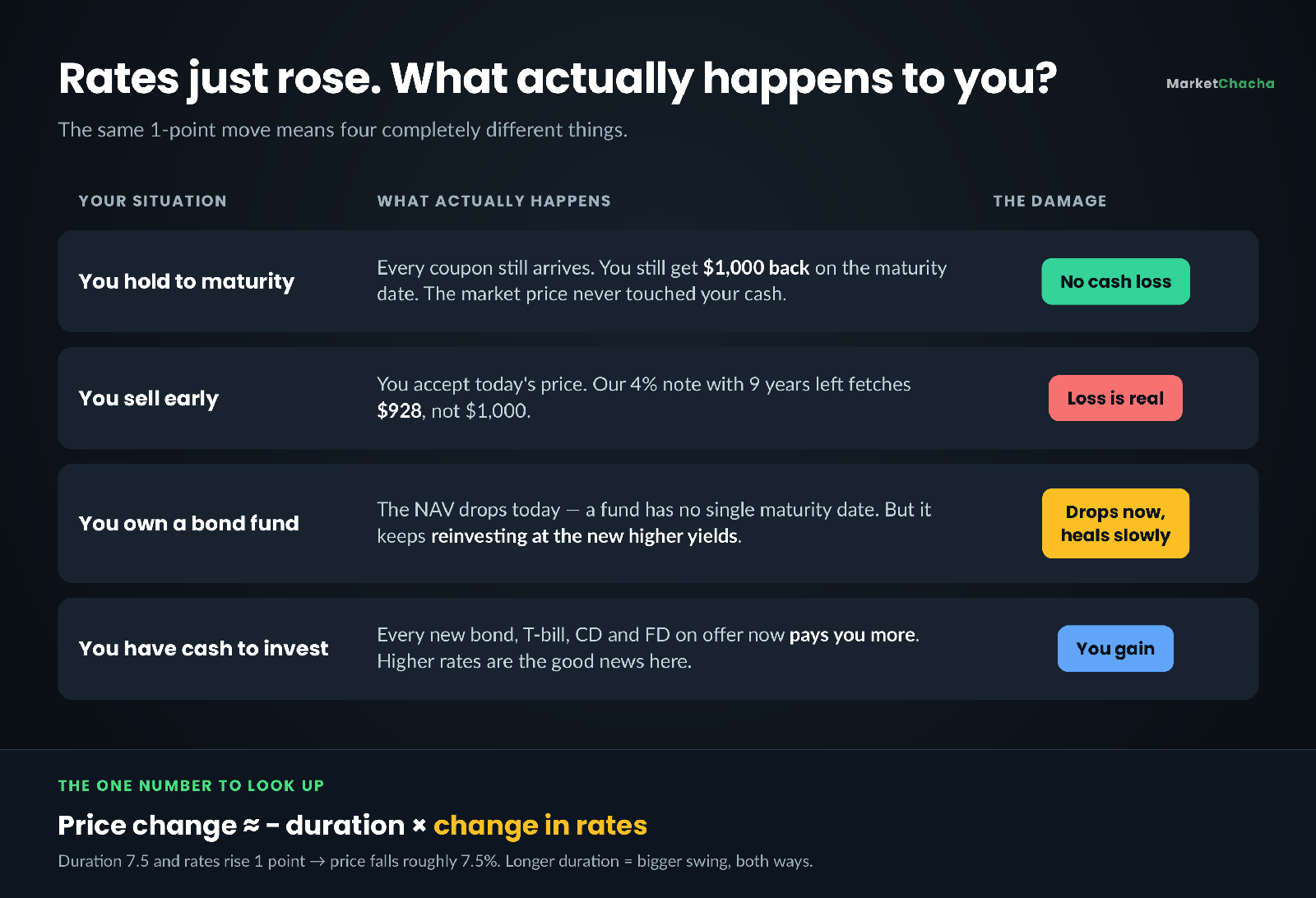
That $928 is a market quote, not a withdrawal from your account. If you hold the note to maturity, the issuer still pays you $20 every six months and hands back the full $1,000 on the maturity date. The price dip never touches your cash flows. FINRA makes this point plainly: for a buy-and-hold investor, interest rate changes may have little or no direct impact.
But be honest about the cost that is real. Your money is locked into 4% for nine more years while the market is paying 5%. You don't lose $72 of cash — you lose the option to earn the higher rate on that money. That's called opportunity cost, and it's the true price of being on the wrong side of a rate move. Anyone who tells you a hold-to-maturity investor is completely unaffected is skipping this.
Duration: the one number that tells you how much it will hurt
Duration measures a bond's sensitivity to interest rates, expressed in years. It is not the same thing as maturity. The working rule, as FINRA states it: for every 1 percentage-point change in rates, a bond's price moves roughly its duration number in the opposite direction.
- Duration 2 → rates up 1 point → price down about 2%
- Duration 7.5 → rates up 1 point → price down about 7.5%
- Duration 17 → rates up 1 point → price down about 17%
Check it against our example. The 9-year 4% note has a modified duration of about 7.5, which predicts a 7.5% drop. The actual drop was 7.2%. The small gap is convexity — the price/yield relationship is a curve, not a straight line, which is why bonds fall slightly less than duration predicts and rise slightly more. That curve is visible in the chart below.
Two rules worth memorising: the longer the maturity, the higher the duration, and the higher the coupon, the lower the duration (a fat coupon returns your money sooner).
Why longer bonds fall harder
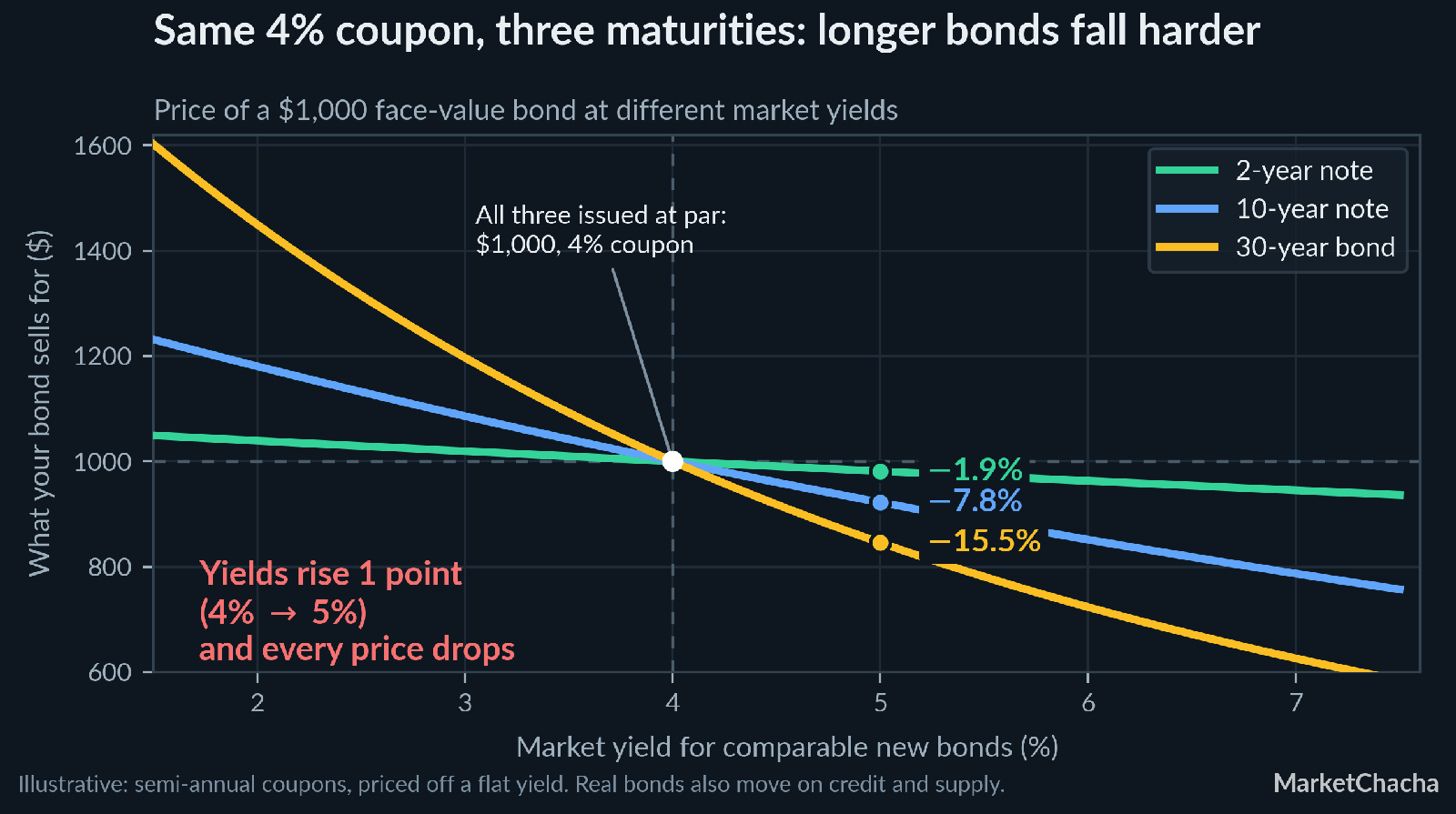
The chart prices three freshly issued bonds — all with a 4% coupon, all bought at $1,000 — across a range of market yields. When yields rise from 4% to 5%, the 2-year loses 1.9%, the 10-year loses 7.8% and the 30-year loses 15.5%. Same coupon, same issuer, same 1-point move, wildly different damage. (Our worked example loses 7.2% rather than 7.8% simply because a year had already elapsed, leaving 9 years instead of 10.)
The intuition: a 30-year bond locks your money into a below-market rate for three decades. Buyers need a far bigger discount to accept that. A 2-year bond hands your cash back almost immediately, so you can reinvest at the new higher rate — there's very little to compensate for.
Bond funds and ETFs behave differently from a single bond
This trips up a lot of first-time investors. An individual bond has a maturity date on which you get par back. A bond fund or ETF doesn't — it holds a rolling basket, constantly selling maturing bonds and buying new ones. There is no date on which the fund promises to return your principal.
So when rates rise, the fund's NAV falls and stays fallen — but the fund is now buying bonds at the new higher yields, so its income rises. The common rule of thumb is that the extra income catches up with the one-off price drop over a holding period roughly equal to the fund's duration. Treat that as a rule of thumb, not a promise; it assumes rates then hold steady. You can find any fund's duration on its fact sheet, usually under "portfolio data" or "key facts".
How to actually check your own interest rate risk
- Find the duration. For a fund or ETF, read the fact sheet. For an individual bond, ask your broker — most platforms show it next to the yield.
- Multiply. Duration × the rate move you want to stress-test. Duration 8 and a 1.5-point rise implies roughly a 12% price fall.
- Match duration to when you need the money. Cash you need in 18 months does not belong in a long-duration bond fund, however attractive the yield looks.
- Check what kind of bond it is. The whole mechanic above assumes a fixed coupon. Floating-rate notes reset their coupon with market rates, so their prices barely move. Inflation-linked bonds (TIPS in the US) respond to real rates instead.
- Look at the yield curve, not one rate. Short and long rates move independently. As of the Federal Reserve's H.15 release covering 17 July 2026, the 2-year Treasury yielded 4.18%, the 10-year 4.55% and the 30-year 5.06% — three different rates on the same borrower.
What it costs you: the catch nobody mentions
Interest rate risk is only one of the ways a bond can disappoint you.
- Inflation risk. A fixed 4% coupon is worth progressively less in real terms if inflation runs hot. This is the quiet killer of long bonds.
- Reinvestment risk. The mirror image. If rates fall, your price gain feels good, but every coupon you receive gets reinvested at a lower rate.
- Credit risk. Corporate bond prices also move on the issuer's health. A government bond has interest rate risk; a corporate bond has interest rate risk plus the risk it doesn't pay you back.
- Liquidity and spreads. That $928 is a mid-market price. Sell a small lot of a thinly traded corporate or municipal bond and the dealer's bid may be meaningfully lower.
Common mistakes beginners make
- Assuming "bonds are safe" means the price can't fall. Safe from default is not the same as safe from a price fall. A 30-year Treasury has essentially no default risk and can still drop 15% in a year.
- Panic-selling a fallen bond you were always going to hold. That converts a paper mark into a permanent loss — and you give up the very coupons that make you whole.
- Reaching for the highest yield without checking duration. The extra yield on that long bond fund is payment for taking on much bigger price swings.
- Confusing coupon with yield. The coupon is what the bond pays on face value. The yield is what you earn given the price you paid. They're only equal when you buy at par.
- Forgetting bonds still go up. The same maths that hurts you when rates rise is what delivers gains when rates fall.
How this works in India
Identical mechanics, different plumbing. Indian government securities (G-secs) and treasury bills are auctioned by the RBI, and their prices move inversely to yields exactly as US Treasuries do. When the market prices in higher rates or higher inflation, the 10-year G-sec yield rises and the price of every existing G-sec falls. The RBI's Monetary Policy Committee left the repo rate unchanged at 5.25% at its June 2026 meeting, holding a neutral stance — but note that the repo rate and long-dated G-sec yields are different animals that can move apart.
Indian retail investors can now access this market directly. The RBI's Retail Direct scheme lets an individual open a free gilt account with the RBI itself, bid in the primary auctions for T-bills, G-secs and state development loans, and trade in the secondary market on NDS-OM — the same order-matching platform institutions use. If you sell a G-sec there before maturity, you take the market price, exactly as in the example above.
The more common Indian holding, though, is a bank fixed deposit, and it behaves differently in one important way: an FD is not marked to market. If rates rise after you lock in an FD, you don't see a price drop on your statement — you simply carry on earning the old rate. The cost shows up if you break the FD early, where banks typically charge a premature-withdrawal penalty on the interest. In other words, an FD hides the same opportunity cost that a bond displays openly as a price.
Debt mutual funds in India work like US bond funds: rising yields push the NAV down on the day, and the fund's disclosed Macaulay duration tells you how sharply. This is precisely why SEBI requires debt-fund categories to be labelled by duration — liquid, ultra-short, short, medium and long duration, plus gilt funds. A long-duration gilt fund and a liquid fund will react to the same RBI decision in completely different ways.
FAQ
Why do bond prices fall when interest rates rise? Because a bond's coupon is fixed for life. When new bonds pay more, an older lower-paying bond can only attract buyers by dropping in price until it offers the same overall yield.
Do I actually lose money if my bond falls in price? Only if you sell. Hold a fixed-rate bond to maturity and you still receive every coupon plus the full face value. What you do lose is the opportunity to have earned the new higher rate on that money.
How much will my bond fall if rates rise 1%? Roughly its duration, as a percentage. A duration of 7.5 implies about a 7.5% drop for a 1-point rise. The actual fall is usually a touch smaller because of convexity.
What's the difference between duration and maturity? Maturity is simply the date you get your principal back. Duration measures price sensitivity to rates and accounts for the coupons you receive along the way, so it's always shorter than maturity for a coupon-paying bond.
Are short-term bonds safer than long-term bonds? Safer from interest rate moves, yes — a 2-year bond fell 1.9% in our example while a 30-year fell 15.5%. That's a statement about price volatility, not about the issuer's ability to repay.
Why did my bond fund lose money when bonds are supposed to be safe? A fund has no maturity date, so a rate rise shows up immediately in the NAV with no promised par repayment to wait for. The fund does then reinvest at the higher yields, which rebuilds income over time.
Educational content only — not investment, tax or insurance advice, and not a recommendation of any product. Rates, yields and rules change constantly; always check current terms and figures before acting. Yield data as of the Federal Reserve H.15 release covering 17 July 2026; RBI repo rate as of the June 2026 MPC. [Sources: Federal Reserve H.15 Selected Interest Rates, SEC Investor Bulletin: Interest Rate Risk, FINRA: Interest Rate Changes and Duration] Always do your own research.
This article is for educational and informational purposes only. It is not financial advice, investment recommendation, or a solicitation to buy or sell securities. Investing involves significant risks. I am not a SEBI-registered investment advisor. Readers should consult their own financial advisor and conduct their own research before making any investment decisions.
Comments
Join the conversation
Sign in to join the conversation.
Follow replies, add your view, and take part in the discussion.
Sign in to commentLoading comments...