

What is a CD ladder and how does it actually work? (with a worked example)
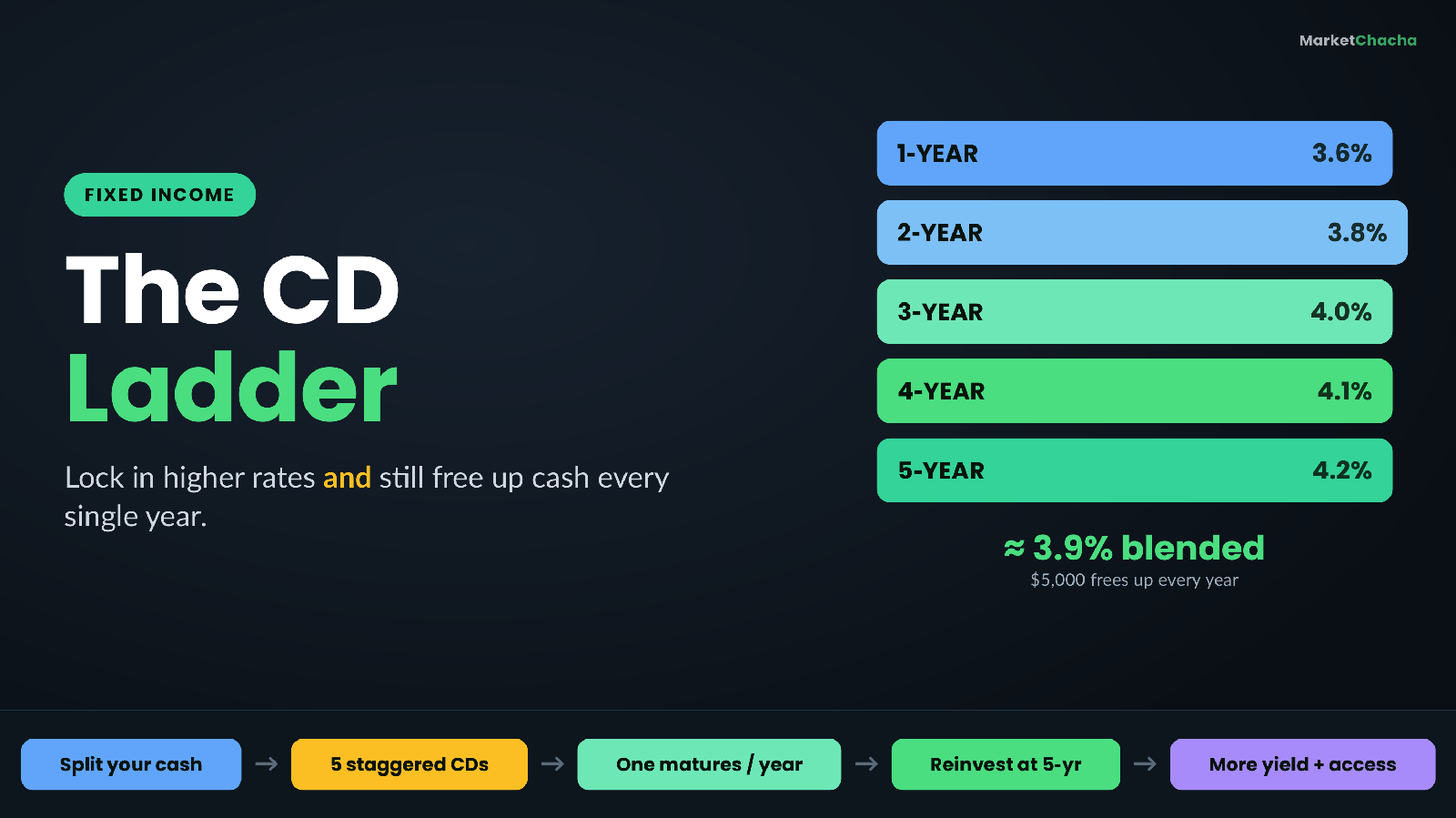
A CD ladder is a simple strategy where you split your cash across several certificates of deposit (CDs) that mature at staggered times — say one CD coming due every year for five years — instead of locking it all into a single CD. The point is to get the higher, locked-in rates that longer CDs pay while still having a chunk of money freeing up at regular intervals, so you rarely have to break a CD early and eat a penalty. This guide walks through exactly what a ladder is, builds a $25,000 five-year ladder step by step with the arithmetic, explains the catch, and closes with how the same idea (FD laddering) works in India.
What is a CD ladder, exactly?
Start with the building block. A certificate of deposit is a deposit account where you agree to leave a fixed sum with a bank or credit union for a set term — 6 months, 1 year, 5 years — and in exchange the bank pays a fixed interest rate (quoted as APY, annual percentage yield) that is usually higher than an ordinary savings account. The trade-off: if you pull the money out before the term ends, you pay an early-withdrawal penalty.
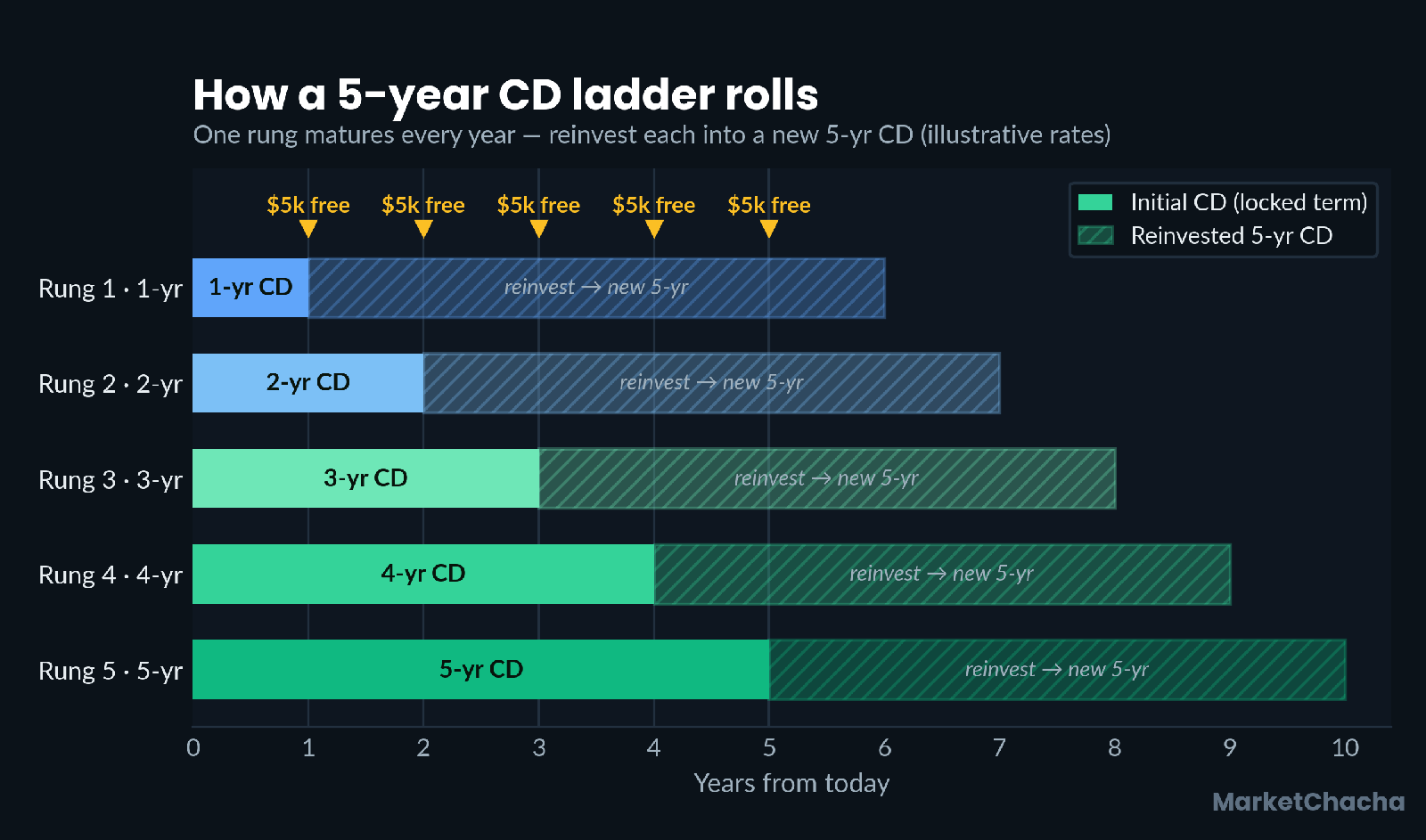
That trade-off creates a dilemma. Long CDs pay more but lock your money away; short CDs keep money accessible but pay less. A ladder resolves it. Instead of one big CD, you divide the money into equal pieces and buy CDs of increasing length — a "rung" for each year. Because the terms are staggered, one rung matures every year. When it does, you either take the cash (penalty-free, because it matured) or roll it into a new long-term CD to keep the ladder going. You end up earning close to long-term rates while always having money coming due soon.
A worked example: building a $25,000 five-year ladder
Say you have $25,000 you won't need immediately. Instead of one 5-year CD, you split it into five equal $5,000 rungs with terms of 1, 2, 3, 4 and 5 years. Using illustrative APYs for an upward-sloping rate curve (real rates change constantly — always check current terms):
- Rung 1 — $5,000 in a 1-year CD at 3.6% → about $180 interest in year one
- Rung 2 — $5,000 in a 2-year CD at 3.8% → about $190/yr
- Rung 3 — $5,000 in a 3-year CD at 4.0% → about $200/yr
- Rung 4 — $5,000 in a 4-year CD at 4.1% → about $205/yr
- Rung 5 — $5,000 in a 5-year CD at 4.2% → about $210/yr
Add up the first-year interest and you get roughly $985 across the whole ladder — a blended yield of about 3.9%. Compare that with putting all $25,000 in a single 1-year CD at 3.6%, which pays about $900: the ladder earns more because part of your money is capturing the higher long-term rates. Yet you are not fully locked in — $5,000 becomes available at the one-year mark.
Here's the elegant part, the reinvestment step. When Rung 1 matures after year one, you reinvest that $5,000 into a brand-new 5-year CD. A year later Rung 2 matures — reinvest it into another new 5-year CD. Repeat every year. After four years, every rung is a 5-year CD, but because you started them a year apart, one still matures every single year. The result: you earn the higher 5-year rate on your whole balance, while $5,000 keeps rolling free annually. That is the ladder fully "climbed."
Why bother? The problem a ladder solves
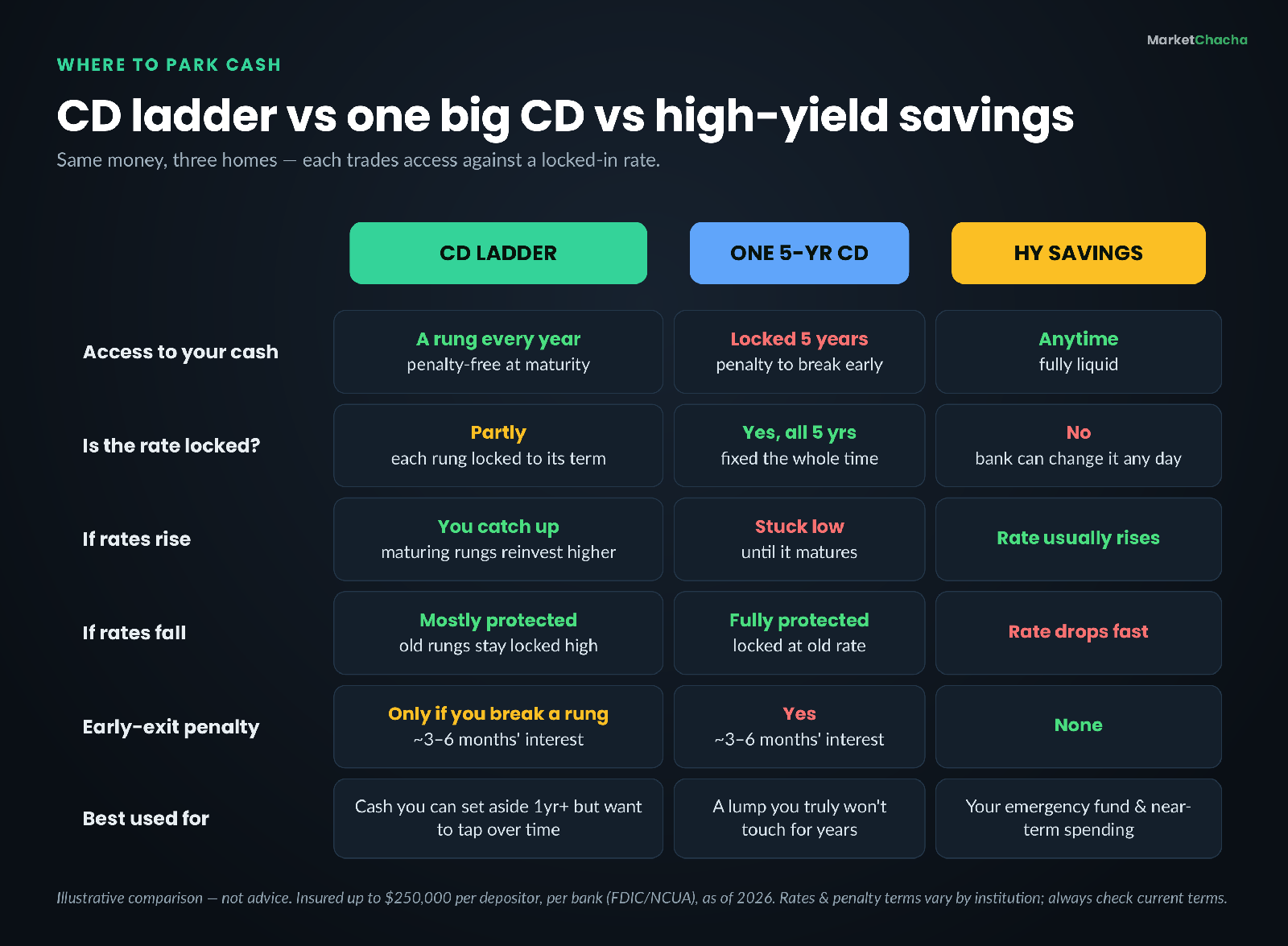
A ladder is really a compromise between two things savers want but usually can't have at once: yield and liquidity. Park everything in a 5-year CD and you get the best rate but zero access for five years. Keep it all in a savings account and you have full access but a lower rate. The ladder sits in between — most of your money earns near long-term rates, and a slice is always within 12 months of being free without penalty.
It also quietly manages interest-rate risk. Nobody knows where rates go next. If you lock 100% into a 5-year CD today and rates jump next year, you're stuck at the old rate. With a ladder, a rung matures every year and gets reinvested at whatever the going rate is — so you're never fully bet on one moment in time. If rates rise, your maturing rungs catch the higher rates; if rates fall, most of your ladder is still locked in at the older, better rates.
How to actually build one, step by step
You can build a ladder at almost any bank, credit union, or brokerage. The mechanics:
- 1. Decide the total and the number of rungs. A common setup is five rungs (1–5 years). For smaller amounts, three rungs (1–3 years) is simpler; for larger sums, some people use more.
- 2. Divide the money evenly. $25,000 into five $5,000 rungs. Equal rungs keep the maturities smooth.
- 3. Buy CDs of increasing term today — 1, 2, 3, 4 and 5 years — all at once. Shop the APYs; online banks and credit unions often pay well above the big-bank average.
- 4. When each CD matures, reinvest into a new longest-term CD (a 5-year, in a 5-year ladder). This is what keeps the ladder rolling. Turn off auto-renew if you want to decide each time rather than have the bank silently roll it into whatever term and rate it chooses.
- 5. Or step off the ladder. If you actually need the cash, just take the maturing rung — no penalty, because it matured on schedule.
Keep every CD (across all banks) within deposit-insurance limits so your principal is protected — more on that below.
What it costs you — the catch
Ladders are low-risk, not no-risk. Know the trade-offs before you commit:
- Early-withdrawal penalties. If you break a CD before its rung matures, you pay a penalty — commonly three to six months of interest, though it varies by bank and term. Withdraw very early, before you've even earned that much interest, and the penalty can eat into your principal. The ladder minimizes this by always having a rung maturing soon, but the penalty is real if you jump the gun.
- Reinvestment risk. When a rung matures, you reinvest at whatever rates exist then. In a falling-rate environment, your new rungs earn less than the old ones.
- Inflation and opportunity cost. CD returns are modest by design. Over long horizons, money you could truly leave untouched has historically grown faster in diversified investments — CDs are for safety and known outcomes, not growth.
- Taxes. In the US, CD interest is taxed as ordinary income in the year it's earned (you'll get a 1099-INT), even if you don't withdraw it.
One reassurance on safety: at an FDIC-insured bank, deposits are protected up to $250,000 per depositor, per insured bank, per ownership category (the same $250,000 limit applies at NCUA-insured credit unions), as of 2026. Stay within that and your principal is government-backed even if the bank fails.
Ladder vs bullet vs barbell: the variations
The classic evenly-spaced ladder isn't the only shape:
- Ladder — equal amounts across staggered maturities (what we built above). Balanced access and yield; the default for most savers.
- Bullet — several CDs bought at different times but all maturing on the same future date (say, to fund a house down payment in three years). Good when you have one target date.
- Barbell — money split between very short and very long CDs, skipping the middle. It's a bet used when you want liquidity and top long rates but expect the middle of the curve to be unattractive.
A note on 2026 specifically: the rate curve has been inverted, meaning shorter CDs have paid more than longer ones. As of the FDIC's July 2026 national-average figures, a 12-month CD averaged about 1.68% versus roughly 1.36% for a 5-year (these deposit-weighted averages include big banks paying near zero; online banks pay well above them). When short rates top long rates, some savers weight their ladder toward shorter rungs. This is exactly why the ladder is smart: you don't have to guess the curve right, because you're spread across it.
Common mistakes beginners make
- Leaving auto-renew on by accident. Many CDs auto-renew at maturity into the same term at whatever rate the bank offers that day — often a poor one — with only a short grace period to opt out. Decide deliberately.
- Chasing a headline rate at a shaky institution. A slightly higher APY isn't worth exceeding insurance limits or banking somewhere questionable. Confirm FDIC/NCUA coverage first.
- Laddering money you'll actually need next month. A ladder is for cash you can leave for a year or more. True emergency money belongs in a liquid high-yield savings account, not locked in a rung.
- Building rungs so unequal that a big chunk is stranded. Roughly equal rungs keep access smooth.
How this works in India
The Indian equivalent is FD laddering — the same idea applied to bank fixed deposits (FDs). Instead of one big FD, you split the amount across several FDs of staggered tenures (say 1, 2, 3, 4 and 5 years) so one matures each year, giving you regular access and averaging your interest rate across the cycle rather than betting on a single day's rate.
Three India-specific points to know. First, deposit insurance: bank deposits (including FDs, savings and recurring deposits) are insured by the RBI's DICGC up to ₹5 lakh per depositor, per bank — covering principal and interest together, as of 2026 (a proposal to raise this limit was under government review). Deposits across branches of the same bank are added together, so spreading FDs across different banks is how savers extend their insured cover. Second, premature withdrawal: breaking an FD early typically means a penalty in the form of a reduced interest rate (often around 0.5%–1% lower), so the laddering logic — always having an FD maturing soon — helps you avoid it. Third, for very safe government-backed alternatives, the RBI Retail Direct platform lets individuals buy Treasury Bills (91, 182 and 364-day) and government securities (G-secs) directly, which some savers ladder alongside or instead of bank FDs. As always, check the current rates and penalty terms with the bank before you commit.
FAQ
What is a CD ladder in simple terms? It's splitting your cash across several CDs that come due at different times — one each year, for example — so you earn the higher rates that longer CDs pay while still having money freeing up regularly without an early-withdrawal penalty.
Is a CD ladder worth it? If you have cash you can set aside for a year or more and want a predictable, low-risk return with some access along the way, a ladder usually beats both a single long CD (no access) and a plain savings account (lower rate). It's not designed to beat the stock market over the long run.
How many rungs should a CD ladder have? There's no single right answer. Three rungs (1–3 years) is a simple starting point for smaller amounts; five rungs (1–5 years) is the classic setup. More rungs means smoother, more frequent access but more accounts to manage.
What happens when a CD in the ladder matures? You choose: take the cash penalty-free because it matured, or reinvest it into a new longest-term CD to keep the ladder rolling. Watch the grace period so it doesn't auto-renew into a term or rate you didn't intend.
Can I lose money in a CD ladder? Your principal is safe up to insurance limits ($250,000 per depositor per bank in the US; ₹5 lakh per depositor per bank in India). The main ways to "lose" are breaking a CD early and paying a penalty, or inflation outpacing your modest return over time.
Is CD laddering better than a high-yield savings account? They do different jobs. A high-yield savings account is fully liquid but its rate can drop any day; a CD ladder locks in rates for longer at the cost of some access. Many people keep an emergency fund in savings and ladder the money beyond that.
Educational content only — not investment, tax or banking advice, and not a recommendation of any product. Rates, fees and rules change — always check current terms with the provider. [Sources: FDIC National Rates and Rate Caps, FDIC Deposit Insurance, DICGC (RBI) Guide to Deposit Insurance, Bankrate CD Ladder Guide] Always do your own research.
This article is for educational and informational purposes only. It is not financial advice, investment recommendation, or a solicitation to buy or sell securities. Investing involves significant risks. I am not a SEBI-registered investment advisor. Readers should consult their own financial advisor and conduct their own research before making any investment decisions.
Comments
Join the conversation
Sign in to join the conversation.
Follow replies, add your view, and take part in the discussion.
Sign in to commentLoading comments...