

Why did CMS Info and cash-logistics stocks jump ~7% today? Blame a new UPI fee
What happened
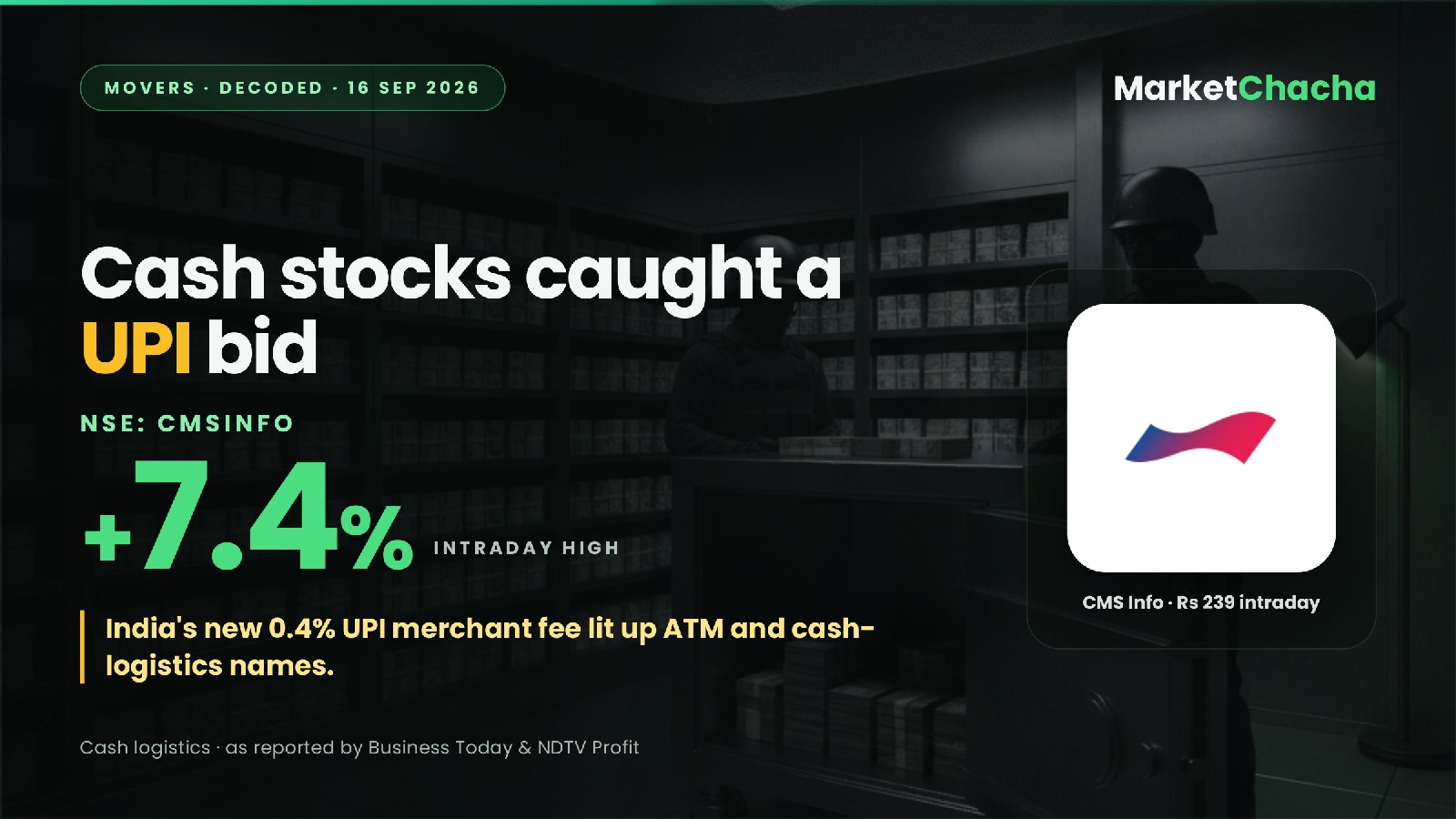
India's cash-logistics stocks — the companies that physically move currency and refill ATMs — got a jolt on Wednesday. CMS Info Systems (NSE: CMSINFO) rose as much as 7.4% to Rs 239 before fading to about +4% at Rs 232 by mid-afternoon, and smaller peer Radiant Cash Management jumped as much as 8.9% to Rs 39.28 (NDTV Profit clocked the intraday spike near 10%). Security-and-cash player SIS Ltd added about 1%. The odd part: this is a digital-payments story lifting cash stocks.
Why it moved
On 15 September the NPCI, which runs UPI, confirmed India will start charging a Merchant Discount Rate (MDR) of 0.4% on person-to-merchant UPI payments above Rs 2,000, effective 15 October 2026. The fee is capped at Rs 300 for payments of Rs 75,000 and up, and — this matters — it's paid by the merchant, not you. Person-to-person transfers stay free. After roughly six years of UPI being completely free, that's a real change of direction.
The trading logic is simple, if a bit of a leap: if accepting a large UPI payment now costs a shopkeeper money, a sliver of big-ticket spending might drift back to cash — which is good for the firms that count, sort, insure and truck that cash around. Hence the pop in ATM and cash-management names.
The catch worth knowing
Be honest about the size of this. UPI processed 2,450 crore transactions worth Rs 29.82 lakh crore in August alone and handles about 84% of India's digital payments by volume. A capped 0.4% fee on only the above-Rs-2,000 slice is a nudge, not a U-turn — most UPI payments are small and stay free. That's exactly why both stocks gave back half their gains within hours. This was a sentiment trade on a headline, not a re-rating on new earnings.
The business
CMS Info is India's largest cash-management company, with a 40%+ share of the market. Its revenue (about Rs 2,487 crore in FY26) splits roughly 60% cash management — ATM replenishment, cash pickup from retailers, sorting and reconciliation — and 40% managed services, where it deploys and maintains ATMs and sells banking-automation and AI-camera monitoring. So the "cash comeback" angle really only touches part of the company; the managed-services half rises and falls with bank ATM spending, not with how you pay at a shop.
Is it expensive?
Not really — and that's the interesting bit. CMS carries a market cap of about Rs 4,220 crore, is net-debt-free, and trades on a trailing P/E in the mid-teens (Screener.in), well below the broader market. Radiant Cash, roughly a tenth of the size at about Rs 408 crore, sits on a similar low-teens P/E after its FY26 profit fell about 31% to Rs 32 crore. A market leader on a mid-teens multiple usually means investors think growth is capped — and here the thing capping it is UPI itself, which is why CMS has been hovering near a 52-week low. That's the neat irony of today: the same force that made these stocks cheap gave them a one-day reason to bounce.
What to watch
- The 15 October start — whether the rule survives intact. Merchant bodies are already lobbying the government to soften or scrap it.
- Whether it actually shifts behaviour, or merchants simply absorb a Rs-300-capped fee and nothing changes at the cash desk.
- CMS's ATM order pipeline, which drives the managed-services half far more than any cash-vs-UPI narrative.
The one risk that flips the story: the government blinks. It has rolled back UPI charges before under public pressure, and if this fee gets diluted, the reason for today's move quietly disappears.
As of close, 16 September 2026 IST. Sources: Business Today, NDTV Profit, Screener.in. For discussion and education only — not investment advice. Verify before acting.
This article is for educational and informational purposes only. It is not financial advice, investment recommendation, or a solicitation to buy or sell securities. Investing involves significant risks. I am not a SEBI-registered investment advisor. Readers should consult their own financial advisor and conduct their own research before making any investment decisions.
Comments
Join the conversation
Sign in to join the conversation.
Follow replies, add your view, and take part in the discussion.
Sign in to commentLoading comments...