

Why did my bond fund lose money? Bond funds vs holding a bond to maturity, explained
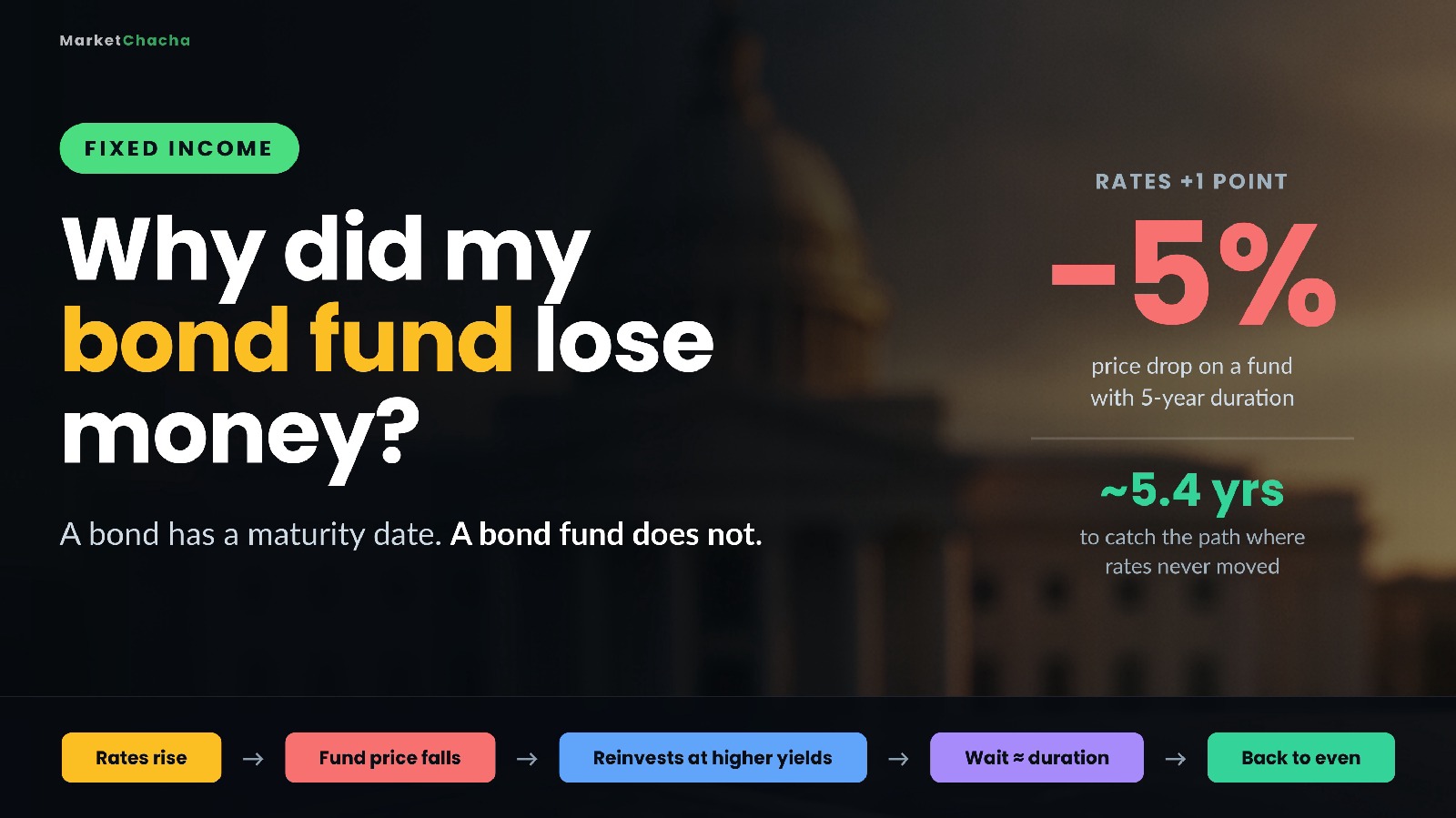
Your bond fund lost money because a bond fund never matures. Buy a single bond and hold it, and there is a date in the contract on which you get your face value back — the SEC puts it plainly: "If bonds are held to maturity the investor will receive the face value, plus interest. If sold before maturity, the bond may be worth more or less than the face value." A bond fund has no such date. It owns hundreds of bonds, rolls them as they age, and prices the whole basket every day at what the market will pay right now. So when interest rates rise, a bond you hold falls in price on a screen you can ignore — and a bond fund posts a real, visible loss.
Below: why rates move bond prices, a worked example with the arithmetic on both sides, what "duration" actually tells you, why the fund's loss usually reverses, where each option genuinely wins, and how the same choice looks in India.
Why a bond loses value when rates rise
A bond is a fixed promise. Buy a $10,000 five-year Treasury note paying 4.00% and you have locked in $400 a year (paid as $200 every six months) plus $10,000 back at the end. Those numbers never change.
What changes is what else is on offer. If new five-year notes start paying 5.00%, nobody will pay the full $10,000 for a bond that pays 4.00%. The only way yours can compete is to get cheaper, until a buyer's total return — the discounted price, plus the coupons, plus the face value at the end — matches the 5.00% available elsewhere. That is the whole mechanism, and the SEC says the same of funds: "When interest rates go up, the market value of bonds owned by a fund generally will go down."
The one thing a bond fund does not have: a maturity date
Be precise here, because this is the part beginners miss. The bonds inside a fund do mature. What the fund does with the proceeds is buy more bonds, so the portfolio's maturity profile stays roughly where the strategy says it should. A "1–3 year Treasury" fund is still a 1–3 year Treasury fund in 2035. It never winds down, never hands you a face value, and never reaches a day when price risk goes to zero.
Which gives you the sentence the rest of this article follows from: with an individual bond your protection is a contract; with a fund your protection is a time horizon.
A worked example: one rate rise, two investors
Same day, same $10,000, same market. Rates rise by one percentage point right after both investors buy. All figures illustrative.
Investor A buys the individual bond. A $10,000 five-year note at 4.00%, held to maturity. She collects $200 every six months — $400 a year, $2,000 over five years — plus $10,000 of face value at the end. Total $12,000, before tax and ignoring what she earns reinvesting the coupons. The rate rise moved the market price of her note; it touched none of those cash flows. If she never sells, the loss never happens.
Investor B buys the bond fund. A fund holding similar bonds, duration 5, starting yield 4.00%. The one-point rise knocks roughly 5% off the portfolio overnight: $10,000 becomes about $9,500. That is a real number on a real statement, and it is what sends people to Google at 11pm.
Here is the part almost nobody explains. From that moment, Investor B's fund is earning about 5.00% a year, not 4.00% — its bonds are now priced to yield 5%, and every maturing bond it replaces is bought at today's higher rates. She got poorer instantly and richer per year, in the same instant.
Duration: the number that tells you how much it will hurt
Duration is the most useful number on a bond fund's page, and it is not a maturity — it is a sensitivity. FINRA's rule of thumb: "for every 1 percentage-point change in interest rates, a bond will rise or fall in the opposite direction by an amount equal to its duration number."
- Duration 2 → a 1-point rise costs roughly 2%.
- Duration 5 → roughly 5%. (Our example.)
- Duration 17 → roughly 17%. Funds holding very long-dated bonds live in this territory, which is why they fell hardest when rates jumped in 2022.
Two honest caveats. It is an approximation: it works well for small moves and gets loose for large ones, because real bonds curve (convexity), so the rule slightly overstates losses when rates rise and understates gains when they fall. And it measures interest-rate risk only — FINRA is explicit that a low-duration bond can still carry credit, inflation and call risk. A short-duration junk-bond fund is not a safe fund.
Why the paper loss usually reverses itself
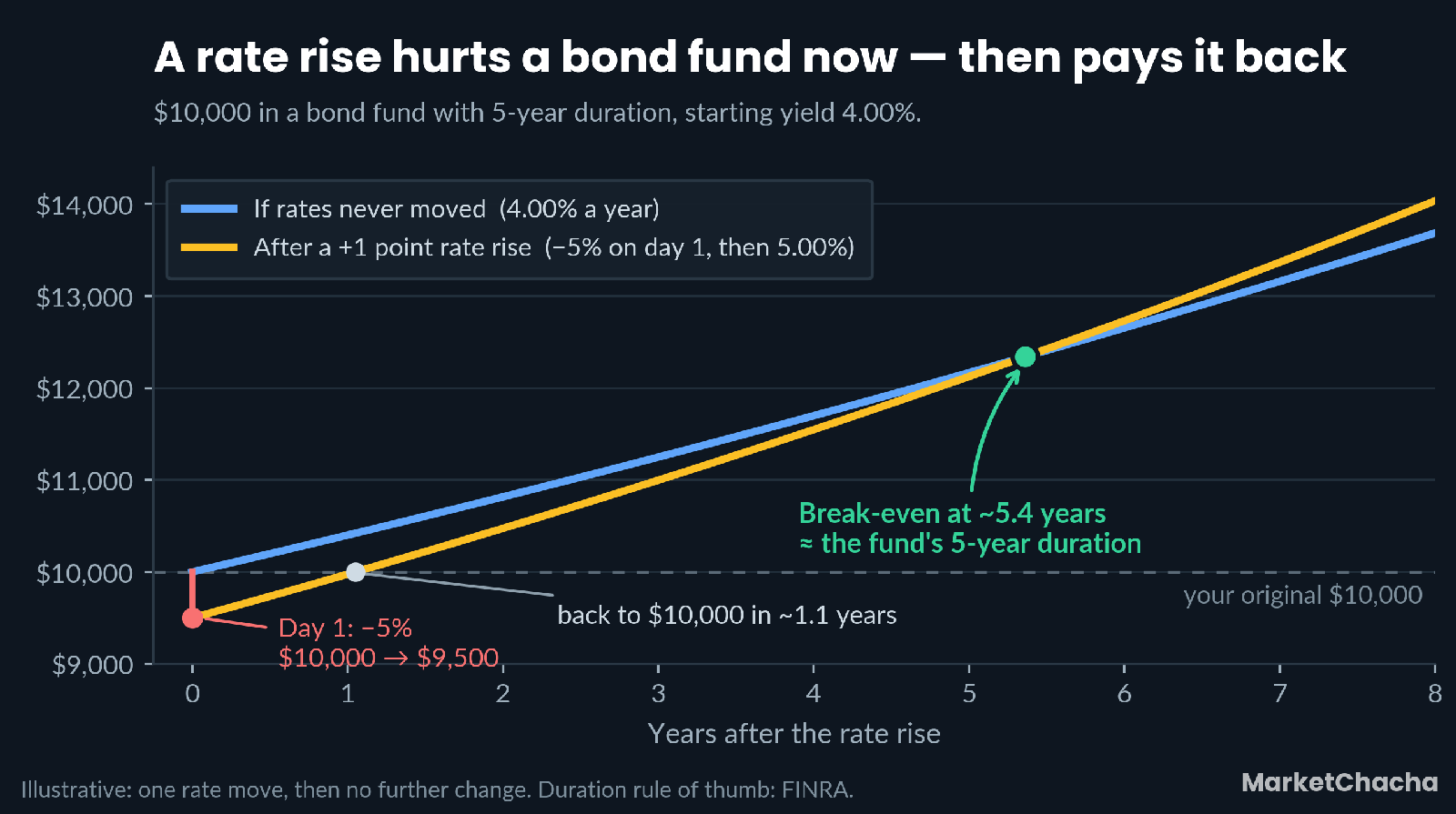
Run Investor B forward. She starts at $9,500 and compounds at about 5.00% a year. Compare that with the parallel universe where rates never moved and she compounded $10,000 at 4.00%.
- Back to $10,000 in about 1.1 years. The higher yield alone repairs the headline loss surprisingly fast.
- Level with the "rates never moved" path at about 5.4 years — very close to the fund's 5-year duration, and that is no coincidence.
- Ahead after that, permanently, because she earns 5% where the other path earns 4%.
That is the deep point about duration: it is not just a loss multiplier, it is roughly the holding period over which a rate rise stops mattering. If your money will sit in the fund for longer than its duration, a rate rise is closer to an upfront price paid for a permanently higher income stream than to a disaster. If your money is leaving before then, it is simply a loss.
The caveat, plainly: this assumes one rate move and no further change, and a fund whose duration stays put. The real world delivers a stream of moves. Keep the shape of the trade-off, not the exact 5.4.
Where the individual bond really wins — and where it quietly loses
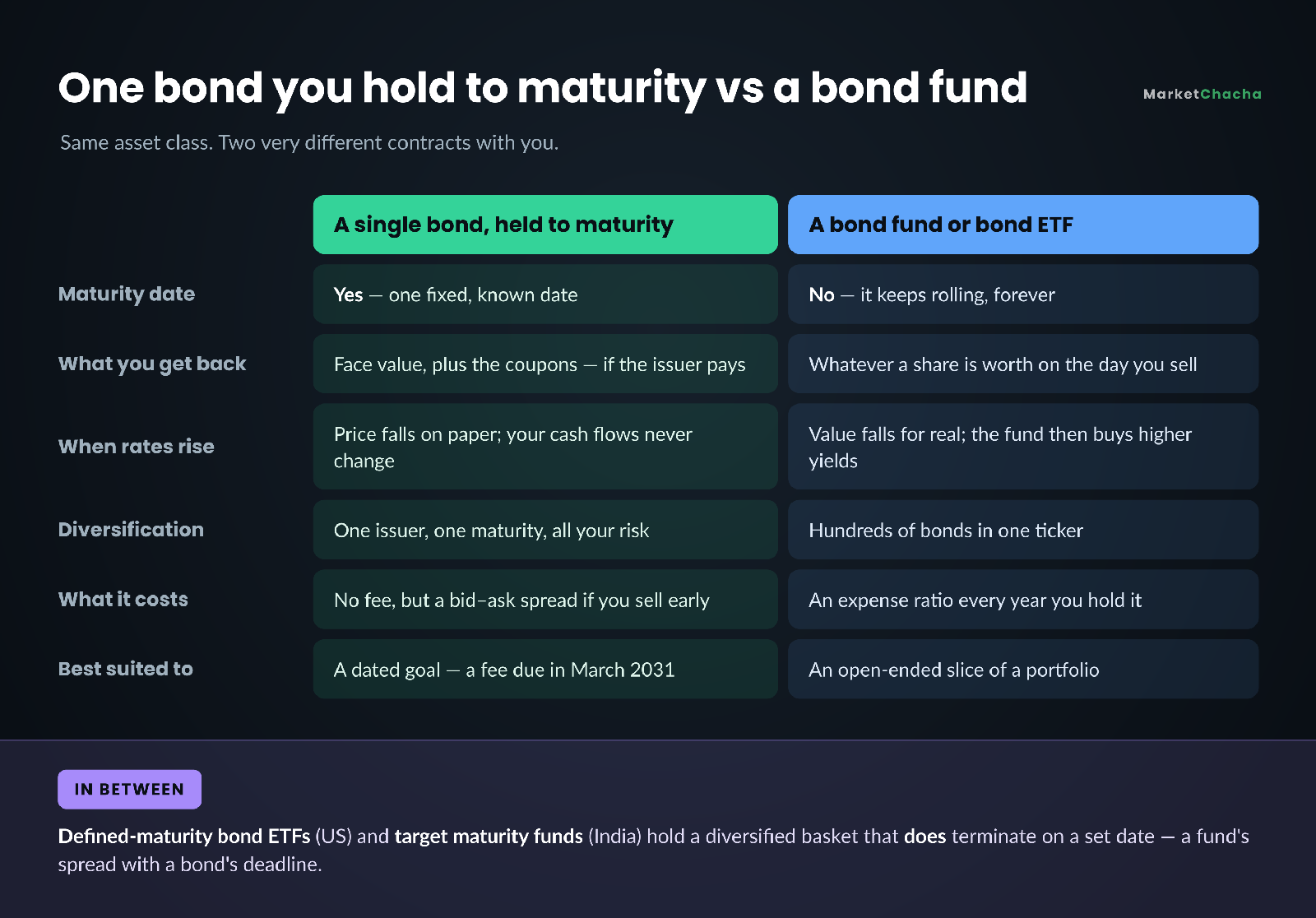
The single bond has one genuine, un-fakeable advantage: a known amount on a known date. If you owe a tuition instalment in March 2031, a bond maturing in March 2031 removes the question of what markets are doing that month. No ordinary fund can promise that.
But be honest about the other side. Investor A did not escape the rate rise; she just cannot see it. She is locked into 4.00% for five years while the world pays 5.00% — roughly $100 a year of income forgone, the same economic wound the fund took upfront. Holding to maturity converts a visible loss into an invisible one; it does not delete it. She also carries risks the fund spreads: one issuer means one default away from a bad year (a US Treasury is a different case from a single corporate bond), and an early sale means paying a bid–ask spread in a market where individuals trade small, unfriendly sizes.
How to actually do it: match the tool to the job
- 1. Write down the date you need the money. Not "someday" — a month and a year, or an honest "no fixed date".
- 2. Fixed date? Use something that matures on it. A T-bill, a Treasury note or a CD dated to the goal. US individuals can buy Treasuries directly at auction through TreasuryDirect, or on the secondary market through a brokerage.
- 3. No fixed date? Use a fund — and match its duration to your horizon. Money you might need in a year does not belong in a duration-8 fund, however good the yield looks.
- 4. Read two numbers before past returns. Duration, and the 30-day SEC yield — a standardised figure calculated by an SEC-prescribed formula and stated net of the fund's expenses, which makes it comparable across funds in a way a trailing distribution yield is not.
- 5. Consider the hybrid. Defined-maturity bond ETFs in the US, and target maturity funds in India, hold a diversified basket that does terminate on a stated date.
What it costs you: the catch on both sides
A fund charges an expense ratio every year you hold it, straight off your return — on a 4% yield, a 0.50% fee is an eighth of your income, every year. A bond ETF also trades on an exchange, and the SEC notes ETF shares trade "at market prices that may or may not be the same as the NAV", so you can buy at a small premium or sell at a small discount.
The individual bond charges no annual fee but bills you in other coins: a bid–ask spread if you sell early, the work of managing maturities, concentration in one issuer, and the opportunity cost of being locked in when rates rise. There is no version of this where you avoid interest-rate risk. You only choose the form it takes.
Common mistakes beginners make
- Believing "bonds are safe" means "bond funds cannot fall". The Bloomberg US Aggregate Bond Index returned roughly −13% in 2022 — the worst calendar year in the index's history, which begins in 1976. Safe means low credit risk, not stable price.
- Selling the fund after a rate shock. The one mistake that turns a temporary paper loss into a permanent real one: you crystallise the price fall and hand away the higher yield that was your compensation for it.
- Matching duration to nothing. Buying a long-duration fund for a two-year goal because it yielded more.
- Judging a fund by its distribution yield. A high payout can include return of premium on bonds bought above par; the 30-day SEC yield is the standardised comparison.
- Thinking "held to maturity" removes all risk. Inflation still erodes the face value you get back, and a corporate issuer can still default.
How this works in India
The mechanics are identical; only the wrappers change. The Indian version of "buy the bond itself" is the RBI's Retail Direct scheme, which lets an individual open a Retail Direct Gilt (RDG) account and buy Treasury bills, dated government securities (G-secs), State Development Loans and other government paper in the primary and secondary markets. The RBI states no fees are charged for the facilities under the scheme. A G-sec bought there and held to maturity behaves exactly like Investor A's note.
The Indian version of "buy the fund" is a debt mutual fund — gilt, corporate bond, short duration. Same structure, same consequence: a daily NAV, no maturity date, a fall when yields rise. Indian factsheets publish Macaulay duration and modified duration; modified duration is the one that behaves like the sensitivity number above.
India also has the hybrid, and it is popular for good reason: target maturity funds — passive debt funds tracking a bond index with a stated maturity date, holding only G-secs, SDLs and PSU bonds. They "roll down" (a 5-year holding becomes a 4-year holding a year later), so rate sensitivity shrinks as the date approaches. It is the closest Indian analogue to a US defined-maturity bond ETF.
One difference matters more in India than in the US: tax. Under the rules applying for assessment year 2026-27, gains on debt mutual fund units purchased on or after 1 April 2023 are taxed at the investor's income slab rate regardless of holding period, with no indexation benefit; interest on a directly-held G-sec is likewise taxable as income. India's tax law is in a transition period, so check the current position with the Income Tax Department or a qualified adviser — tax treatment can change which wrapper suits you far more than a few basis points of yield.
FAQ
Why did my bond fund lose money when bonds are supposed to be safe? "Safe" in bond language means low risk that the borrower fails to pay, not that the price stays still. When rates rise, existing bonds must fall in price to compete with newly issued ones, and a fund reprices its whole portfolio daily — so the fall shows up immediately in your account.
Will my bond fund recover if I just wait? If rates stop rising, the arithmetic works for you: the fund now earns a higher yield. In our illustrative example it returns to its starting value in about 1.1 years and catches the no-rate-change path at about 5.4 years, close to its 5-year duration. Not a guarantee — rates can keep rising — but time and a higher yield are what repair the loss.
Is it better to buy individual bonds or a bond fund? Neither is better in general; they answer different questions. An individual bond when you need a known amount on a known date; a fund when you want diversification with no fixed date, choosing a duration that matches your horizon.
What does duration mean on a bond fund? It estimates how much the fund's value moves for a 1 percentage-point change in interest rates — duration 5 implies roughly a 5% move, in the opposite direction. It doubles as a rough guide to the holding period over which a rate change stops mattering.
Do bond funds ever mature like individual bonds do? Ordinary bond funds and bond ETFs do not — they reinvest maturing bonds indefinitely. Defined-maturity bond ETFs in the US and target maturity funds in India are the exception: they hold a diversified basket that terminates on a stated date.
If I hold an individual bond to maturity, have I avoided the rate rise? You have avoided a realised loss, not the economics. You are locked into your old, lower rate while new bonds pay more — the cost is real, it is just an opportunity cost that never appears on a statement.
Educational content only — not investment, tax or insurance advice, and not a recommendation of any product. Rates, fees and rules change — always check current terms with the provider. Figures cited as of August 2026. [Sources: SEC Investor.gov — Bonds FAQ, SEC Investor.gov — Bond Funds and Income Funds, SEC Investor Bulletin — Exchange-Traded Funds, FINRA — Bonds, Interest Rate Changes and Duration, Forbes on the 2022 bond market, Business Standard — RBI Retail Direct, ClearTax — debt mutual fund taxation (AY 2026-27)]. Always do your own research.
This article is for educational and informational purposes only. It is not financial advice, investment recommendation, or a solicitation to buy or sell securities. Investing involves significant risks. I am not a SEBI-registered investment advisor. Readers should consult their own financial advisor and conduct their own research before making any investment decisions.
Comments
Join the conversation
Sign in to join the conversation.
Follow replies, add your view, and take part in the discussion.
Sign in to commentLoading comments...