

What is an interest rate, really — and why does the Fed raise or cut it?
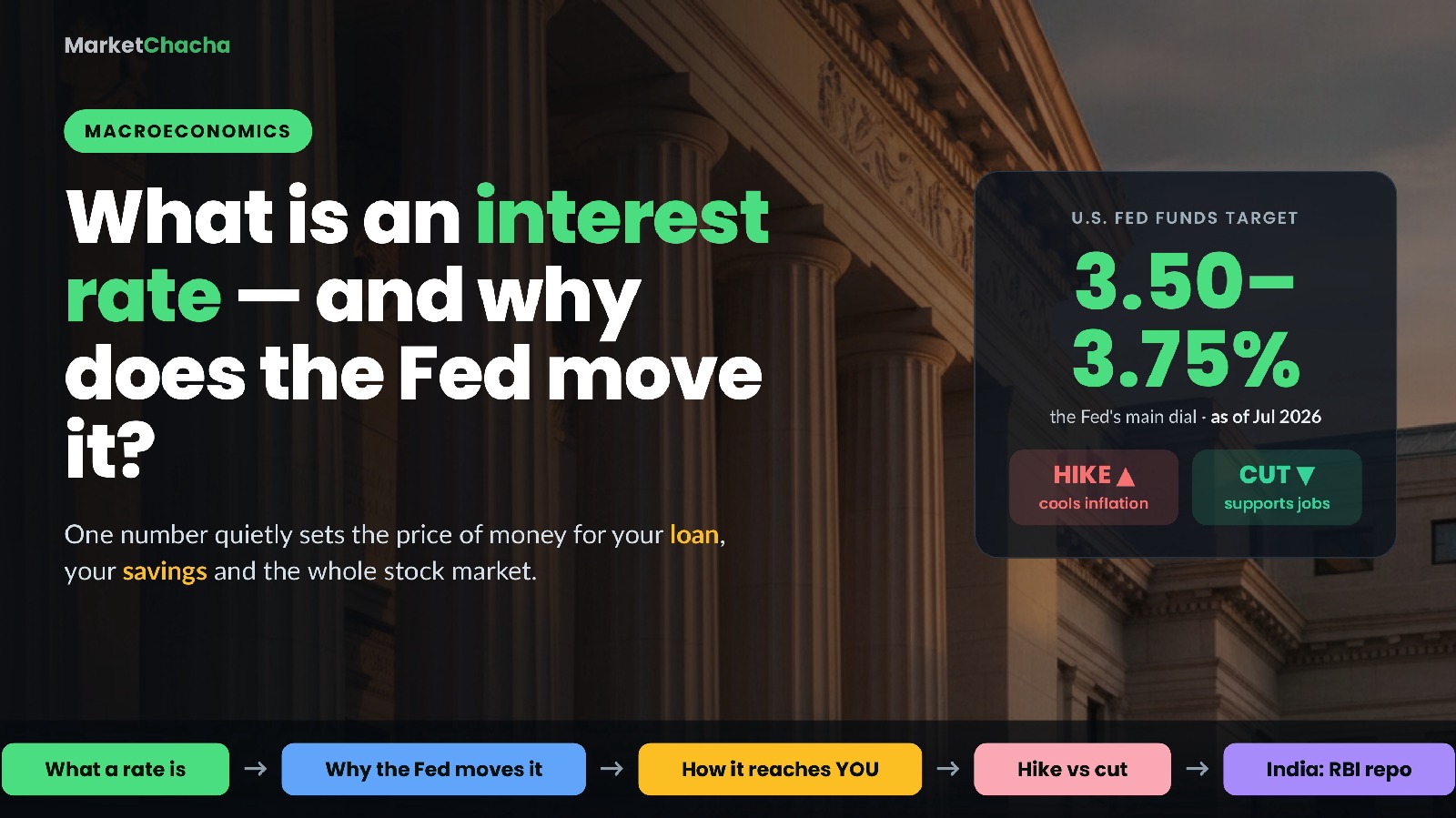
An interest rate is the price of money — what a lender charges you to borrow, or what you get paid to save, quoted as a percentage per year. In the United States the single most important interest rate is the federal funds rate, the range the Federal Reserve ("the Fed") aims for. It sounds abstract, but almost every rate you touch — your mortgage, your car loan, your credit card, the yield on a savings account or a Treasury bill — takes its cue from it. The Fed raises this rate to cool inflation and lowers it to support jobs and growth. This guide explains, from scratch, what an interest rate really is, why the Fed moves it, exactly how one change travels into your wallet, who wins and who loses each time — and how the same machinery works in India.
What an interest rate actually is
Think of money like anything else you can rent. If you borrow it, you pay rent for the time you hold it; that rent is the interest rate. It always has two sides: the borrower pays it, and the saver or lender earns it. Rates are almost always quoted as an annual percentage rate (APR) so you can compare a credit card to a car loan to a savings account on the same yardstick.
A simple example: borrow $1,000 for one year at 6% and you owe about $60 in interest. Save that same $1,000 in an account paying 4% and you earn about $40. One more distinction beginners miss: the nominal rate is the sticker number; the real rate is what's left after inflation. If your savings pays 4% but prices rise 3%, your real return is only about 1% — your money grew, but your buying power barely did.
The one rate that rules them all: the federal funds rate
Banks keep reserve balances at the Fed, and at the end of each day some have a little extra while others are short. They lend those reserves to each other overnight, and the interest on those loans is the federal funds rate. The Fed does not directly set your mortgage or your credit card — instead it sets a target range for this interbank rate and uses its tools to keep the market rate inside that band.
As of July 2026, the target range is 3.50%–3.75%; the Fed's rate-setting committee, the FOMC, voted 12–0 to hold it there at its June 2026 meeting. Notice it is a range, not a single number. This rate is the closest thing finance has to a "risk-free" anchor, and because it is the cheapest, safest short-term rate in the economy, every riskier rate is essentially built on top of it.
Why does the Fed move it? The dual mandate
Congress gave the Fed two jobs, known as the dual mandate: maximum employment and stable prices. The Fed defines stable prices as inflation averaging about 2% a year (measured by the PCE price index). Those two goals pull in opposite directions, which is why the job is hard.
When the economy runs hot and inflation climbs above 2%, the Fed raises rates to make borrowing more expensive, cool spending, and bring prices back down. When the economy weakens and unemployment threatens to rise, it cuts rates to make money cheaper, encourage borrowing and hiring, and revive growth. That is the see-saw behind every headline: hikes fight inflation, cuts fight unemployment. The FOMC meets eight times a year to decide which way to lean.
A worked example: how a rate change reaches your wallet
This is the part most people never see — the "transmission mechanism." Start with a rule that has held since 1994: the prime rate (the base rate banks charge their best customers) equals the fed funds target's upper limit plus 3 percentage points. With the range at 3.50%–3.75%, prime is about 6.75% (as of mid-2026).
Your credit card APR is usually "prime plus a margin." Say your card is prime + 14%, giving 20.75%. Now suppose the Fed hikes by a quarter point (0.25). Prime rises to 7.00%, and your card APR rises to 21.00%. If you carry a $5,000 balance for a year, each 0.25-point rise adds roughly $12.50 in annual interest (0.25% × $5,000). Crucially, this only bites if you carry a balance — if you pay your statement in full within the grace period, your card's APR never actually charges you a cent, no matter how high it goes.
The same lever works in reverse for savers. When the fed funds rate rises, the yields on high-yield savings accounts, CDs, money-market funds and Treasury bills climb too — which is why "park your cash" products suddenly got attractive during the 2022–2023 hiking cycle. One important exception: 30-year fixed mortgage rates do not track the fed funds rate directly. They follow the 10-year Treasury yield and the market's expectations for future inflation and Fed policy, so a rate cut today may not lower mortgage rates at all if markets already expected it.
Rate hikes vs rate cuts: who wins and who loses
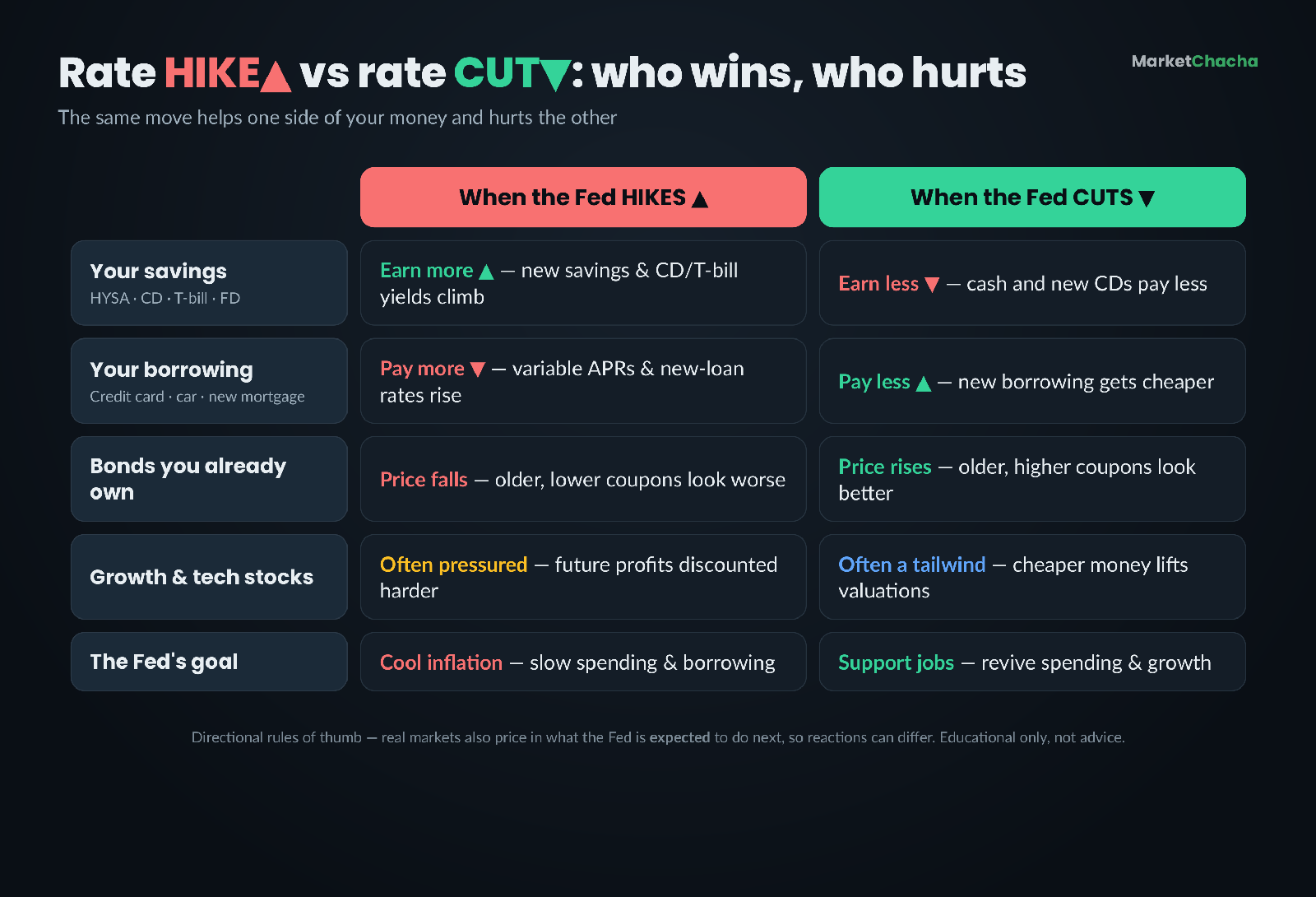
Every rate move helps one side of your finances and hurts the other. A hike is good news for savers (new savings and CD yields climb) and bad news for borrowers (variable APRs and new-loan rates rise). A cut flips it: cheaper borrowing, but less income on cash. The card above is a directional cheat-sheet — but remember markets also move on what the Fed is expected to do next, so the real-world reaction isn't always textbook.
Why bond and stock prices react too
Bonds you already own fall in price when rates rise. If you hold a bond paying a 3% coupon and new bonds suddenly pay 5%, nobody wants your lower-paying bond at full price, so its market value drops until its effective yield matches. When rates fall, the opposite happens and your older, higher-coupon bond becomes more valuable.
Stocks feel it two ways. First, a share price is partly the value of the company's future profits, and higher rates make those far-off profits worth less today — which hits fast-growing, high-valuation tech stocks hardest. Second, when safe Treasury bills pay 5%, they compete with stocks for your money; when they pay almost nothing, investors are pushed toward riskier assets in search of a return. That is a big reason the near-zero era after 2008 and 2020 was such a powerful tailwind for stocks.
The rate cycle over time
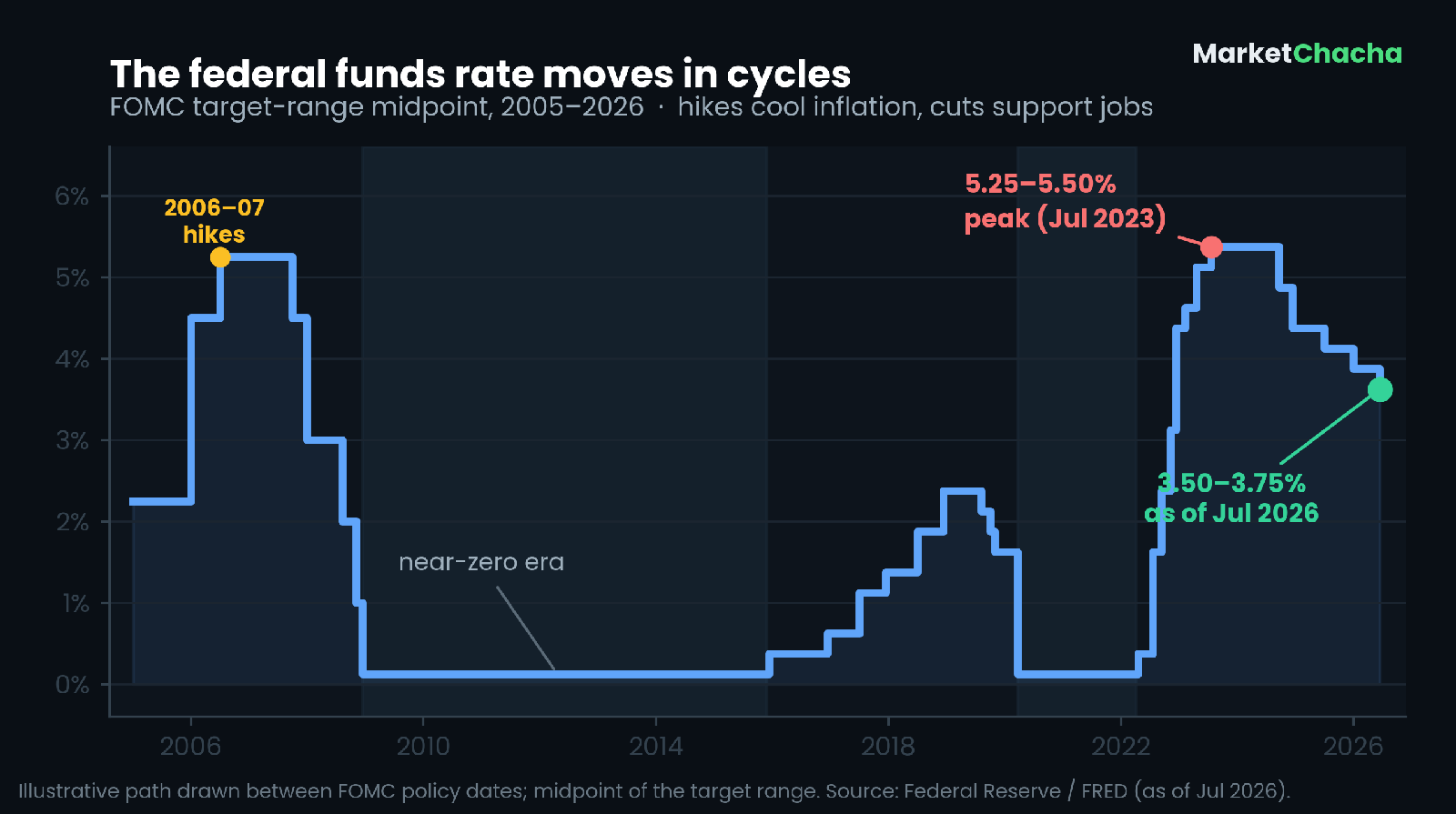
The Fed rarely moves just once. It moves in cycles — long hiking campaigns and long cutting campaigns — as the chart shows. After the 2008 crisis, rates sat near zero for roughly seven years; they were pushed back to zero in 2020; then, to fight the post-pandemic inflation spike, the Fed hiked rapidly through 2022–2023 to a peak range of 5.25%–5.50%, before easing back to today's 3.50%–3.75%. The practical takeaway: what matters for markets is not just today's rate but the direction and expected path of the whole cycle.
Common mistakes beginners make
- Thinking the Fed sets your mortgage rate. It sets a short-term overnight rate; long-term mortgage rates are set by the bond market and expectations.
- Assuming "the Fed cut, so stocks must jump." Markets price the expected move in advance, so the actual announcement can be a non-event — or even move the "wrong" way if the Fed surprises on what comes next.
- Panicking over the "average" credit card APR. A scary figure like a ~20%+ average APR only applies to accounts that carry a balance. If you pay in full each month, it doesn't touch you.
- Confusing nominal and real returns. A savings account "paying 4%" is barely keeping up if inflation is 3%.
How to actually use this
You cannot and should not try to out-guess the Fed, but you can position your own money sensibly for where the cycle is:
- Know the direction. Are we in a hiking or cutting phase? Is inflation the worry or is jobs the worry? That one read tells you which way most rates are drifting.
- When rates are high, it can make sense to lock in yields on cash (CDs or T-bills) before rates fall, and to prioritise paying down variable-rate debt like credit cards, whose cost rises with the Fed.
- When cuts are underway, cash returns shrink, so parking everything in savings gets less rewarding, and locking a fixed borrowing rate can be attractive.
- Focus on your rates, not the headline. The number that matters is the APR on your loan and the yield on your savings — check those, not just the Fed's press release.
This is about understanding the weather, not timing it. None of the above is a recommendation to buy or sell any specific product.
How this works in India
India has the exact same machinery, run by the Reserve Bank of India (RBI). Its version of the fed funds rate is the repo rate — the rate at which the RBI lends to commercial banks. As of June 2026, the repo rate is 5.25%, which the RBI has held steady with a neutral stance. The decision is made by a six-member Monetary Policy Committee (MPC), and the RBI works to a flexible inflation target of 4% (within a 2%–6% band) — the Indian equivalent of the Fed's 2% goal.
The transmission is arguably more direct for Indian borrowers today: since 2019 the RBI has required banks to link most retail floating-rate loans (home, auto, personal) to an external benchmark, usually the repo rate itself, under the EBLR system. So when the RBI changes the repo rate, floating home-loan EMIs adjust relatively quickly — much faster than in the old system. Fixed-deposit (FD) rates and small-savings returns also rise and fall with the cycle. The see-saw is identical: the RBI hikes the repo rate to fight inflation and cuts it to support growth.
FAQ
What is an interest rate in simple words? It is the price you pay to borrow money, or the amount you earn for saving it, expressed as a percentage per year. Borrow $1,000 at 6% and you owe about $60 in interest for the year.
Does the Fed set my mortgage or credit card rate? Not directly. The Fed sets a target range for the overnight federal funds rate. Credit card APRs move closely with it (via the prime rate), but 30-year mortgage rates follow the 10-year Treasury yield and market expectations, so they can move independently.
Why does the Fed raise interest rates? To cool inflation. Higher rates make borrowing and spending more expensive, which slows demand and helps bring prices back toward the Fed's roughly 2% target. It cuts rates when the economy weakens and it wants to support jobs.
What is the federal funds rate right now? As of July 2026 the FOMC's target range is 3.50%–3.75%, held at the June 2026 meeting. Rates change often, so always check the Fed's latest statement for the current figure.
Are rate cuts good for the stock market? Usually they are a tailwind because cheaper money lifts valuations and makes safe assets less competitive — but markets price expected cuts in advance, so the actual announcement doesn't always push stocks up.
What is India's version of the fed funds rate? The RBI's repo rate, the rate at which the central bank lends to banks. As of June 2026 it stands at 5.25%, set by the six-member Monetary Policy Committee.
Educational content only — not investment, tax or financial advice, and not a recommendation of any product. Interest rates, yields and rules change constantly; always check current figures with the provider or the central bank. [Sources: Federal Reserve, FRED (St. Louis Fed), Reserve Bank of India.] Always do your own research.
This article is for educational and informational purposes only. It is not financial advice, investment recommendation, or a solicitation to buy or sell securities. Investing involves significant risks. I am not a SEBI-registered investment advisor. Readers should consult their own financial advisor and conduct their own research before making any investment decisions.
Comments
Join the conversation
Sign in to join the conversation.
Follow replies, add your view, and take part in the discussion.
Sign in to commentLoading comments...