

How is credit card interest actually calculated — and why is paying only the minimum a trap?
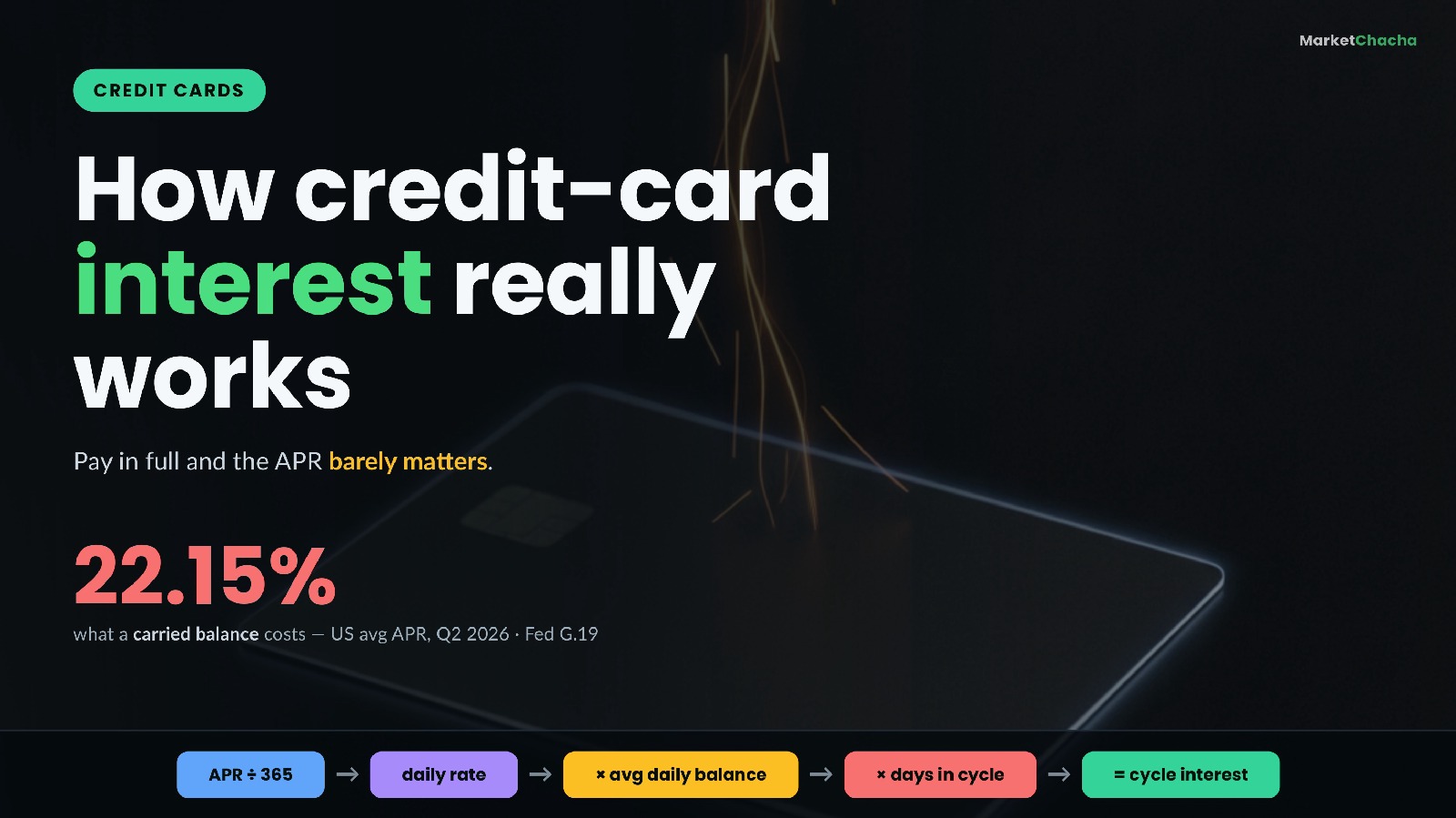
Credit card interest is the fee you pay for borrowing money on your card, and it is worked out from the balance you carry — not once a year in a lump sum, and not on your whole credit limit. Your card has an APR (Annual Percentage Rate); the issuer divides that APR by 365 to get a daily periodic rate, tracks your balance day by day through the billing cycle, and uses that to compute the interest for the cycle. The single most important thing to know: if you pay your statement balance in full by the due date, most cards charge you zero interest on purchases — so for anyone who pays in full, the APR barely matters. Interest only becomes your problem the moment you carry a balance past the due date.
This guide breaks down exactly how the number is built, walks through the arithmetic with real figures, clears up a common point of confusion about daily compounding, shows why paying only the minimum keeps you in debt for years, and explains how the same mechanics play out in India.
What "credit card interest" actually is
Interest is the price of using the bank's money instead of your own. When you buy something on a credit card, the issuer pays the merchant right away and effectively lends you that amount. If you repay it in full by the due date, that loan is free. If you don't, you rent that money — and credit cards are one of the most expensive ways to borrow that ordinary consumers can access.
As of Q2 2026, the average rate on U.S. credit card accounts that were actually charged interest was about 22.15%, per the Federal Reserve's G.19 Consumer Credit release. Note what that figure is measuring: it deliberately excludes the many cardholders who pay in full and never pay a cent of interest. In other words, it's the cost paid by people who carry a balance — if you clear your statement every month, this number simply doesn't apply to you. Rates also change constantly, so treat any specific figure as a snapshot and check your own cardholder agreement for your APR.
APR vs. the daily periodic rate: the number behind the number
Your APR is the headline annual rate — say 22.15%. But interest isn't applied once a year. The issuer converts the APR into a daily periodic rate (DPR) like this:
DPR = APR ÷ 365
So a 22.15% APR becomes a daily rate of 0.2215 ÷ 365 = 0.0607% per day. That tiny-looking daily number is the engine: the issuer looks at your balance each day and uses the DPR to build up the interest charge for the whole cycle. Whether that interest also compounds daily depends on which calculation method your card uses — and that's exactly the detail that trips people up.
How the charge is built: the two common methods (and the daily-compounding confusion)
U.S. cards generally use one of two closely related methods. Which one applies to you is spelled out in the "How we calculate interest" or "Interest charge calculation" box on your statement and in your cardholder agreement:
- Average daily balance method. The issuer records what you owe at the end of every day in the cycle, adds those daily balances together, and divides by the number of days to get your average daily balance. Interest is then applied once, at the end of the cycle. Under this method your interest does not compound during the month.
- Daily balance method. Each day the issuer adds that day's interest to your balance, so the next day's interest is figured on the slightly larger amount. This method does compound daily.
This is where a lot of online explainers (and, in an earlier version, this article) go wrong: they describe the average-daily-balance formula but also claim interest "compounds daily." Those two statements can't both be true for the same card. The honest answer is that it depends on the issuer — the CFPB notes that some issuers compound on a daily basis, not all. Many major U.S. cards do use daily compounding, but plenty use the average daily balance method and don't. So before assuming your card compounds daily, read that interest-calculation box. One thing is always true regardless of method: any interest you don't pay off gets rolled into next cycle's balance, so unpaid interest compounds at least once a month.
The formula and a worked example
For the average daily balance method, the arithmetic is:
Interest for the cycle = Average Daily Balance × Daily Periodic Rate × Number of Days in the cycle
Worked example (illustrative): suppose you carry an average daily balance of $3,000 across a 30-day cycle at a 22.15% APR (DPR = 0.0607%). Your interest is:
$3,000 × 0.000607 × 30 = about $54.62 for that one month.
That's roughly $655 a year in interest on a $3,000 balance — money that buys you nothing. (On a card that compounds daily, the figure is a shade higher, but for a single month the difference is only a few cents.) Notice the charge is based on your average balance across the cycle, not your credit limit and not the single highest amount you owed. Paying the balance down during the cycle lowers the average and therefore the interest, which is why paying early and often helps.
The grace period: how to pay zero interest
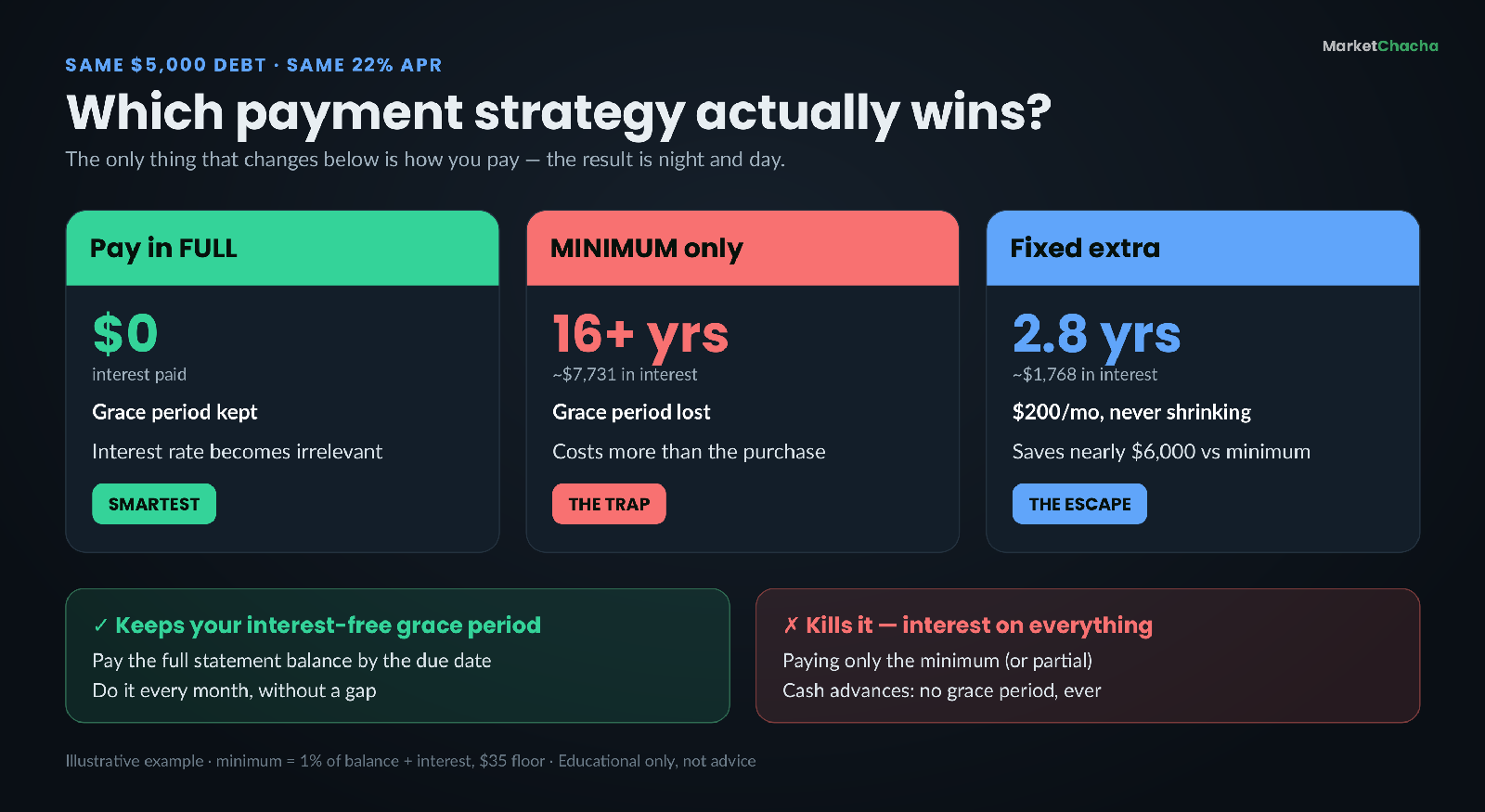
The grace period is the window between the end of your billing cycle and your payment due date — usually at least 21 days, because U.S. rules require statements to be delivered at least 21 days before payment is due. Here is the rule that saves people the most money: if you pay your statement balance in full by the due date, you are charged no interest on purchases. The grace period essentially gives you an interest-free loan every month, which is why a responsible user never actually pays the 22% headline rate.
But the grace period is fragile. According to the CFPB, if you don't pay in full, you lose it — and you get charged interest on the unpaid balance and on new purchases from the day you make them, with no interest-free window. Worse, once you've lost it, you often have to pay in full for two consecutive months to win it back. Paying only the minimum does not preserve it. This is the single most important mechanic to understand: full payment = free; partial payment = the meter starts running on everything.
Why paying only the minimum is a trap
The minimum payment is the smallest amount you can pay to keep the account current. A common structure is the greater of a small floor (roughly $25–$35) or about 1% of your balance plus that month's interest and fees. It's designed to be easy to afford — and that's exactly the problem. Almost all of a minimum payment goes to interest, leaving the principal barely touched.
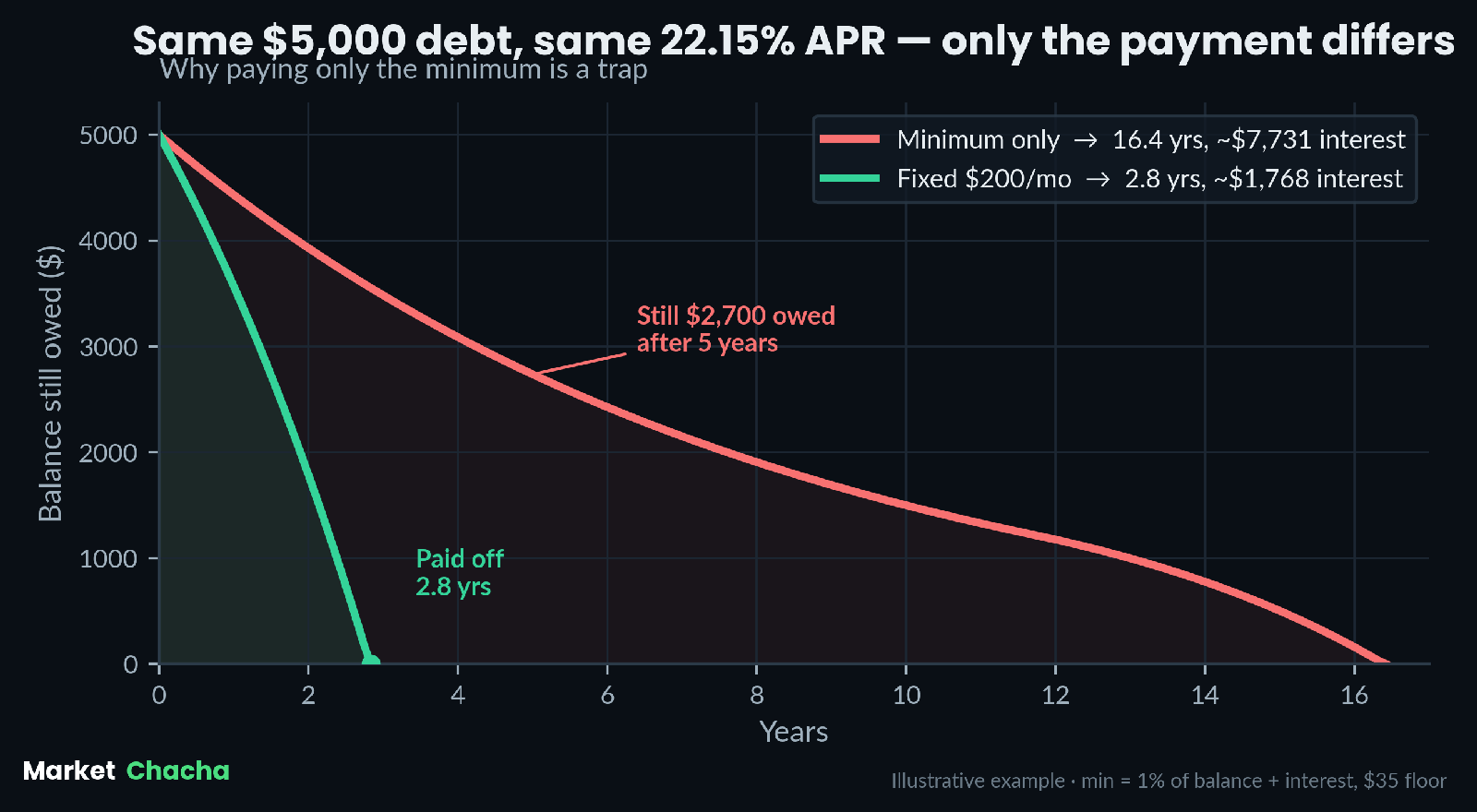
Worked example (illustrative): say you owe $5,000 at a 22.15% APR and pay only the minimum each month.
- Month one interest: $5,000 × 22.15% ÷ 12 ≈ $92.29.
- Minimum payment (1% of balance + interest): about $142.29 — of which only $50 actually reduces what you owe.
- Keep paying only the shrinking minimum and you'd be in debt for roughly 197 months — over 16 years — and pay about $7,731 in interest, more than the original balance.
Now change one thing: pay a fixed $200 a month instead of the falling minimum. You'd clear the same $5,000 in about 34 months (under 3 years) and pay roughly $1,768 in interest — saving close to $5,963. Same debt, same rate; the only difference is refusing to let the payment shrink. That gap is the trap, and the escape.
How to actually take control of it: step by step
- Pay the statement balance in full whenever you possibly can. This keeps your grace period and makes your interest rate irrelevant.
- If you must carry a balance, never let the payment float down. Pick a fixed monthly amount well above the minimum and keep paying it even as the balance falls.
- Pay more than once a month. Because interest is based on your average daily balance, an extra mid-cycle payment lowers the average and the interest.
- Attack the highest-APR card first (the avalanche method) if you have several, while paying at least the minimum on the rest.
- Read the "how we calculate interest" box on your statement to see your APR and which balance method your card uses, and ask your issuer whether a lower rate is available — sometimes it is, just for asking.
What it really costs you: the catch
The headline APR isn't the only cost. Cash advances usually have a higher APR and — critically — no grace period at all, so interest starts the instant you withdraw. Balance-transfer and promotional 0% offers can be powerful, but they often carry an upfront transfer fee and the low rate expires; if any balance remains when the promo ends, the regular APR snaps back. Late payments can trigger fees and, on some cards, a much higher penalty APR. And rewards or cashback don't offset interest: if you're paying 22% to earn 2% back, you're losing badly. The math only works for people who pay in full.
Common mistakes beginners make
- Thinking the minimum payment is "enough." It keeps you current, not solvent — it's engineered to maximize the interest you pay.
- Believing interest is charged on the credit limit. It's charged on what you actually owe (your average daily balance), not your limit.
- Assuming every card compounds interest daily. Some do (daily balance method), some don't (average daily balance method) — check your statement rather than guessing.
- Chasing rewards while revolving a balance. The interest almost always dwarfs the rewards.
- Only paying on the due date. Paying earlier or twice a month lowers the average daily balance and the interest.
How this works in India
The mechanics are the same, but the numbers are steeper. Indian card issuers quote interest as a monthly rate — commonly around 2.5% to 3.75% per month, which annualizes to roughly 30% to 45% per year (some cards reach ~48%). As of 2026, the Reserve Bank of India (RBI) requires issuers to clearly disclose the interest rate, finance charges, billing cycle and the compounding method, and to communicate changes in advance — but the responsibility to read the terms is yours.
The interest-free period (India's version of the grace period, typically up to ~45–50 days) works exactly like the U.S. one, and it vanishes the same way: pay the "Total Amount Due" in full and you owe no interest on purchases; pay only the "Minimum Amount Due" (often just 5% of the outstanding) and interest is charged on the entire balance and on fresh purchases from the transaction date. Cash withdrawals on an Indian credit card, as in the U.S., attract interest immediately with no interest-free window. The lesson is identical in both countries: full payment is free money; a carried balance at 30–48% is one of the most expensive debts you can hold.
FAQ
How is credit card interest calculated? Your issuer divides your APR by 365 to get a daily periodic rate and applies it to your balance through the cycle. On most cards the monthly charge is your average daily balance times the daily periodic rate times the number of days in the cycle. Check the "how we calculate interest" box on your statement for your card's exact method.
Does credit card interest compound daily? It depends on the card. Cards using the daily balance method add each day's interest to your balance, so it compounds daily; cards using the average daily balance method apply interest once at the end of the cycle and don't compound within the month. Either way, unpaid interest rolls into next month's balance, so it compounds at least monthly.
If I pay my credit card in full every month, do I pay any interest? No — as long as you pay the full statement balance by the due date, most cards charge zero interest on purchases thanks to the grace period, so your APR is effectively irrelevant. Interest only starts once you carry a balance past the due date.
Why is paying only the minimum payment a bad idea? The minimum is mostly interest, so your principal barely moves. On a $5,000 balance at about 22% APR, paying only the minimum can take over 16 years and cost more in interest than the original amount, while a fixed higher payment clears it in under three years.
Does carrying a small balance help my credit score? No. That's a myth. You never need to pay interest to build credit — paying your statement in full and on time builds credit just as well and costs you nothing.
What is the credit card interest rate in India? Indian cards typically charge about 2.5%–3.75% per month, which works out to roughly 30%–45% a year, and the interest-free period disappears the moment you stop paying the full amount due.
Educational content only — not investment, tax or financial advice, and not a recommendation of any product. Rates, fees and rules change, and the exact interest-calculation method varies by issuer — always check current terms with your card issuer. Sources: Federal Reserve G.19 Consumer Credit, Consumer Financial Protection Bureau, Reserve Bank of India. Always do your own research.
This article is for educational and informational purposes only. It is not financial advice, investment recommendation, or a solicitation to buy or sell securities. Investing involves significant risks. I am not a SEBI-registered investment advisor. Readers should consult their own financial advisor and conduct their own research before making any investment decisions.
Comments
Join the conversation
Sign in to join the conversation.
Follow replies, add your view, and take part in the discussion.
Sign in to commentLoading comments...