

HFCL approves ₹820 crore fibre capex — what it means
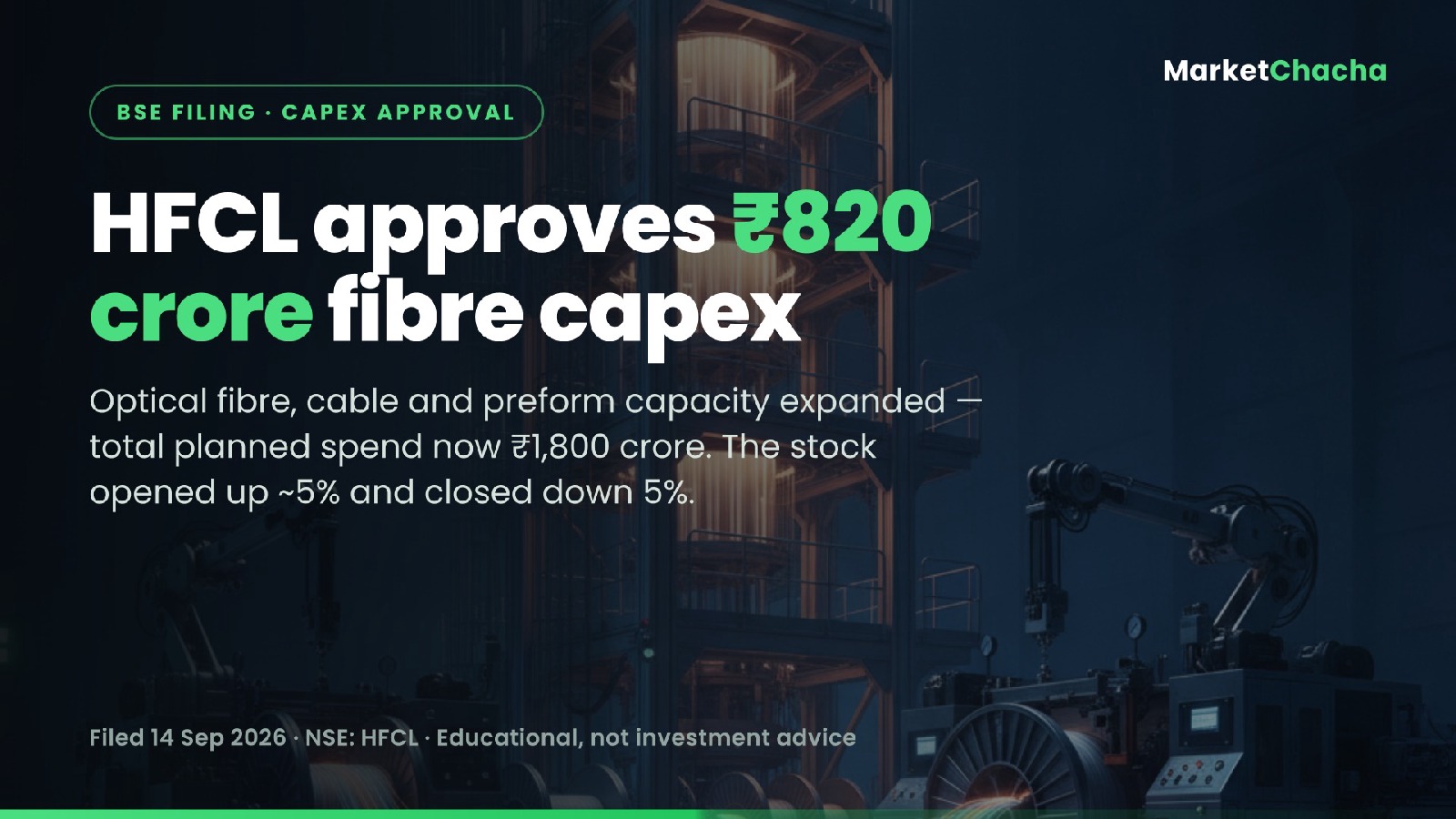
HFCL told the exchanges on 14 September 2026 that its board approved roughly ₹820 crore of additional capital expenditure to expand optical fibre, optical fibre cable and preform manufacturing capacity. This is a capex approval, not an order win — the company is committing to spend money, not announcing money coming in — and that distinction is most of the story.
What was announced
- ₹820 crore of fresh capex, on top of about ₹980 crore already approved — total planned spend now roughly ₹1,800 crore.
- Optical fibre: +4.60 mn fibre-km a year, to 43.10 mn fkm (from 28.0 mn today).
- Optical fibre cable: +5.64 mn fibre-km a year, to 62.00 mn fkm (from 39.0 mn today).
- Preform: +300 MT a year, to about 600 MT.
- Timeline: fibre and cable by July 2028; preform by October 2028.
- Funding: internal accruals, bank borrowings, and preferential warrants already issued to the promoter group.
What this type of filing means
A "board meeting outcome" under Regulation 30 reports what a company's directors formally decided. When the decision is capex, three things are worth separating.
Approved is not spent — it is permission to invest, cash going out over the build period, plans open to re-phasing. Capacity is not revenue: new fibre-km becomes sales only if customers order enough to fill it — which is why this reads differently from an order-win filing. And a preform plant is backward integration: preform is the thick glass rod drawn out into optical fibre, so making it in-house keeps more of the value added. That is where the hope of margin improvement comes from.
Why it matters
HFCL's rationale points at AI data centres, fibre-to-the-home and network modernisation. Real demand pools — but pipeline, not order book.
The balance sheet is where this bites. FY26 sales were ₹4,949 crore and net profit ₹329 crore, against borrowings of ₹1,896 crore — so a ₹1,800 crore programme is large relative to both. Part is funded by promoter warrants (equity — no interest, some dilution), part by debt. Heavy capex also drags on return ratios near term, since the assets earn nothing until commissioned; ROCE was 10.8% and ROE 6.98% in FY26. Hence a big spending announcement is not automatically read as good news.
How the market took it
The reaction on 15 September was two-sided. HFCL closed at ₹233.69 on the 14th, traded around ₹245.10 (about +5%) early on the 15th, then reversed to close at ₹222.01, down 5.00%. The broader market was soft that day too, so not all of the fade belongs to the filing — but the round trip is a reminder that news can be significant and still be sold. Other big moves are on movers.
Valuation, as reported
Market cap about ₹35,769 crore on a P/E of ~62.5 (Screener, FY26 basis; GuruFocus put TTM P/E at 60.27 on 6 September), P/B 7.31x on book value of ₹32.0. GuruFocus reports a 10-year median P/E of 29.94 (range 4.09–388.65) — roughly double its long-run median today. Closest listed peer Sterlite Technologies is ₹23,753 crore, FY26 sales ₹4,745 crore but profit just ₹56 crore — its ~499 P/E is arithmetically real but not meaningful. Adjacent comparator Polycab India is ₹1,24,185 crore at a P/E of 43.4 with 33.2% ROCE. Figures as reported, not a verdict.
The business
HFCL is a diversified telecom infrastructure enabler, split roughly two ways: telecom products (~59% of FY26 revenue) — optical fibre and cable, where it is among India's largest OFC suppliers, plus networking gear and data-centre products; and infrastructure services (~41%) — network rollout and system integration. This filing sits entirely in the first bucket.
Beginner takeaway
A capex approval tells you what management believes about future demand, and how much balance sheet they will put behind that belief. It is not revenue and it is not an order. Track whether the order book grows into the new capacity, how much of the ₹1,800 crore ends up as debt, and whether the preform plant delivers the margin gain described.
FAQ
What exactly is a "preform"? The solid glass rod heated and drawn into hair-thin optical fibre. Making it in-house means buying less of the key raw material from outside.
Why would a stock fall on a big investment announcement? Spending is a cost before it is a return. Investors may worry about funding, added debt, or the years before capacity earns anything — and some take profits on the news.
Does this mean HFCL has new customers? No. It cites a healthy order book and pipeline but announces no new contract. Capacity and orders are separate things.
Related: HFCL's ₹522 crore export order, its upper-circuit day on a doubled order book, and the full HFCL file.
As of 15 September 2026. Source: official BSE/NSE filing — read it directly here. We summarise filings for education and may make errors, so always verify against the official document. Educational content only — not investment advice, not a buy/sell recommendation.
This article is for educational and informational purposes only. It is not financial advice, investment recommendation, or a solicitation to buy or sell securities. Investing involves significant risks. I am not a SEBI-registered investment advisor. Readers should consult their own financial advisor and conduct their own research before making any investment decisions.
Comments
Join the conversation
Sign in to join the conversation.
Follow replies, add your view, and take part in the discussion.
Sign in to commentLoading comments...