

What is credit utilization — and how does it actually affect your credit score?
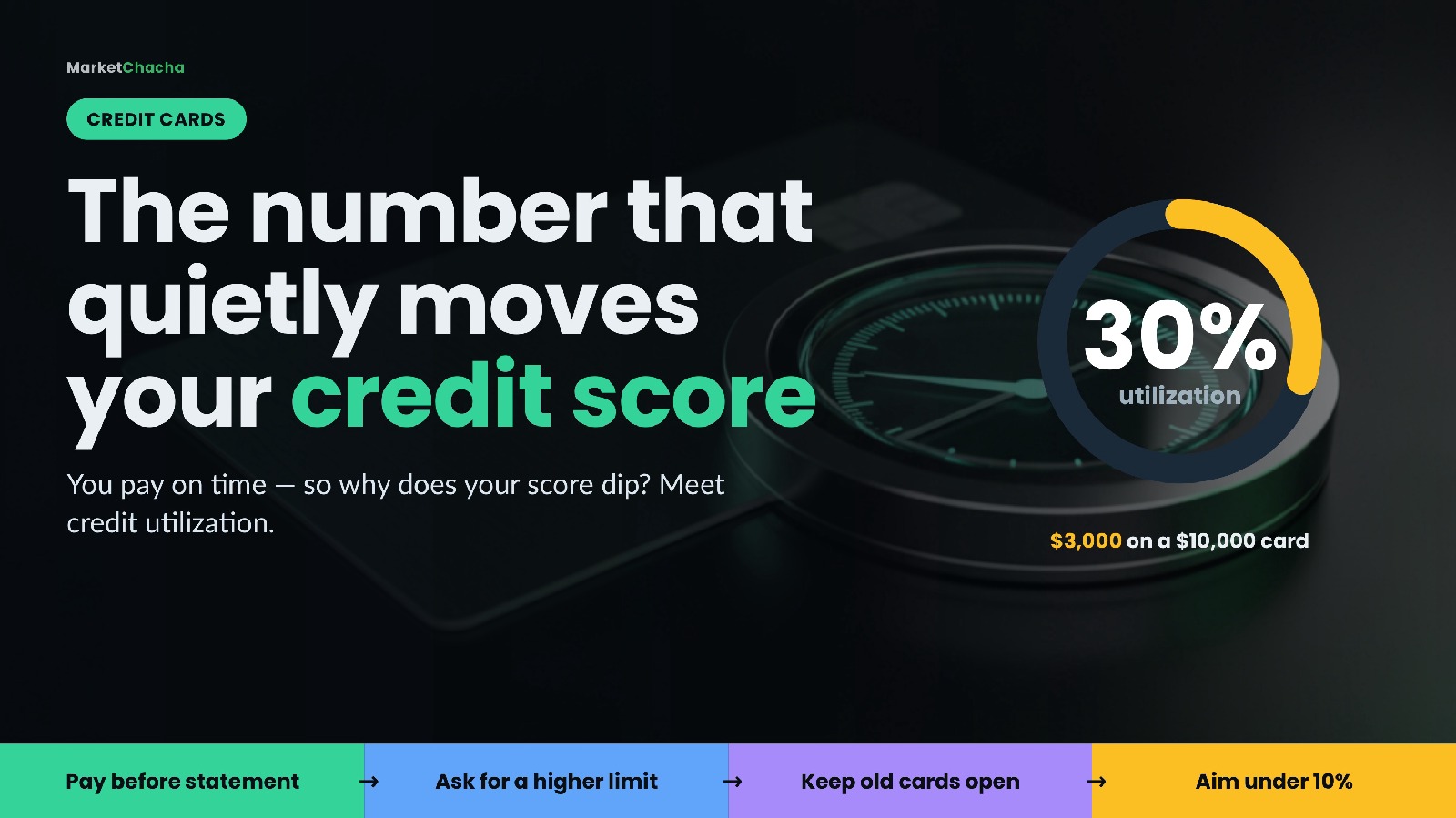
Credit utilization is the share of your available credit-card limit that you are currently using — your reported balance divided by your credit limit, written as a percentage. If you owe $3,000 on a card with a $10,000 limit, your utilization is 30%. It is one of the biggest levers on your credit score: in the FICO model, the "Amounts Owed" category it belongs to influences about 30% of your score, second only to payment history. The good news is that unlike a late payment, high utilization does no lasting damage — it is one of the few score factors you can fix in a single billing cycle. This guide explains exactly what the number is, how it is calculated on each card and across all of them, which balance actually gets reported, how to lower it fast, and how the same idea works with a CIBIL score in India.
What credit utilization actually is (the formula)
Credit utilization (also called your credit utilization ratio or rate) applies to revolving credit — mainly credit cards and lines of credit, not fixed instalment loans like a car loan or mortgage. The formula is simple:
Utilization = (balance owed ÷ credit limit) × 100
So a $500 balance on a $2,000 limit is 25% utilization. Scoring models read a low ratio as a sign you are not leaning too hard on borrowed money, and a high ratio as a sign of possible financial stress — which is why it moves your score so much. Importantly, it is calculated two ways at once: for each individual card, and for all your revolving accounts added together. Both matter, and we will see why that catches people out.
A worked example: watch the ratio move
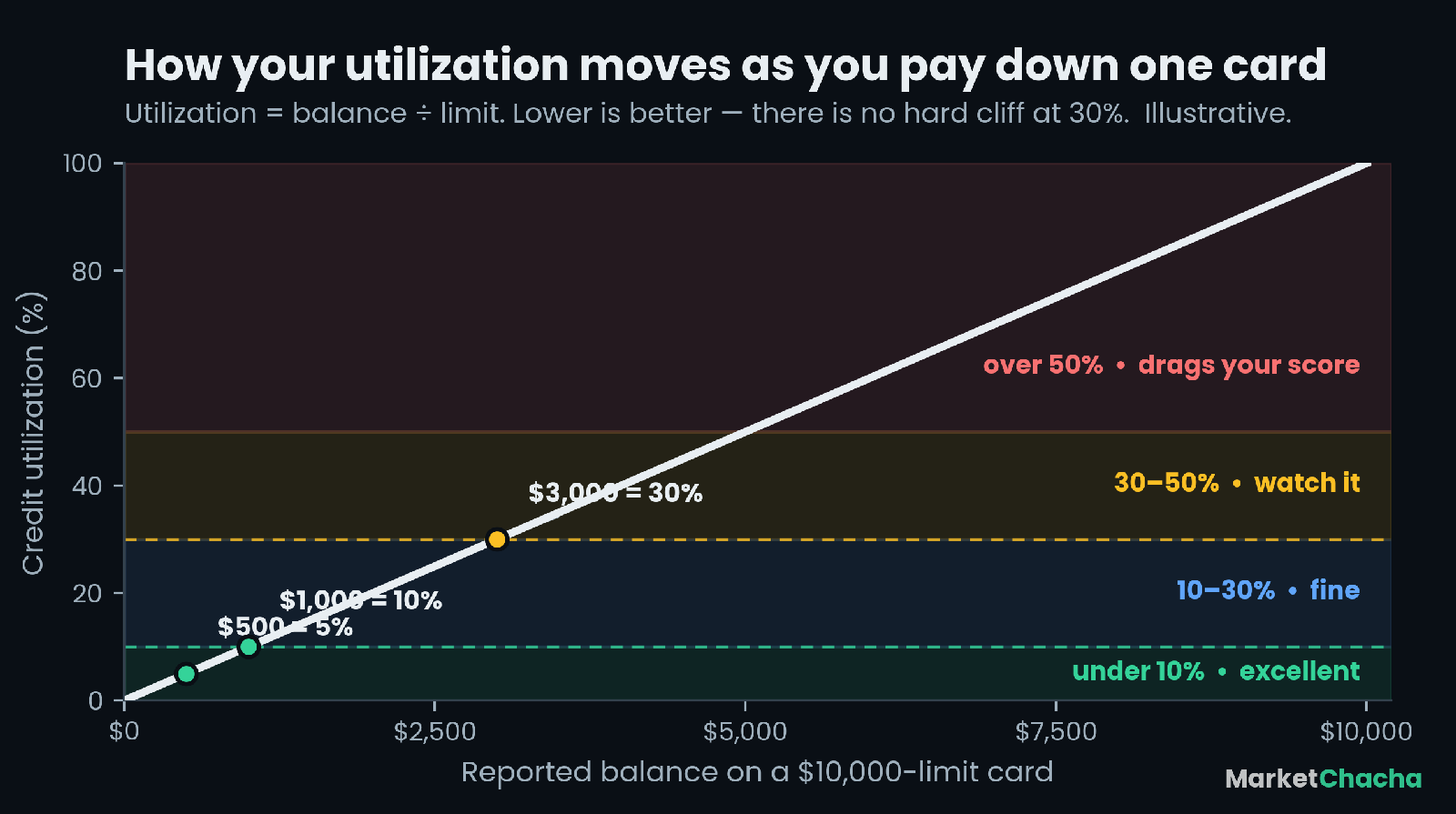
Say you have one card with a $10,000 limit and a $3,000 balance. Your utilization is 3,000 ÷ 10,000 = 30%. Pay it down to $1,000 and it drops to 1,000 ÷ 10,000 = 10%. Pay it to $500 and you are at 5%. Nothing else changed — same card, same limit — but the ratio the bureaus see fell sharply, and lower is better for your score.
The chart below shows how the reported ratio moves as the balance on that $10,000-limit card changes. Notice there is no magic cliff at exactly 30%: the ratio is a smooth line, and the widely repeated "keep it under 30%" figure is a rough guideline, not a pass/fail threshold. myFICO is explicit that "the 30% point doesn't determine who has good or bad credit," and that people with excellent credit typically sit well below it.
Per-card vs overall: why one maxed card still hurts
Here is the trap. Suppose you have two cards: Card A with a $10,000 limit and Card B with a $5,000 limit, for $15,000 of total credit. You owe $4,000 on Card A and $500 on Card B — a total of $4,500. Your overall utilization is 4,500 ÷ 15,000 = 30%, which sounds fine. But Card A on its own is at 4,000 ÷ 10,000 = 40%. FICO looks at that individual card too, so a single card running hot can weigh on your score even when your aggregate ratio looks healthy. The fix is to spread balances or, better, pay down the highest-ratio card first.
Which balance actually gets reported (the statement-date trick)
A common surprise: the balance that lands on your credit report is usually your statement balance — the figure on your bill when the billing cycle closes — not the balance on your payment due date, and not $0 just because you always pay in full. Your issuer typically reports to the bureaus once a month, around the statement closing date. That has a useful implication: if you make a payment before the statement closes, a smaller balance gets reported and your utilization looks lower. Paying after the statement closes still avoids interest (as long as you pay by the due date), but it does not change the number that was already reported that cycle. So if you want a lower utilization on your report — for example before applying for a loan — pay the card down a few days before its statement date, not just before the due date.
How to actually lower your utilization
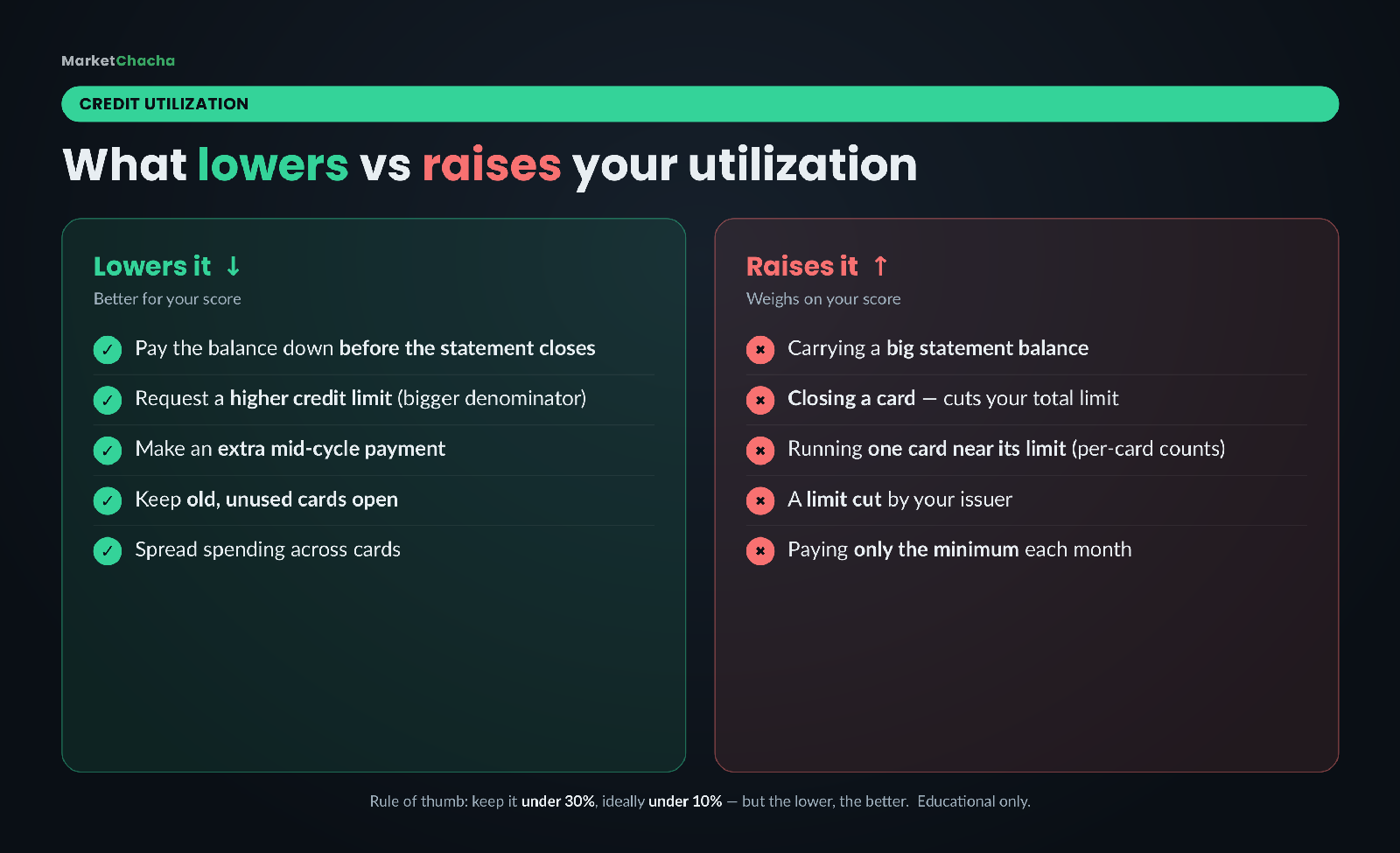
Four levers move the ratio, fastest first:
- Pay down the balance before the statement closes — the most direct lever, and it can show up on your report within a cycle.
- Ask for a credit-limit increase. Utilization is balance ÷ limit, so raising the denominator lowers the ratio even if you owe the same amount. Many issuers let you request this online; ask whether it triggers a "hard" credit inquiry first.
- Make an extra mid-cycle payment. If you charge a lot, paying twice a month keeps the reported balance down.
- Keep old cards open. Closing a card removes its limit from your total available credit, which can raise your overall utilization overnight even though you did nothing else.
The reference card below sums up what pushes your utilization down versus up.
The catch: "no memory," trended data, and the zero-balance trap
Classic FICO utilization has "no memory" — it reflects your most recently reported balances, so a bad month can be fixed the next month with no lingering penalty. That is genuinely reassuring. But two nuances matter. First, newer scoring models increasingly use trended data, looking at your balance pattern over roughly the last two years rather than a single snapshot, so a long habit of carrying high balances can still show through. Second, reporting 0% on every card is not the optimum: the model wants to see that you use credit responsibly, so a small reported balance (low single-digit utilization) can score marginally better than a flat zero. Experian has reported that people with top-tier scores average roughly 4–7% utilization, not 0%. The takeaway is not to chase zero — it is to keep the reported number low while still using your cards.
Common mistakes beginners make
- Treating 30% as a hard line. It is a guideline. Below 10% is better; the relationship is continuous, not a switch.
- Only watching overall utilization. One near-maxed card can drag your score even if your aggregate ratio is low.
- Paying just before the due date and expecting a lower reported ratio. The statement-closing balance is usually what gets reported.
- Closing an old card to "tidy up." It shrinks your total limit and can spike utilization.
- Confusing utilization with interest. Utilization affects your score; interest is charged only if you carry a balance past the due date. You can have low utilization and pay zero interest by paying in full.
How this works in India (CIBIL)
The mechanic is essentially the same for an Indian CIBIL score. Your credit utilisation ratio — total credit-card balances divided by total card limits — is one of the most heavily weighted factors, and lenders here also treat around 30% as the comfort zone, with lower being better. Indian issuers likewise report your balance to the bureaus (CIBIL, Experian, Equifax, CRIF High Mark) roughly once a month, so the same timing logic applies: pay down before your statement date to have a lower balance reported. Guidance from Indian lenders notes that after you lower a balance, the improvement typically shows in your CIBIL score within about 15–30 days, once the new figure is reported. Two India-specific tips: if you regularly bump against your limit, ask your bank for a limit enhancement, and if you are about to apply for a loan or a new card, get your utilisation down first, because a high ratio at application time is a common reason for rejection even when you have never missed a payment.
FAQ
What is a good credit utilization ratio? Below 30% is the common rule of thumb, but below 10% is better. There is no exact cutoff — generally, the lower your reported ratio, the better for your score, whether that is a FICO or a CIBIL score.
Does credit utilization reset every month? For the classic FICO model it effectively does — it reflects your latest reported balances, so a high month can be repaired the next month with no lasting penalty. Newer "trended data" models, however, look at your balance pattern over the past couple of years.
Should I keep my credit card balance at zero? Not necessarily. A flat 0% on every card shows no credit activity; a small reported balance (low single digits) can score slightly better. The goal is a low reported number, not literally zero.
Which balance do credit bureaus actually see? Usually your statement balance — the amount owed when the billing cycle closes — not the balance on your due date. Paying before the statement closes is what lowers the reported figure.
Will asking for a higher credit limit lower my utilization? Yes. Utilization is balance divided by limit, so a higher limit reduces the ratio even if your balance is unchanged — but check whether the request triggers a hard credit inquiry.
Does closing a credit card help my score? Often the opposite. Closing a card removes its limit from your total available credit, which can raise your overall utilization and may lower your score.
Educational content only — not investment, tax or financial advice, and not a recommendation of any product. Scoring models, rates and rules change, and impacts vary by individual credit profile — always check current terms and your own credit report. [Sources: myFICO, Experian, myFICO: 0% vs low utilization, Paisabazaar (India/CIBIL)]. Always do your own research.
This article is for educational and informational purposes only. It is not financial advice, investment recommendation, or a solicitation to buy or sell securities. Investing involves significant risks. I am not a SEBI-registered investment advisor. Readers should consult their own financial advisor and conduct their own research before making any investment decisions.
Comments
Join the conversation
Sign in to join the conversation.
Follow replies, add your view, and take part in the discussion.
Sign in to commentLoading comments...