

Why did Zee Entertainment fall ~6% today? A CBI FIR against its founder
Zee Entertainment fell again on a founder story — but the company itself isn't the one charged. That gap is the whole point, so let's do it properly.
What happened
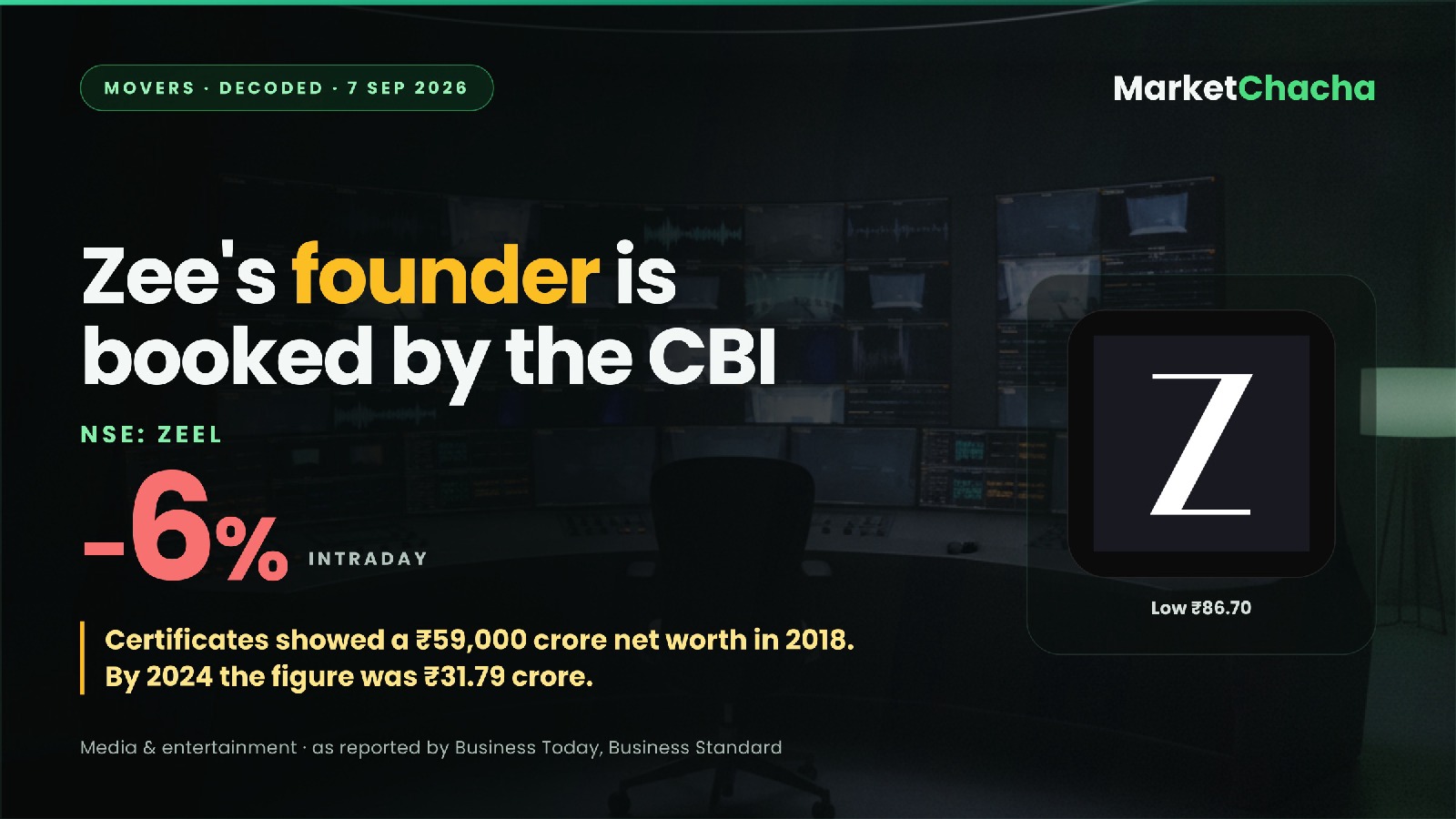
ZEEL dropped about 6% on Monday, touching a low of ₹86.70 and trading near ₹86, as reported by Business Today. The trigger was a CBI FIR against Subhash Chandra, Zee's founder and promoter, filed on 5 September.
Why it moved — the actual allegation
The FIR concerns loans from LIC Housing Finance, not anything on Zee's books. Per Business Standard, the CBI alleges Chandra inflated his personal net worth to get ₹980 crore of credit sanctioned across two facilities:
- ₹500 crore to Vasant Sagar Properties, with Pan India Infra Projects as co-borrower
- ₹480 crore to Digital Subscriber Management and Consultancy Services, with Spirit Infra Power and Multi Ventures as co-borrower
The numbers behind the "inflated" claim are what make this land. Net worth certificates submitted in 2018 showed Chandra worth ₹59,000 crore (28 March, by DIM & Co) and ₹40,562 crore (6 July, by MPJ & Co). By 2024, his claimed net worth was ₹31.79 crore. Both loans defaulted, and the FIR puts the alleged wrongful loss at over ₹1,322 crore. The CBI says Chandra acted "in collusion with the borrowers" to cheat the lender. Officers and directors of the four borrowing entities are also named.
These are allegations in an FIR. An FIR is the start of an investigation, not a finding of guilt, and nothing here has been tested in court.
So why does Zee's stock care?
Here's the part most headlines skip. Chandra's guarantees were for Essel Group infrastructure ventures — nothing to do with making or selling television. And promoter holding in ZEEL is just 3.99%, per Screener.in.
That last number matters more than it looks. Normally when a promoter is booked, the mechanical fear is pledged promoter shares being attached or dumped, flooding the market with supply. At a 3.99% stake there simply isn't much promoter stock left to attach — so this isn't a supply shock. It's a re-pricing of trust.
Zee's entire re-rating case rests on being seen as a professionally run broadcaster that has moved past its founder. Every headline that staples the Chandra name back onto the ticker pushes that day further away. And this arrives roughly five weeks after SEBI's action against the founder, so the market is now reading a pattern rather than an incident.
Is it expensive?
Zee looks cheap and expensive at the same time, and understanding why is genuinely useful. Screener.in shows a P/B of 0.72 — the stock trades nearly 30% below its book value of ₹122 — but a P/E of about 39.4, on a market cap of ₹8,272 crore.
Both are true because the assets barely earn. FY26 net profit was ₹271 crore on ₹8,099 crore of sales — a net margin near 3% — for an ROE of 2.4%. Screener also flags that earnings quality leans on other income. A stock below book value is only a bargain if the book actually produces something.
Compare Sun TV Network: P/E ~11.8, P/B 1.47, market cap ₹18,557 crore, and ₹1,441 crore of profit on ₹4,335 crore of sales at 12.2% ROE. Zee does roughly 1.9x Sun TV's revenue and earns under a fifth of the profit. Sun TV trades above book precisely because its book earns; Zee trades below book for the same reason in reverse. Not a call either way — just the honest frame.
The business
Zee is a broadcaster and content company: a bouquet of Hindi and regional entertainment channels, a movie business, music (Zee Music), and the ZEE5 streaming platform. Revenue is roughly two things — advertising and subscription — which means it's geared to the ad cycle and to how fast linear TV viewers migrate to streaming. Today's news touches none of that operationally.
Who this touches
- LIC Housing Finance is the complainant here, not the accused — this is an old defaulted exposure now getting a criminal case attached, which is a recovery step rather than a fresh hit
- Other Essel Group-linked entities, since the guarantees trace back to that group's infrastructure arms
- Zee's institutional shareholders, who own most of a company with a 4% promoter — governance headlines, not promoter selling, are the live risk
What to watch
Whether the CBI's scope stays with Chandra personally and the Essel borrowers, or reaches into anything ZEEL-related — so far it has not. A clear company statement separating itself from the FIR would help. If nothing new attaches to the listed entity, this is a sentiment hit on an operating business that didn't change today; if it does, the discount gets structural.
As of 7 Sep 2026, ~2:50 pm IST. Figures as reported by the sources cited, not live quotes. Allegations described are unproven. Sources: Business Today, Business Standard, Screener.in. For discussion and education only — not investment advice. Verify before acting.
This article is for educational and informational purposes only. It is not financial advice, investment recommendation, or a solicitation to buy or sell securities. Investing involves significant risks. I am not a SEBI-registered investment advisor. Readers should consult their own financial advisor and conduct their own research before making any investment decisions.
Comments
Join the conversation
Sign in to join the conversation.
Follow replies, add your view, and take part in the discussion.
Sign in to commentLoading comments...