

Actual cash value vs replacement cost: why is your insurance payout smaller than the damage?

The short answer: your insurance policy can price the same damage in two completely different ways. Replacement cost pays what it costs to repair or replace your property today with materials of like kind and quality. Actual cash value (ACV) pays that same amount minus depreciation for age and wear. Nothing about the fire, the storm or the burst pipe changes — only the settlement basis written into your policy changes — and on a single claim the gap between the two can run to five figures.
This article walks through what each term actually means, the arithmetic on a real-sized claim, how the two-payment replacement cost process works, how depreciation is argued over, the 80% rule that can quietly drop you back to ACV, and how the same idea shows up in Indian home and motor policies.
What actual cash value and replacement cost actually mean
The National Association of Insurance Commissioners (NAIC) puts it plainly. Under replacement cost, "your policy will pay the cost to repair or replace your damaged property using materials of like kind and quality." Under actual cash value, "your policy will pay the cost to repair or replace your home or personal property based on its value, considering its age and wear and tear (depreciation)" — and the NAIC warns that ACV "often does not pay enough to fully replace your property or repair the damage."
The North Carolina Department of Insurance uses the same distinction: ACV is "the amount of money needed to fix your home, minus the decrease in value of your property because of age or use," while replacement cost is "the amount of money needed to repair your home at today's prices of building supplies; or replace your belongings at today's cost of the similar or like item."
Note what is not being compared here: neither one is the market value of your house, and neither one is what you originally paid. Both start from the cost to put things back. ACV then subtracts wear; replacement cost does not.
A worked example: the $30,000 kitchen
Suppose a fire damages a kitchen. The adjuster agrees it will cost $30,000 to repair and refit it — that is the replacement cost of the loss. The kitchen is 6 years old, and for this example the adjuster applies straight-line depreciation over an assumed 20-year useful life, so 5% per year. Your deductible is $1,000.
- Depreciation: 6 years × 5% = 30% of $30,000 = $9,000
- Actual cash value of the loss: $30,000 − $9,000 = $21,000
- On an ACV policy: $21,000 − $1,000 deductible = $20,000 paid. You are $10,000 short of the money needed to actually rebuild the kitchen.
- On a replacement cost policy: $30,000 − $1,000 deductible = $29,000 paid — but not all at once. More on that below.
Same fire, same kitchen, same adjuster's estimate. A $9,000 difference, decided entirely by one line in the policy.
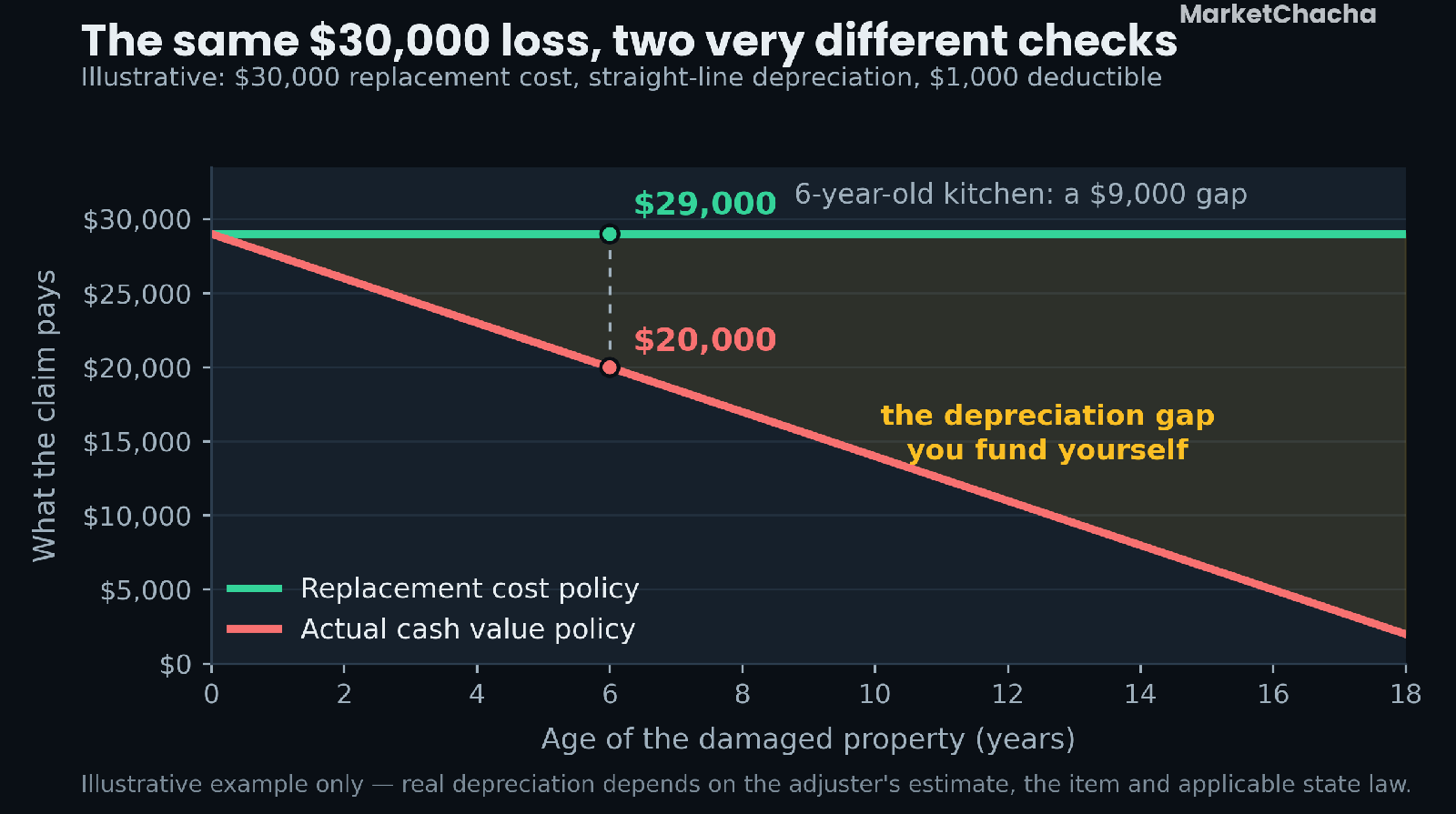
The chart shows why this stings more the older your property gets. A replacement cost payout does not care how old the kitchen is. An ACV payout falls every year, and the shaded gap between the two lines is money you have to find yourself.
How a replacement cost claim actually pays: the two-cheque process
Here is the part most people are surprised by. A replacement cost policy usually does not hand you the full amount up front. Insurers typically pay the actual cash value first and hold back the depreciation — often called recoverable depreciation — until the work is genuinely done.
The NC Department of Insurance describes the second step: "Once the item is repaired/replaced and receipt(s) submitted, the company will reimburse you the extra money you paid to replace/repair the item."
So in our example the sequence is:
- Cheque 1: ACV of $21,000 less the $1,000 deductible = $20,000
- You do the work and submit receipts showing you spent $30,000
- Cheque 2: the held-back depreciation of $9,000 is released
- Total received: $29,000 — the full $30,000 less your deductible
The practical consequence: if you never do the repair, or you do a cheaper version of it, you generally keep only the first cheque. Replacement cost coverage reimburses replacement — it does not simply pay you the higher number in cash. Exact timing rules, deadlines for completing the work, and what counts as proof vary by policy and by state, so read the loss settlement condition rather than assuming.
How depreciation is actually worked out — and why it is arguable
The straight-line calculation above is the textbook version, and it is a fair mental model: estimate a useful life, work out how much of it is used up, subtract that share. But it is not a universal legal rule, and this is where a lot of confident internet advice is simply wrong.
US courts calculate actual cash value using three different approaches: fair market value, replacement cost less depreciation, and the broad evidence rule. The broad evidence rule — which is followed by a majority of states, including New York and New Jersey — lets an adjuster or court weigh any relevant factor, including original cost, replacement value, market value, obsolescence, condition and location. As one industry commentary bluntly puts it, "nobody should assume Actual Cash Value equals Replacement Cost Value less Depreciation."
There is a second live dispute: whether labour can be depreciated as well as materials. Some states say no. California Insurance Code § 2051(b) restricts depreciation to "components of a structure that are normally subject to repair and replacement." Washington's rule, effective 1 January 2022, states that labour "is not a component of physical depreciation and may not be subject to depreciation or betterment." Vermont's insurance regulator has called depreciating labour an unfair claim settlement practice. Other courts have gone the other way. In short: how your depreciation is calculated depends on your policy wording and your state.
The practical takeaway is not to memorise a formula. It is that the depreciation figure on a claim is an estimate that can be questioned, and you are entitled to ask the adjuster to show how they built it.
The 80% rule: how you can have replacement cost coverage and still be paid ACV
You can buy replacement cost coverage and still not get it. Most homeowners policies require you to insure the dwelling for at least 80% of its full replacement cost at the time of the loss. Insurance industry guidance describes the condition this way: if the limit on the damaged home is 80% or more of full replacement cost, replacement cost valuation is used; if it fails that test, the loss is settled differently.
Importantly, the standard ISO homeowners wording is not a straight commercial-style penalty. It pays the greater of (a) the actual cash value of the damage, or (b) a proportional amount from the "did / should" calculation — the limit you carried divided by the limit you should have carried, times the loss — subject to your policy limit. Commercial property policies are harsher: they generally pay the lesser of the coinsurance result or the limit.
A worked example. Your home would cost $400,000 to rebuild today, so the 80% requirement is $320,000. You are still insured for $280,000 because you never updated the limit after construction costs rose. A storm causes $100,000 of damage, with $25,000 of depreciation, and your deductible is $2,000.
- Proportional amount: $280,000 ÷ $320,000 = 0.875, so 0.875 × $100,000 = $87,500
- Actual cash value of the damage: $100,000 − $25,000 = $75,000
- The policy pays the greater of the two: $87,500, less the $2,000 deductible = $85,500
- Out of pocket: $14,500 — a $12,500 valuation shortfall plus the $2,000 deductible
This is why rebuilding costs matter more than your home's market value, and why insurance-to-value is worth re-checking after a renovation or a stretch of construction-cost inflation. Note that the exact wording differs between insurers and policy forms, so treat 80% as the common benchmark rather than a law of nature.
Where you meet actual cash value without ever choosing it
Vehicle total losses. When a car is written off, the settlement is based on the vehicle's actual cash value, not what you paid or what you still owe. Washington's regulation is a good illustration of how tightly this is defined: an insurer "may settle a total loss claim by offering a cash settlement based on the actual cash value of a comparable motor vehicle, less any applicable deductible," and only a genuinely comparable vehicle may be used to set that value. Rules differ state by state, but the ACV principle is near-universal for total losses.
Contents. Many homeowners and renters policies insure the building at replacement cost but settle personal property at actual cash value unless a replacement cost endorsement is added. Whether yours does is a question for your declarations page, not for a general article.
Roofs. Some insurers, in some states, apply an ACV schedule specifically to roof coverage once the roof passes a certain age — even when the rest of the dwelling is on replacement cost. This is insurer- and state-specific, and it is one of the more expensive surprises in a hail claim.
What it costs you — and the catch
Replacement cost coverage costs more in premium. That is the honest trade-off, and for someone on a tight budget it is a real one. But there are three catches worth understanding before deciding either way:
- The cash-flow catch. Even with replacement cost coverage, the first cheque is the depreciated amount. You may need to fund the gap yourself, or arrange contractor billing around it, before the second cheque arrives.
- The "you must actually replace it" catch. The held-back depreciation is only released against proof of replacement. Choosing to bank the money instead usually means forfeiting it.
- The deductible always applies. Both settlement bases sit on top of your deductible — it is not an alternative to depreciation, it is an additional subtraction.
How to actually check which one you have
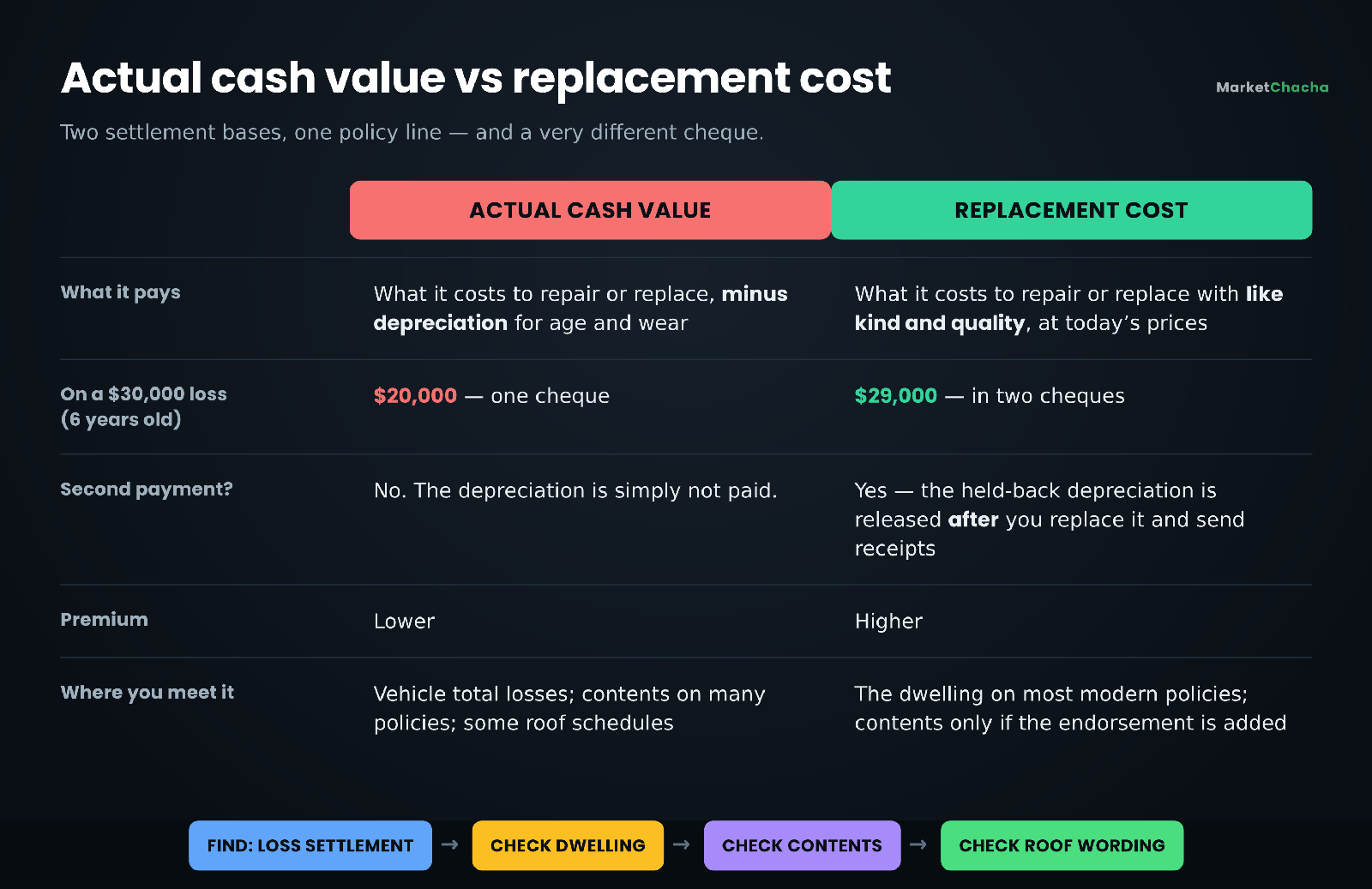
- Open your declarations page — the summary at the front of your policy, not the marketing brochure.
- Look for the words "loss settlement." That is the clause that names the basis. It will say replacement cost, actual cash value, or something like "functional replacement cost."
- Check the dwelling and personal property separately. They are frequently on different bases in the same policy.
- Check for a roof endorsement or roof schedule if you own the building.
- Check your dwelling limit against current rebuilding costs, not the market value or your mortgage balance, and see whether you still clear the 80% test.
- Ask your insurer or agent to confirm in writing what the second payment requires and how long you have to complete the work.
Common mistakes beginners make
- Insuring for market value. Land does not burn. Rebuilding cost and market value are different numbers, and in some places they are wildly different.
- Assuming "replacement cost" means one big cheque. It usually does not — it means two, and the second one is conditional.
- Assuming contents follow the building. They often do not.
- Never revisiting the limit. A limit set years ago can quietly fall below the 80% threshold after renovations or a jump in construction costs.
- Accepting the depreciation figure as fixed. It is an estimate. You can ask how it was calculated, and in several states parts of it — such as depreciated labour — may not be permitted at all.
- Choosing ACV purely on premium without doing the maths on what a realistic claim would leave you to fund.
How this works in India
The same underlying question — do you get "new for old," or "old for old"? — runs through Indian policies too, but the answers are structured differently.
Home insurance. Since 2021 the IRDAI has mandated a standard home policy, Bharat Griha Raksha, sold by every general insurer with identical core wording. Two features matter here. First, the sum insured for the home building is fixed as the carpet area of the structure in square metres multiplied by the rate of cost of construction that you declare and the insurer accepts — explicitly the cost of construction, not the market value of the flat. Second, and unusually generous by global standards, underinsurance does not apply. New India Assurance's policy documentation states that "if your Sum Insured calculated on the basis of the information that you have provided us is less than the actual value at risk, the difference will not affect the amount we pay." There is no Indian equivalent of the 80% rule biting you on a partial loss under this policy. General contents are automatically covered at 20% of the building sum insured, capped at ₹10 lakh, where both covers are taken.
Motor insurance. This is where Indian policyholders meet actual cash value head-on, under a different name: Insured Declared Value (IDV). For a total loss or constructive total loss, the payout is capped at the IDV, and the IDV itself is the manufacturer's listed selling price reduced by a fixed depreciation schedule based on the vehicle's age. The schedule, as published in Indian motor policy wordings, runs: not exceeding 6 months — 5%; over 6 months to 1 year — 15%; 1 to 2 years — 20%; 2 to 3 years — 30%; 3 to 4 years — 40%; 4 to 5 years — 50%. Beyond 5 years, or for discontinued models, the IDV is set by mutual agreement between insurer and insured. That is a depreciation grid doing exactly what an American adjuster's ACV calculation does — only fixed in advance rather than argued after the event.
Depreciation on repairs. Separately from IDV, Indian motor policies normally apply depreciation to the cost of replaced parts on a repair claim, with the rate depending on the material of the part and the age of the vehicle. Add-on covers marketed as "zero depreciation" or "nil depreciation" exist precisely to remove that deduction, at extra premium and usually with limits on the vehicle's age and the number of claims. The mechanic is the same trade-off as the American replacement-cost-versus-ACV choice: you pay more up front to avoid a depreciation subtraction later. Terms differ by insurer, so read the specific add-on wording rather than the advertisement.
FAQ
What is the difference between actual cash value and replacement cost in simple terms? Replacement cost pays what it costs to repair or replace your property today with something of like kind and quality. Actual cash value pays that amount minus depreciation for age and wear, so the payout shrinks as the property gets older.
Why did my insurance company only pay part of my claim? The three usual reasons are your deductible, a depreciation deduction because the settlement basis is actual cash value, and — on a replacement cost policy — the fact that the first payment deliberately holds back the depreciation until you complete the work and send receipts.
What is recoverable depreciation and how do I get it? It is the depreciation the insurer withheld from the first cheque on a replacement cost claim. You generally recover it by actually repairing or replacing the property and submitting receipts, within the deadline your policy sets.
Is replacement cost coverage worth the extra premium? That depends on the age of your property, the size of a realistic loss and whether you could fund a five-figure gap yourself. The useful exercise is not to ask which is "better" but to price out what an ACV settlement on your own home would actually leave you short by, then compare that to the premium difference.
What is the 80% rule in home insurance? Most homeowners policies require the dwelling to be insured for at least 80% of its full replacement cost at the time of loss. Fall below it and the policy typically pays the greater of the actual cash value of the damage or a proportional share based on the limit you carried versus the limit you should have carried — either way, less than the full repair cost.
Does actual cash value mean the same thing everywhere? No. In the US, courts use three different approaches — fair market value, replacement cost less depreciation, and the broad evidence rule — and states differ on whether labour can be depreciated at all. In India the closest equivalent for vehicles is the Insured Declared Value, which uses a fixed age-based depreciation schedule.
Educational content only — not investment, tax or insurance advice, and not a recommendation of any product. Rates, fees and rules change — always check current terms with the provider. Figures in the worked examples are illustrative. [Sources: NAIC, North Carolina Department of Insurance, IRMI, IRMI on labour depreciation, Washington WAC 284-30-391, Property Insurance Coverage Law Blog, New India Assurance — Bharat Griha Raksha, Tata AIG Bharat Griha Raksha FAQ, IDV depreciation schedule. Accessed August 2026.] Always do your own research.
This article is for educational and informational purposes only. It is not financial advice, investment recommendation, or a solicitation to buy or sell securities. Investing involves significant risks. I am not a SEBI-registered investment advisor. Readers should consult their own financial advisor and conduct their own research before making any investment decisions.
Comments
Join the conversation
Sign in to join the conversation.
Follow replies, add your view, and take part in the discussion.
Sign in to commentLoading comments...