

Why did Tata Elxsi hit a 52-week low even though Q1 profit rose 18%?
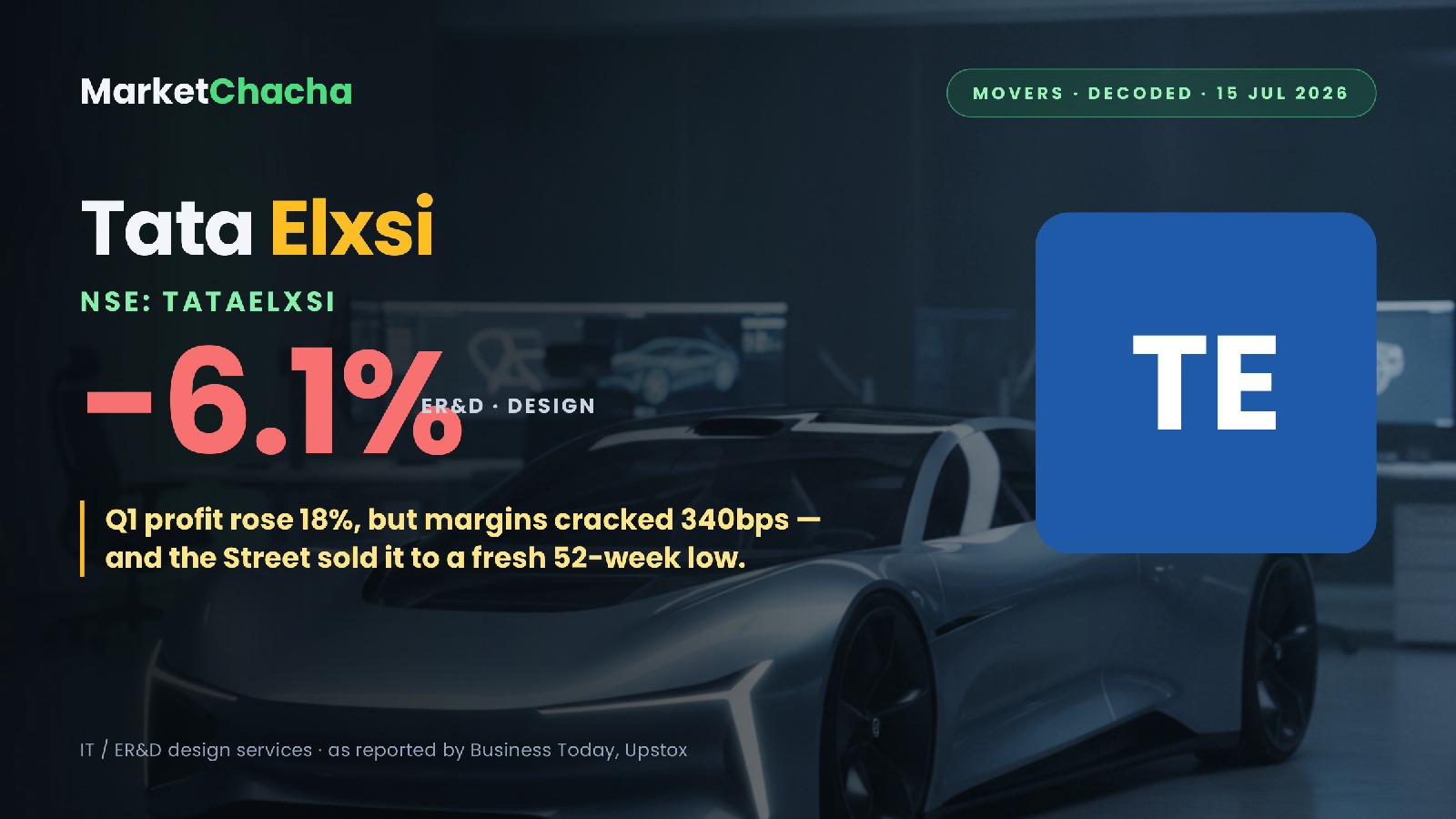
Tata Elxsi just did something odd: it grew profit, and the stock got clobbered for it. Shares fell about 6% on Wednesday to a fresh 52-week low — down to roughly ₹3,470 from the previous close near ₹3,697, as reported by Business Today and Upstox. The headline numbers looked fine. The detail underneath is what spooked people.
What happened
For Q1 FY27 (the June quarter), Tata Elxsi crossed a milestone: revenue topped ₹1,000 crore for the first time, coming in at ₹1,021 crore — up 14.5% year-on-year and 2.8% over the prior quarter. Net profit was ₹170.6 crore, up 18.2% from a year ago. So far, so good. But profit actually fell about 23% versus the previous quarter, and that's the number the market fixated on.
Why it moved
The real trigger was profitability. Operating margin (EBITDA margin — roughly, how much of each rupee of revenue is left after running costs) slipped to 21.2%, down a steep 340 basis points — 3.4 percentage points — in a single quarter. Management pinned it on a pile-up of costs: ramp-up and transition spend on a large new deal, more onsite delivery (hiring subcontractors abroad, which is expensive), talent investment, some customer-related provisions, and one-off annual costs. Some of that is genuinely one-time. But when a "premium" stock misses on margin, the market rarely waits to find out.
Brokerages weren't kind. Kotak Institutional Equities stayed a seller with a target of ₹3,000, flagging weak auto demand and cutting FY27-29 earnings estimates by 10-14%. JPMorgan was neutral at ₹3,500 — barely above where the stock already trades. (Targets are analysts' views, not ours.)
The business
This matters because Tata Elxsi isn't a plain IT-services shop — it's an engineering R&D (ER&D) and design company that builds tech for other companies' products. Its three engines: Transportation (its biggest — autonomous, EV and connected-car software), Media & Communications (OTT, broadcast, telecom), and Healthcare & Life Sciences (medical devices, pharma), plus an industrial design studio. This quarter Media grew nicely (~11.5% constant-currency), while auto and healthcare dragged. So today's wobble isn't one stray project — margin pressure and soft auto demand touch the whole company.
Is it expensive?
Even after a brutal year — the stock is down roughly 41% over 12 months and about 36% in six months — it isn't cheap. Tata Elxsi trades at a trailing P/E near 36-37x on a market cap of about ₹23,000 crore. That's below its own 10-year median of ~45x, so it's cheaper than its own history — but still the priciest name in its peer group. Compare: LTTS ~27-28x, KPIT Technologies ~24-27x, and Cyient ~20-23x (P/Es as reported by Screener, GuruFocus and Yahoo Finance). In plain terms, a high-30s P/E still bakes in a healthy recovery. If growth and margins don't bounce back, that premium has further to fall.
Who feels the read-across:
- Other ER&D names — LTTS, KPIT, Cyient, Tata Technologies. Weak auto R&D spend is a sector story, not just a Tata Elxsi one.
- The auto-tech cycle — global carmakers trimming or delaying software and design budgets ripple straight into these order books.
- Long-term holders — a former market darling sitting at a 52-week low is a gut-check on how much you pay for "quality".
What to watch
One thing flips this story: margins. If the cost hit really was one-off — deal-transition and ramp-up spend rolling off — and auto clients start spending again, margins snap back toward the mid-20s and a de-rated stock can re-rate fast. If auto weakness lingers, expect more estimate cuts. The next two quarters of margin prints are the whole ballgame.
As of ~2:20 PM IST, 15 Jul 2026. Sources: Business Today, Upstox, Tata Elxsi Q1 FY27 release, Screener. For discussion and education only — not investment advice. Verify before acting.
This article is for educational and informational purposes only. It is not financial advice, investment recommendation, or a solicitation to buy or sell securities. Investing involves significant risks. I am not a SEBI-registered investment advisor. Readers should consult their own financial advisor and conduct their own research before making any investment decisions.
Comments
Join the conversation
Sign in to join the conversation.
Follow replies, add your view, and take part in the discussion.
Sign in to commentLoading comments...