

Texas Instruments 8-K: dividend up 7% to $1.52 a share — what it means
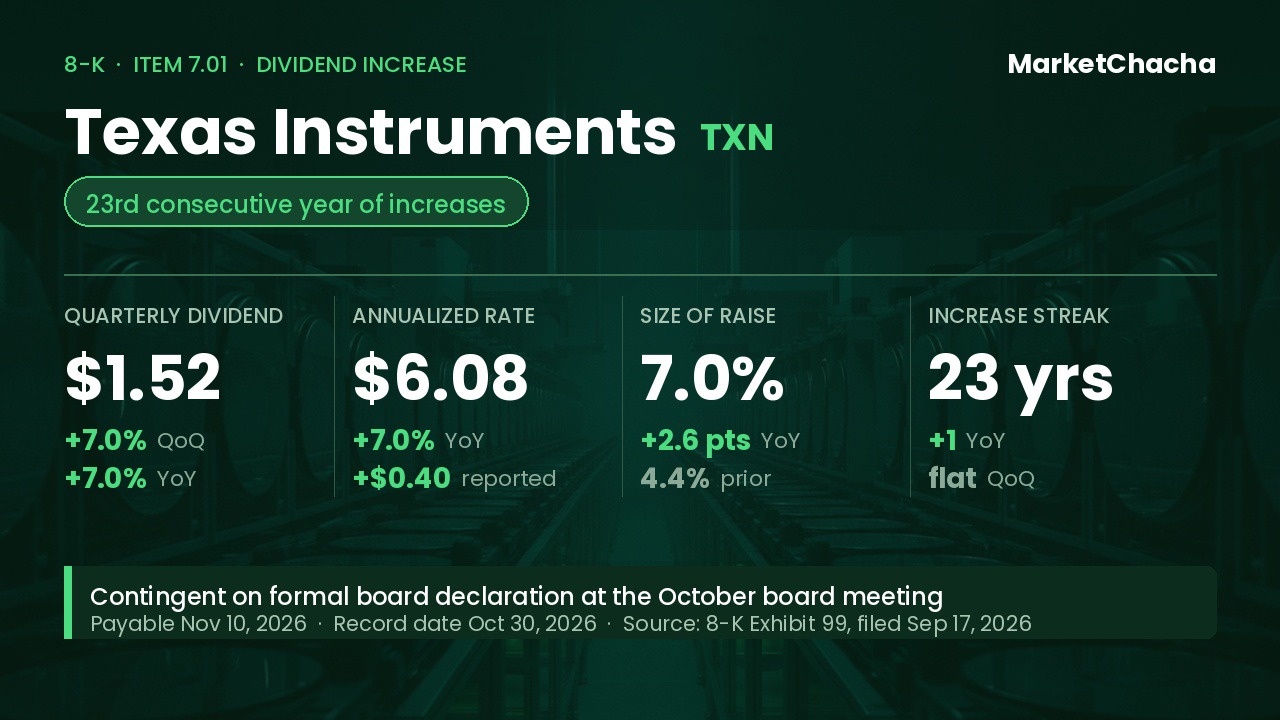
Texas Instruments filed an 8-K after the close on September 17, 2026 disclosing that it will raise its quarterly cash dividend 7%, from $1.42 to $1.52 a share — $6.08 annualised, and its 23rd consecutive year of increases. It was filed under Item 7.01, not the earnings item, which tells you something about what this document is.
The numbers
- New quarterly dividend: $1.52 per share, up from $1.42 — a 7.0% increase.
- Annualised rate: $6.08 per share, up from $5.68.
- Dates: payable November 10, 2026 to holders of record on October 30, 2026.
- The catch: "contingent upon formal declaration by the board of directors at its regular meeting in October." Announced now, legally declared later.
- Streak: 23 straight years. TI's dividend history shows the rate was $1.36 a year ago, so last year's raise was about 4.4% — this one is bigger.
What was filed — and why Item 7.01 matters
An 8-K is the "something happened" form: filed between quarterly reports when an event is material enough that investors should not wait for the 10-Q. Each one carries an item number identifying the type of event.
Item 7.01 is Regulation FD Disclosure. Reg FD is the rule against selective disclosure — a company may not give material information to favoured analysts or large holders before the public. So when a press release contains market-moving content, it goes out under 7.01 to make the disclosure simultaneous and universal.
One wrinkle worth knowing: material under Item 7.01 is furnished, not filed. Furnished material carries a lower liability standard under Section 18 of the Exchange Act and is not automatically pulled into registration statements. That is why earnings releases (Item 2.02) and Reg FD releases are usually furnished, while a signed acquisition agreement (Item 1.01) is filed. It is a legal distinction, not a signal about how seriously to take the content.
Why it matters
A dividend raise is one of the few forward-looking statements a board makes without calling it guidance. Cuts are punished severely, so boards raise only when they believe the higher rate survives a downturn. The size of the raise is a rough read on management's confidence.
The context is cash generation. In Q2 2026 TI reported revenue of $5.463 billion, up 23% year on year, with diluted EPS of $2.14 against $1.41. More relevant to a dividend decision: trailing-twelve-month free cash flow was $6.534 billion against $1.763 billion a year earlier, on trailing capex of $3.312 billion. TI's stated policy is to return all free cash flow to owners over time, and over those twelve months it returned $5.819 billion — $5.112 billion in dividends, $707 million in buybacks.
That explains both the raise and its restraint. Dividends alone already absorb roughly four-fifths of trailing free cash flow, capping how aggressive a raise can be while TI funds a heavy fab build-out. A 7% increase says the analog cycle has turned enough to commit to a permanently higher payout without crowding out capex. It also resets the floor: $6.08 is the baseline the board must defend in the next downturn. Analog chips are cyclical — TI's own filing lists customer inventory adjustments and trade policy among the risks.
Beginner takeaway
A dividend increase in an 8-K is a commitment, not a forecast, and the item number tells you what kind of disclosure you are reading. Check what funds it — free cash flow, not reported profit — and what share of that cash is already spoken for. A raise that consumes nearly all of a company's cash is a different signal from one with room to spare.
FAQ
Does a 7% dividend increase mean the stock is a good buy? No. It tells you about the board's confidence in future cash generation, not whether the share price already reflects that. Those are separate questions.
Why announce in September if the board only declares in October? Reg FD requires broad, simultaneous disclosure once the information exists. Sitting on a market-moving intention while a few people know it is the selective-disclosure problem the rule exists to prevent.
What is the difference between "furnished" and "filed"? Filed material carries full Exchange Act liability and can be incorporated into registration statements automatically; furnished material — typically Items 2.02 and 7.01 — carries a lower standard. Both are public, and both matter.
See the movers page for the day's moves and the calendar for what is next. Related decodes: Salesforce's $25B buyback, Uber's debut €4.5B euro bond, and Oracle's cancelled 50M-share sale plan.
As of September 17, 2026. Source: official SEC filing — read it directly here. We summarise filings for education and may make errors, so always verify against the official document. Educational content only — not investment advice, not a buy/sell recommendation.
This article is for educational and informational purposes only. It is not financial advice, investment recommendation, or a solicitation to buy or sell securities. Investing involves significant risks. I am not a SEBI-registered investment advisor. Readers should consult their own financial advisor and conduct their own research before making any investment decisions.
Comments
Join the conversation
Sign in to join the conversation.
Follow replies, add your view, and take part in the discussion.
Sign in to commentLoading comments...