

Salesforce 8-K: a $25B buyback and a $63B FY30 target — what it means
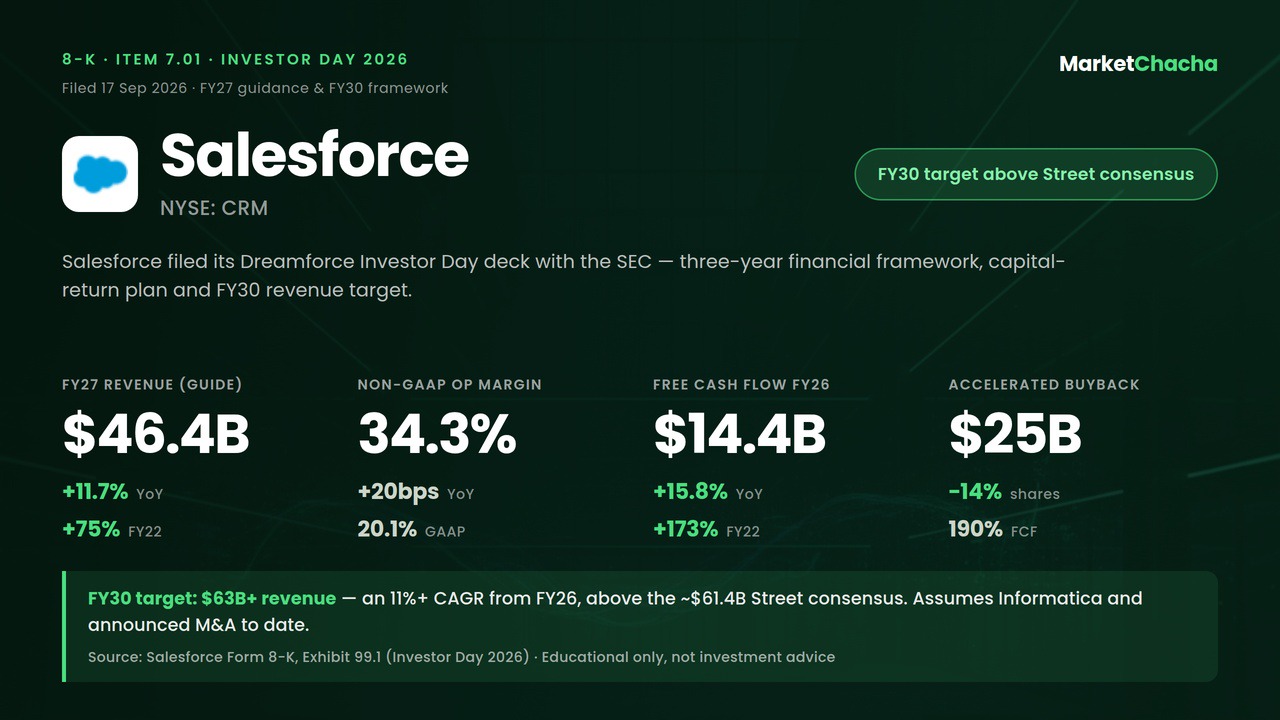
Salesforce filed an 8-K on 17 September 2026 attaching the investor presentation it used at its Investor Day at Dreamforce. The deck sets out a $63B+ FY30 revenue target and the largest accelerated share repurchase the company has ever done — $25 billion.
The numbers in the deck
- FY27 revenue guidance: $46.1–$46.4B, against FY26 revenue of $41.5B — about +11.7% at the top of the range.
- FY30 target: $63B+, an 11%+ CAGR from FY26. The deck footnotes this as of May 2026 and says it includes Informatica and other announced M&A.
- Non-GAAP operating margin: 34.3% guided for FY27 versus 34.1% in FY26 and 18.7% in FY22 — 1,560bps of expansion since FY22, per the deck.
- GAAP operating margin: 20.1% guided. The 14-point gap is mostly stock-based compensation (9.0% of revenue) and amortisation of purchased intangibles (4.4%).
- Free cash flow: $14.4B in FY26, up from $12.4B in FY25 and $5.3B in FY22.
- Capital returns: a $25B ASR at an expected average share price of $182, an expected 14% share count reduction, and 190% of FY27 free cash flow returned. Cumulative returns to date: $60B+.
What was filed, and what Item 7.01 means
An 8-K is the "something happened" form — filed between quarterly reports when an event matters enough that investors should not have to wait. Numbered items say what kind of event it was.
Item 7.01 is Regulation FD Disclosure. Reg FD is the rule that stops a company handing market-moving information to analysts or large investors privately. Present new targets to a room of investors and the same material has to reach everyone — filing the deck as an 8-K exhibit is how that happens.
One nuance worth learning: Item 7.01 material is furnished, not filed, and Salesforce says so explicitly here. Furnished material carries a lighter liability standard and is not automatically pulled into registration statements. That is routine for decks full of forward-looking projections — but it is a reason to weigh investor-day targets differently from audited 10-K numbers. The same logic shows up in Uber's 8-K on its debut euro bond.
Why it matters
Two things here do real work. The first is the FY30 target: press coverage put Wall Street's FY30 consensus near $61.4B, so $63B+ sits above it. It also speaks to the central bear argument on Salesforce — that AI agents shrink the number of human seats a company needs, and Salesforce has historically sold by the seat. The deck's answer is consumption: Agentforce usage, Data 360 and premium editions pitched as monetisation that can grow even when seat counts do not.
The second is the buyback. An accelerated share repurchase is not a normal open-market programme. The company pays a bank a lump sum up front, the bank delivers most of the shares immediately by borrowing them, and the final count is trued up later against the average price — which is why a 14% share count reduction can be guided in advance.
The counterweights matter. Returning 190% of free cash flow means paying out roughly twice what the business generates this year, drawing on the balance sheet — not a run-rate. And while the margin story looks dramatic from an FY22 base, FY27 is guided to expand only about 20bps year over year: the easy expansion is behind them. Targets in a furnished deck are projections, not commitments.
Beginner takeaway
An investor-day 8-K is one of the densest documents a company files, because it shows the multi-year model rather than a single quarter. Read the footnotes — the ones here date the FY30 target to May 2026 and confirm it assumes already-announced M&A. And always find the GAAP number next to the non-GAAP one; the gap tells you what management is asking you to look past. Our Salesforce Q2 FY27 decode covers the quarter these targets build on, and upcoming reporting dates sit on the events calendar.
FAQ
Is an investor-day 8-K the same as an earnings report? No. Earnings arrive under Item 2.02 with a results release. This is Item 7.01 — strategy and targets, with no new quarterly results attached.
What does "furnished, not filed" actually change? It lowers the liability standard attaching to the document and keeps it out of registration statements by default. The information is still public and still Reg FD-compliant.
Why does a share count reduction matter? Earnings per share is profit divided by shares outstanding, so fewer shares means each one represents a larger claim on the same profit — though the cash spent buying them is cash not spent elsewhere. Our balance-sheet guide covers where that cash sits.
As of 17 September 2026. Source: official SEC filing — read it directly here. We summarise filings for education and may make errors, so always verify against the official document. Educational content only — not investment advice, not a buy/sell recommendation.
This article is for educational and informational purposes only. It is not financial advice, investment recommendation, or a solicitation to buy or sell securities. Investing involves significant risks. I am not a SEBI-registered investment advisor. Readers should consult their own financial advisor and conduct their own research before making any investment decisions.
Comments
Join the conversation
Sign in to join the conversation.
Follow replies, add your view, and take part in the discussion.
Sign in to commentLoading comments...