

MobiKwik's UPI filing: NPCI's 0.4% MDR above ₹2,000 — what it means
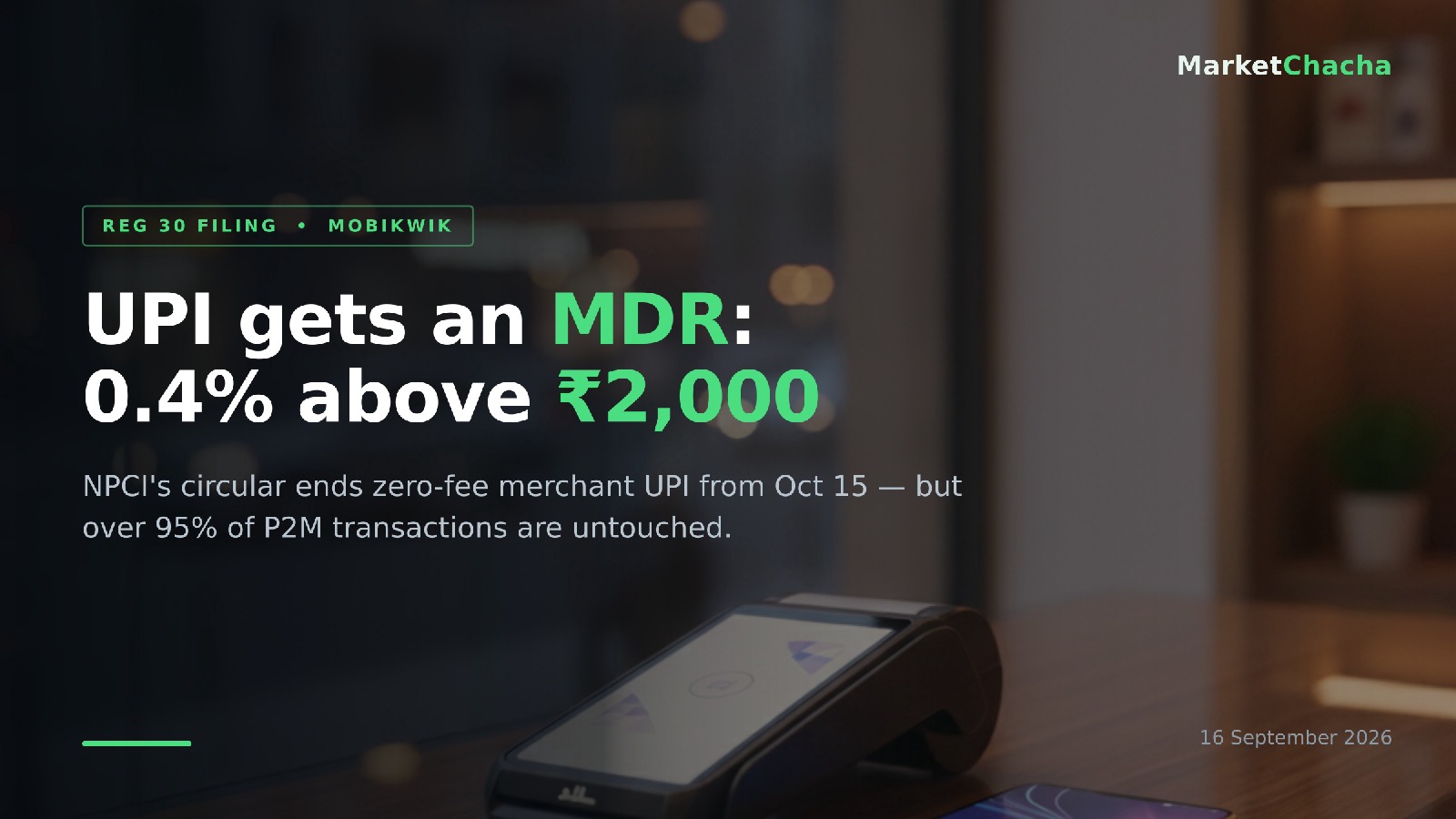
MobiKwik filed a Regulation 30 disclosure with BSE and NSE this morning: UPI is no longer free for merchants. NPCI has introduced a Merchant Discount Rate of up to 0.4% on person-to-merchant payments above ₹2,000, effective 15 October 2026 — and MobiKwik says transactions that previously earned it nothing will now generate revenue.
What was announced
The filing cites NPCI circular NPCI/UPI/OC-No.237/2026-27 of 15 September 2026. As reported:
- 0.4% MDR on UPI P2M transactions above ₹2,000, capped at ₹300 per transaction.
- Merchants pay it, not you. The filing is explicit: "The Circular does not permit any charge on customers, so UPI payments remain free for users."
- Exempt: all person-to-person transfers, any P2M payment of ₹2,000 or less, and small vendors under P2PM (up to ₹1 lakh a month).
- Flat ₹5 instead of 0.4% for categories such as railways, telecom, insurance and fuel; 0.02% for capital-market transactions.
- Roughly ₹700 crore a year reportedly funds payments infrastructure in smaller towns and the northeast.
MobiKwik names two revenue routes: as a Third-Party Application Provider, on the P2M share of its consumer UPI volume; as an acquirer, on merchant volume it processes directly.
What "MDR" and a Regulation 30 filing mean
A Merchant Discount Rate is the cut a merchant pays out of each digital transaction, split between bank, payment rail and app. You already pay it invisibly on every card swipe — it funds credit-card cashback, as covered in how credit card rewards actually work. UPI was deliberately built with zero MDR from 2020 to drive adoption, making it enormous and structurally unprofitable to process. This partially reverses that.
Regulation 30 of SEBI's LODR rules requires prompt disclosure of anything price-sensitive. Note what this filing is not: MobiKwik won nothing and decided nothing. It discloses a regulatory change made by someone else — sector-wide news one company happened to file.
Why it matters — and why the stock still fell
The circular is revenue-positive for payment apps, yet on 15 September Paytm fell about 4% to ₹1,731.10 and MobiKwik about 4.29% to ₹200, per Business Today.
Two reasons. First, the ₹2,000 threshold is high relative to how Indians use UPI: more than 95% of P2M transactions fall below it, so the fee touches a thin slice of volume. Second, fintech shares had already run up on expectations of an MDR returning, and the detail arrived narrower than hoped. Good news plus a falling stock is no contradiction — markets price expectations, not headlines.
The open question — unsettled in this circular — is how the 0.4% is split between bank, app and acquirer. Track the reaction on the movers page.
Valuation, as reported
MobiKwik: market cap about ₹1,614 crore, price-to-book 3.0x on book value of ₹68.4, trailing P/E near 549 — a figure reflecting a barely-positive trailing profit, not real earnings, since FY26 closed with revenue of ₹1,119 crore and a net loss of ₹62 crore. 52-week range ₹326–₹151; listed December 2024, so no five-year multiple range exists yet.
Named peer Paytm is far larger: market cap roughly ₹1,11,069 crore, P/E near 137, price-to-book 6.96x, FY26 revenue ₹8,437 crore, profit ₹552 crore, 52-week range ₹1,840–₹931. Both spent most of their listed lives loss-making, so a long-run P/E band is largely meaningless for either. Figures per Screener.in — descriptions, not verdicts.
The business
MobiKwik runs a two-sided payments network — roughly 161 million registered users, about 4.26 million merchants — with digital credit, investment and insurance sold on top. Because payments are the whole company, not one division, this hits essentially all of it, unlike a diversified group where one filing touches a single slice. Same broadly for Paytm, broken down in the full Paytm file; MobiKwik's first profitable quarter is here.
Beginner takeaway
Nothing changes for you as a shopper: consumers are explicitly protected and UPI stays free. What changed is that the pipes carrying UPI finally earn a fee on large merchant payments, making them less loss-making to run. Whether that becomes real profit depends on the bank-versus-app split.
FAQ
Will I be charged for paying by UPI now? No. The circular does not permit charging customers, and P2P transfers are fully exempt. The merchant bears the 0.4%.
Does this apply to my ₹150 chai payment? No. Only merchant payments above ₹2,000 qualify — more than 95% of UPI merchant transactions fall below that line.
Why would a payment company's shares fall on news it will earn more? The expectation was already in the price. Markets move on the gap between what was hoped and what arrived — and this framework was narrower than many assumed.
As of 16 September 2026. Source: official BSE/NSE filing — read it directly here. We summarise filings for education and may make errors, so always verify against the official document. Educational content only — not investment advice, not a buy/sell recommendation.
This article is for educational and informational purposes only. It is not financial advice, investment recommendation, or a solicitation to buy or sell securities. Investing involves significant risks. I am not a SEBI-registered investment advisor. Readers should consult their own financial advisor and conduct their own research before making any investment decisions.
Comments
Join the conversation
Sign in to join the conversation.
Follow replies, add your view, and take part in the discussion.
Sign in to commentLoading comments...