

Why was my insurance claim denied — and how do you actually appeal it?
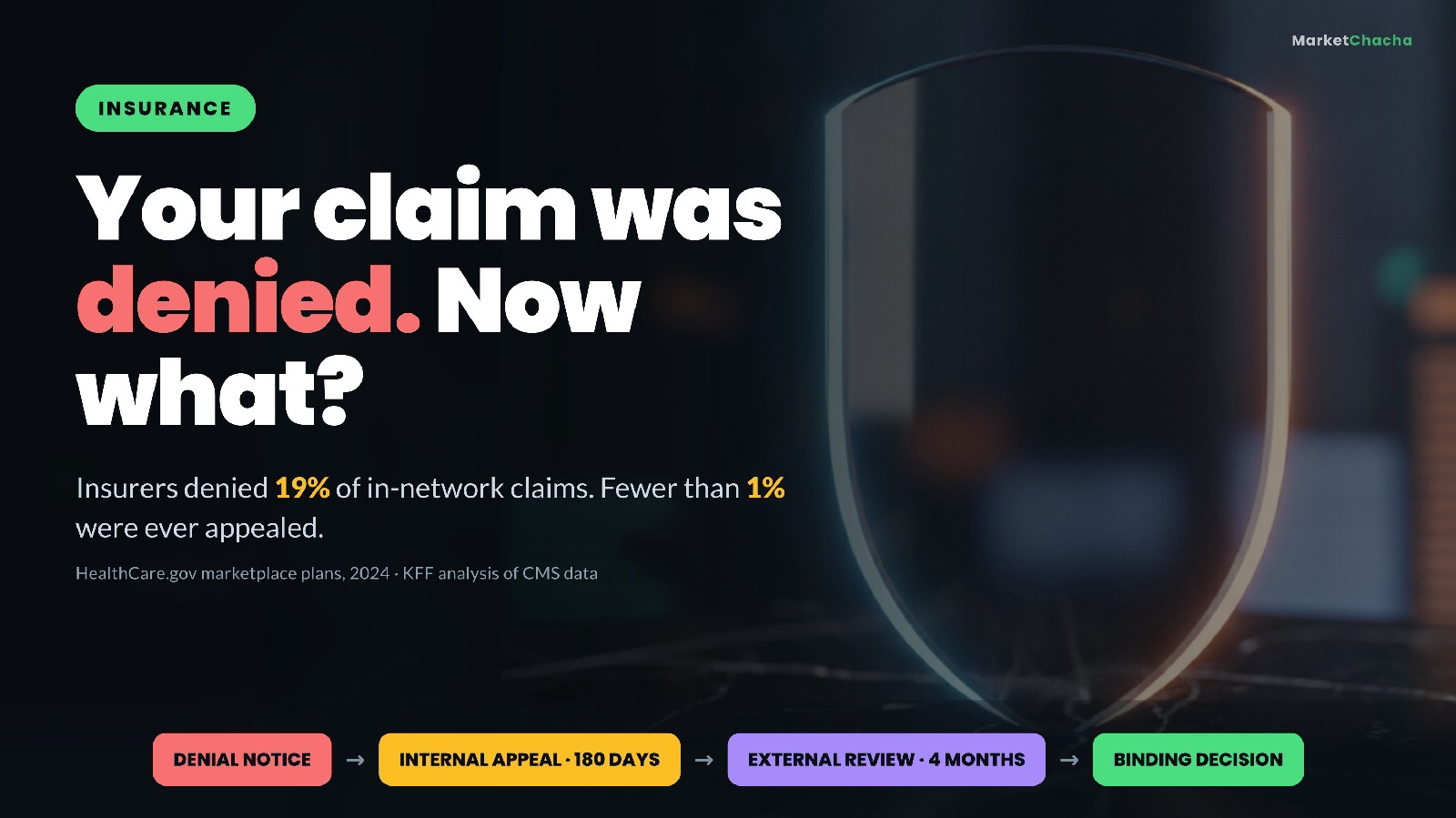
The short answer: a denied claim is not a final bill. It is a decision — an "adverse benefit determination" — that your insurer made about one specific claim, and federal law gives you a formal, deadline-bound right to challenge it: first an internal appeal at the insurer, then an external review by an independent reviewer whose decision the insurer must accept. Most denials are never contested. Of roughly 85 million in-network claims denied by HealthCare.gov marketplace plans in 2024, consumers appealed fewer than 1% — and where they did appeal, about a third of denials were overturned (KFF analysis of CMS Transparency in Coverage data, 2024).
This article covers what a denial actually is, the reasons claims really get denied, the arithmetic of what a denial costs you, the exact deadlines, how to appeal step by step, and how the equivalent process works in India.
What a denial actually is — and what it is not
A denial is your plan saying: for this claim, we are not paying. It is not a statement that the treatment was wrong, and it is very often not a statement about your coverage at all. A large share of denials are clerical — a wrong procedure code, a missing referral, the claim sent to the wrong payer, a date-of-service typo.
Two things get confused here. A denial means the plan paid nothing (or less than expected) on that claim. Cost-sharing — your deductible, copay and coinsurance — is what you owe on a claim the plan did approve. If you are not sure which one you are looking at, the deductible, copay, coinsurance and out-of-pocket max explainer is the place to start, because an approved claim with a $900 deductible balance is a completely different problem from a denied one.
The reasons claims actually get denied
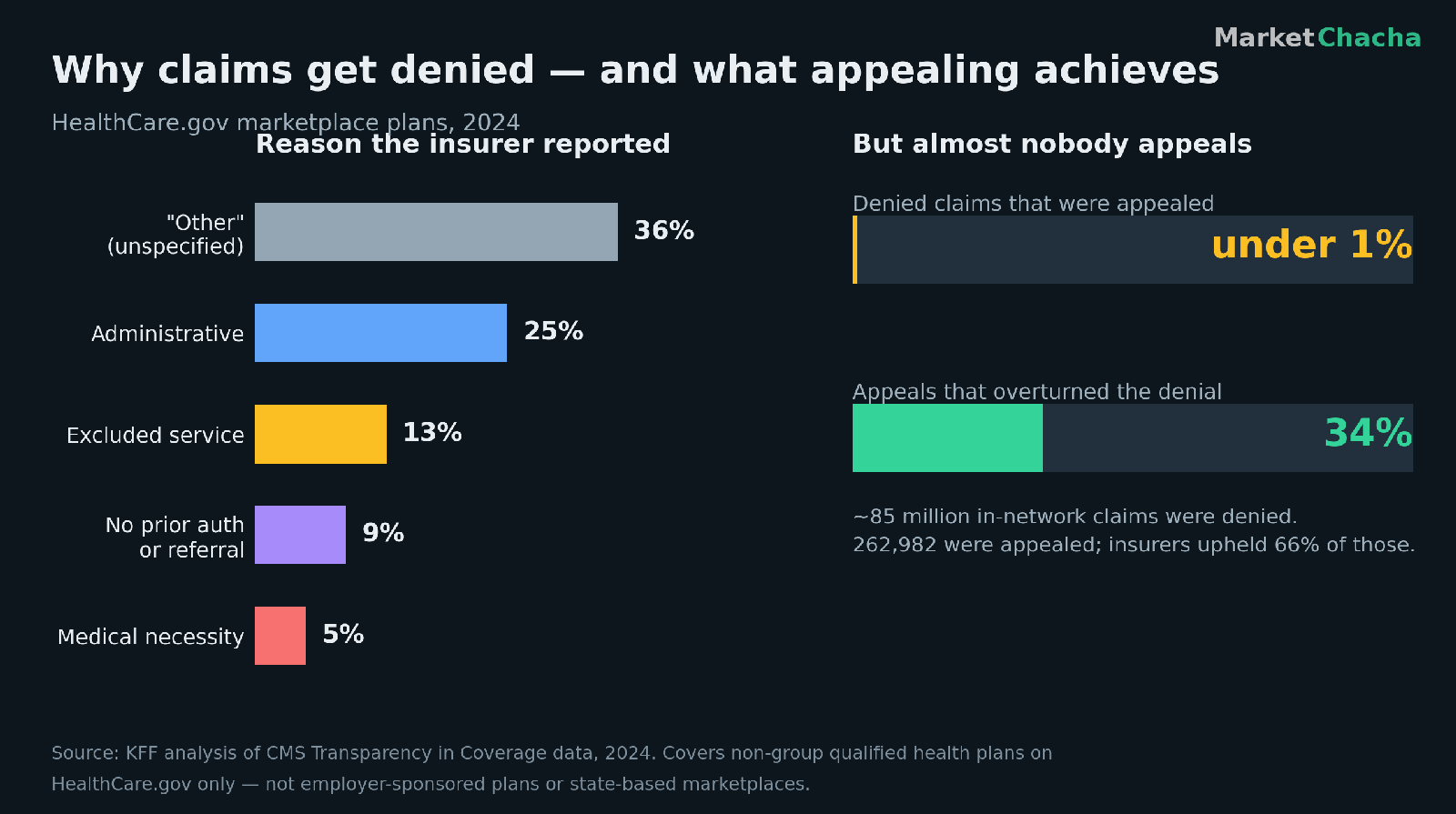
The reported reasons are less dramatic than most people expect. In 2024, across HealthCare.gov plans, insurers attributed 25% of in-network denials to administrative reasons, 13% to an excluded service, 9% to a missing prior authorisation or referral, and only 5% to medical necessity. The largest single bucket — 36% — was simply "other", a category the reported data does not explain.
That 19% headline denial rate deserves a caveat, because it is routinely quoted as if it applied to everyone. It does not. It covers non-group qualified health plans sold on HealthCare.gov — not employer-sponsored coverage, which is how most working-age Americans are insured, and not state-run marketplaces. It also averages over enormous variation: in 2023 KFF found insurer-level denial rates ranging from 1% to 54%. Your plan's rate is not the national rate.
The practical takeaway is the opposite of fatalism. If a quarter of denials are administrative and another tenth are a missing authorisation, then a large share of denials are fixable paperwork, and the only thing standing between you and payment is somebody re-filing the claim correctly.
A worked example: what a denial costs, and what the appeal saves
Say you have an outpatient MRI. The imaging centre's billed charge is $6,000. Because it is in your network, the contract between your insurer and that provider sets an allowed amount of $2,400 — that negotiated figure, not the billed charge, is the number everything is calculated from. (If that distinction is new, see why you get a bill after your insurance pays.)
The claim comes back denied as "not medically necessary". The plan pays $0, and the bill you receive is generally the $2,400 allowed amount rather than the $6,000 charge, because the provider's network contract limits what it can bill you — though that protection is contract-specific, so check it rather than assume it.
Now suppose you appeal, your doctor sends a letter documenting why the scan was indicated, and the denial is overturned. You have $500 of deductible left and 20% coinsurance after that. The arithmetic:
- Allowed amount: $2,400
- $500 applies to your remaining deductible, leaving $1,900
- Coinsurance: 20% of $1,900 = $380
- You owe $500 + $380 = $880. The plan pays $1,520
So the appeal is worth $1,520 — the difference between owing $2,400 and owing $880. That is the number to weigh against an afternoon of phone calls and one letter. It is also why the sub-1% appeal rate is the most striking statistic in this whole subject.
The denial letter is your appeal: how to read it
Federal rules require the notice to tell you the specific reason for the denial and the specific plan provision it relied on. If the decision rested on an internal clinical rule or guideline, the plan must either describe it or tell you a free copy is available on request — and you should request it, because an appeal that argues against the actual criterion used is far stronger than one that argues in general terms.
Three things to extract before you write anything: the denial reason code and its plain-English meaning; the plan language being cited; and the deadline stated on the notice. If the reason is administrative, you often do not need an appeal at all — you need the provider's billing office to correct and resubmit.
How to actually appeal, step by step
- 1. Get the paperwork. The denial notice or Explanation of Benefits, the itemised bill, and your plan's Summary of Benefits and Coverage.
- 2. Call both sides. The insurer, to confirm the reason and whether a corrected resubmission would fix it; the provider's billing office, to check the codes. A large share of denials end here.
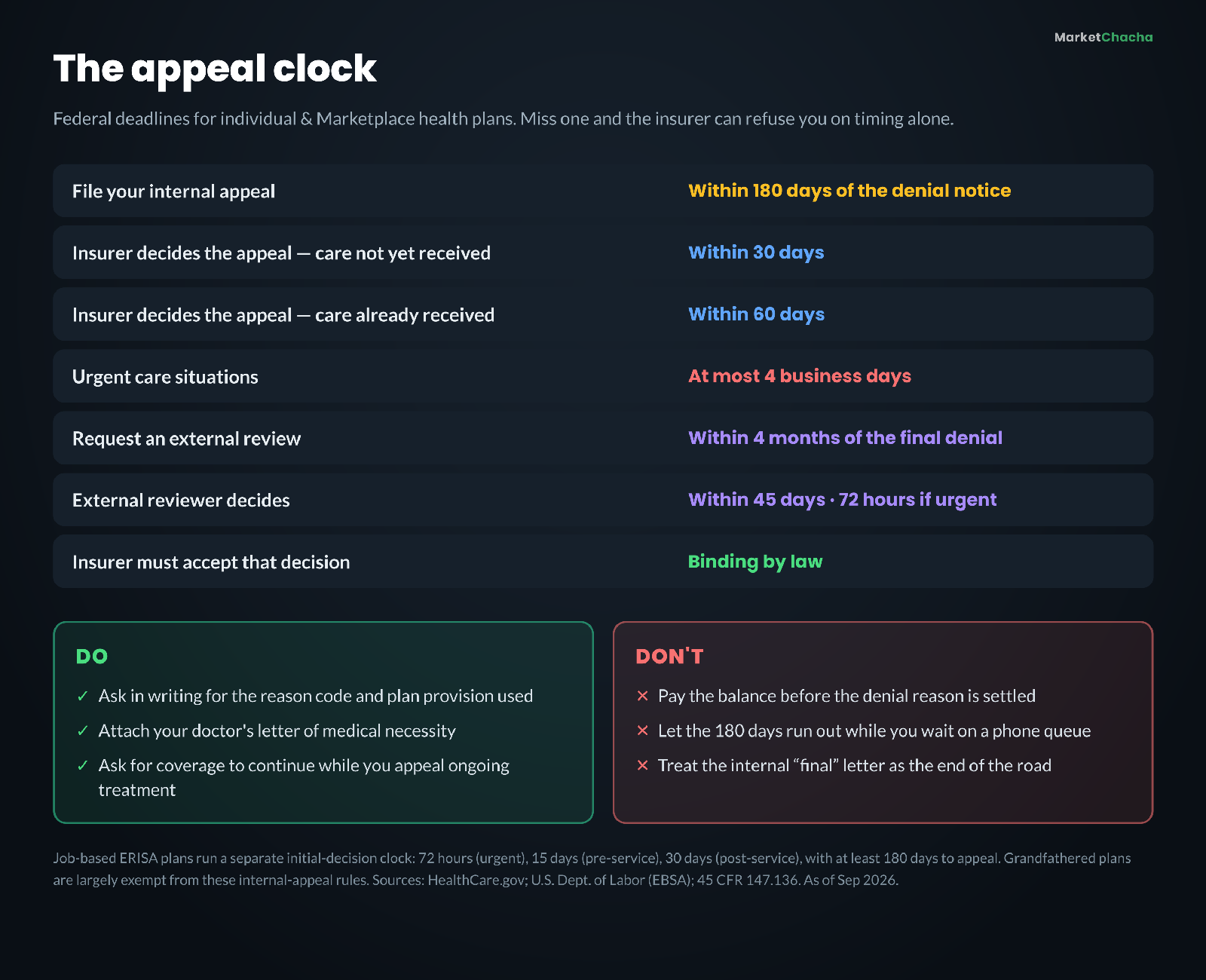
- 3. File the internal appeal in writing. You have 180 days from the denial notice. State the claim number, the reason given, and why it is wrong — citing the plan provision or clinical criterion. The insurer must complete the appeal within 30 days if the care has not happened yet, or 60 days if you have already received it.
- 4. Attach clinical support. A letter of medical necessity from the treating doctor, referencing the insurer's own criteria, is the single highest-value attachment.
- 5. Ask for coverage to continue. For an ongoing course of treatment, plans must provide continued coverage pending the outcome of the internal appeal (45 CFR 147.136).
- 6. Escalate to external review. If the internal appeal fails, you have 4 months from the final denial to request an independent external review. A standard review is decided within 45 days, an expedited one within 72 hours — and the insurer is required by law to accept the result.
One timing nuance worth knowing: those decision windows are the individual and Marketplace figures. Job-based ERISA plans run their own initial-decision clock — 72 hours for urgent care, 15 days pre-service, 30 days post-service — with at least 180 days to appeal. And "grandfathered" plans, a shrinking set that predate the 2010 rules, are largely exempt from the internal-appeal requirements altogether.
What it costs you — and the catch
An appeal costs no fee, but it costs time and it runs on a clock that is not generous. The main catch is that the deadlines are real: a late internal appeal can be refused on timing alone, regardless of how right you are on the merits. The second catch is that an external review is generally available only after you exhaust the internal process — there are narrow exceptions, such as urgent cases or where the plan failed to follow its own rules — so a missed first deadline can close both doors.
The third is that not every denial is winnable. If a service is genuinely excluded from your plan, no appeal creates coverage that the contract never contained — which is why the exclusions page of your policy, boring as it is, is the document that decides most of these arguments in advance.
Common mistakes beginners make
- Paying the bill to make it go away. Once paid, you are chasing a refund instead of contesting a charge.
- Appealing by phone only. Call to understand; file in writing, and keep dated copies.
- Treating "final determination" as final. It ends the internal stage and starts your external-review window.
- Arguing sympathy rather than criteria. Reviewers respond to the plan's own clinical criteria and policy language.
- Assuming health rules apply everywhere. Property claims are settled on valuation clauses, not medical necessity — see actual cash value vs replacement cost.
How this works in India
India's system runs on the same logic — a claim is assessed against policy wording — but the timelines and the enforcement architecture are set by the IRDAI's Master Circular on Health Insurance Business (29 May 2024), and they are unusually specific.
On cashless claims, the insurer must decide a pre-authorisation request "immediately but not more than one hour" from receipt. At discharge, final authorisation must be granted "within three hours" of the hospital's request, and if the insurer is late, any additional amount the hospital charges for the delay is borne by the insurer from its shareholders' fund. The circular also shifts document collection off the patient: insurers and TPAs are to collect required documents from the hospital, not ask the policyholder to run them around.
On rejections, no claim may be repudiated without approval of a Claims Review Committee, and where a claim is repudiated or only partly allowed, the insurer must convey full details with reference to the specific policy terms and conditions relied on. That is the Indian equivalent of the US "specific reason plus plan provision" requirement, and it is what makes an Indian appeal writable.
The most under-known Indian protection is the moratorium period. After 60 months of continuous coverage, no health policy or claim can be contested on grounds of non-disclosure or misrepresentation — only established fraud. Credits earned under ported or migrated policies count towards it, so switching insurers need not reset the clock. If the insurer's grievance process fails you, the Insurance Ombudsman is the next step; an Ombudsman award must be honoured within 30 days, with a penalty of ₹5,000 per day for delay.
FAQ
Why was my health insurance claim denied? Most often for administrative or coding reasons, a missing prior authorisation or referral, or because the service is excluded from your plan. Medical necessity accounted for only about 5% of reported in-network denials on HealthCare.gov plans in 2024. The denial notice must state the specific reason and the plan provision relied on.
How long do I have to appeal a denied insurance claim? For plans covered by the federal rules, you have 180 days from the date of the denial notice to file an internal appeal, and 4 months from the final internal denial to request an external review. Missing either deadline can end the matter regardless of the merits.
What are my chances if I appeal? Among HealthCare.gov consumers who appealed in 2024, insurers upheld 66% of denials — meaning roughly 34% were overturned. Outcomes vary widely by insurer and by the reason for the denial; administrative and coding errors are typically the easiest to reverse.
What is an external review and is the decision binding? It is a review by an independent organisation not employed by your insurer, available once you have exhausted the internal appeal. A standard review is decided within 45 days, an expedited one within 72 hours, and your insurer is required by law to accept the reviewer's decision.
Can my insurer stop paying for ongoing treatment while I appeal? Under 45 CFR 147.136, plans subject to the rule must provide continued coverage pending the outcome of an internal appeal for an ongoing course of treatment, and cannot reduce or terminate those benefits without advance notice and an opportunity for review.
Can my insurer reject an old claim in India for something I did not disclose? After 60 months of continuous coverage — the moratorium period under IRDAI's 2024 master circular — no health policy or claim can be contested for non-disclosure or misrepresentation, except in cases of established fraud.
Educational content only — not investment, tax or insurance advice, and not a recommendation of any product. Rates, fees and rules change — always check current terms with the provider. [Sources: HealthCare.gov — internal appeals, HealthCare.gov — external review, KFF — Claims Denials and Appeals in ACA Marketplace Plans in 2024, U.S. Department of Labor (EBSA), 45 CFR 147.136, IRDAI Master Circular on Health Insurance Business, 29 May 2024] Always do your own research.
This article is for educational and informational purposes only. It is not financial advice, investment recommendation, or a solicitation to buy or sell securities. Investing involves significant risks. I am not a SEBI-registered investment advisor. Readers should consult their own financial advisor and conduct their own research before making any investment decisions.
Comments
Join the conversation
Sign in to join the conversation.
Follow replies, add your view, and take part in the discussion.
Sign in to commentLoading comments...