

Why do corporate bonds pay more than Treasuries? Credit risk, ratings and spreads explained
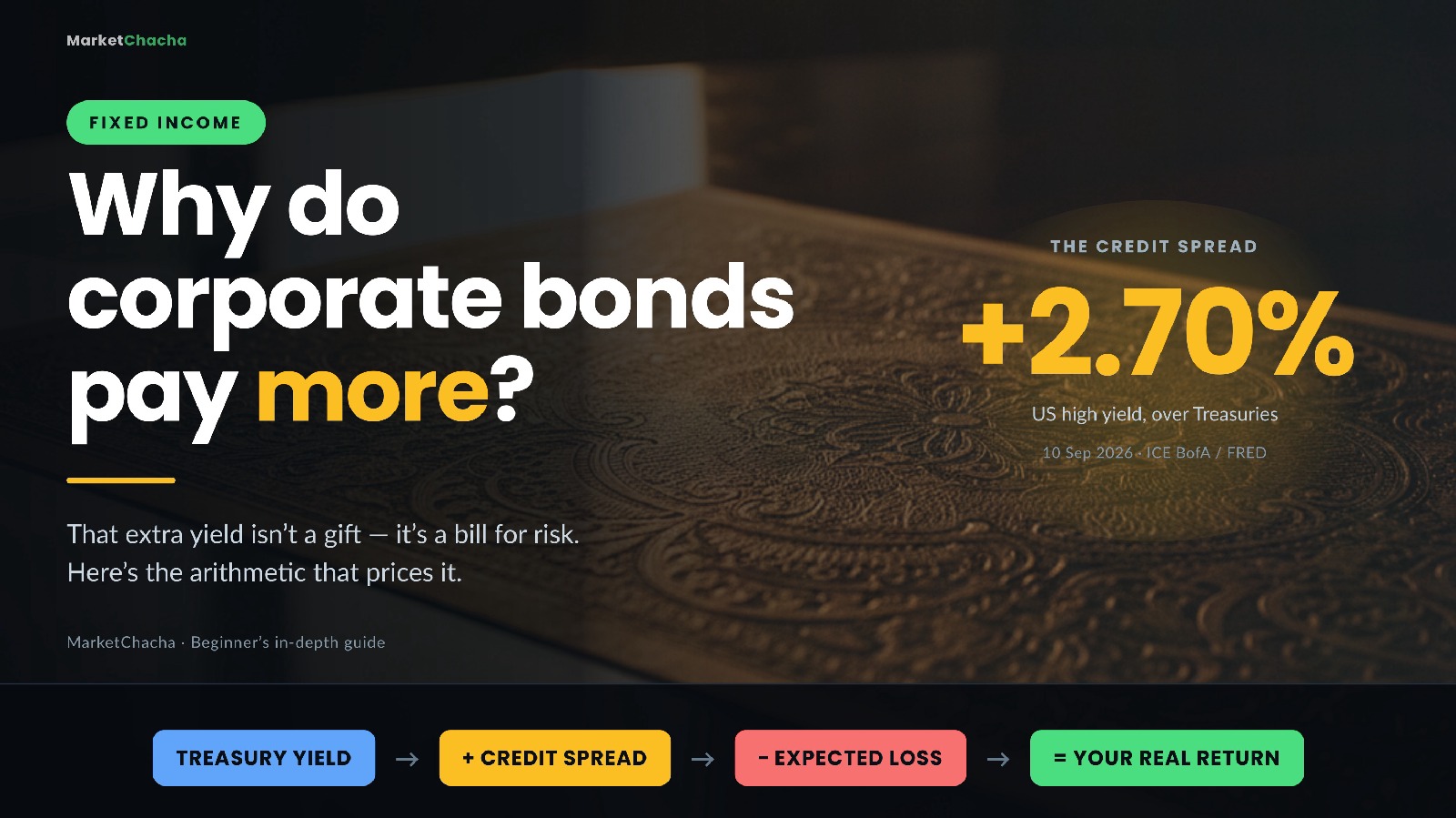
A corporate bond is a loan you make to a company instead of to the government, and it pays more than a Treasury for one blunt reason: a company can fail to pay you back, and the US Treasury, in practice, does not. That extra yield has a name — the credit spread — and it is not a bonus. It is the market's price for the risk that some of these loans never come back in full. As of 10 September 2026, the ICE BofA US High Yield index yielded 7.42% while a 5-year Treasury note yielded 4.75%, and that index's measured spread over Treasuries was 2.70 percentage points (FRED/ICE BofA; US Treasury). This guide covers what that gap is made of, what a credit rating actually measures, how to work out whether a spread is big enough to be worth taking, and how the same picture looks in India.
What a corporate bond is — and how it differs from a Treasury
Both are IOUs. You hand over money, the borrower pays you interest (the coupon) on a schedule and returns the face value on a fixed maturity date. The mechanics are nearly identical. The difference is who can fail to pay you. The US Securities and Exchange Commission puts credit risk plainly: "The issuer may fail to timely make interest or principal payments and thus default on its bonds." A company can run out of money. The Treasury issues debt in the currency it also controls, which is why Treasuries serve as the market's benchmark for a near-risk-free return — not because of a guarantee written anywhere.
Credit risk sits on top of interest-rate risk, not instead of it. Corporate bonds still fall in price when rates rise, for the reasons covered in why bond prices fall when interest rates rise. A corporate bond simply carries a second, separate way to lose money.
The credit spread: the number that measures your extra pay
The credit spread is the difference between a corporate bond's yield and the yield on a Treasury of comparable maturity, usually quoted in basis points (100bp = 1.00 percentage point). If a corporate bond yields 6.75% and the comparable Treasury yields 4.75%, the spread is 200bp.
Professionals quote an option-adjusted spread (OAS), which strips out the value of any embedded option — most commonly the issuer's right to call the bond, repaying early. That matters to you as a buyer: a callable bond's headline yield flatters it, because if rates fall the company refinances and your high-yielding bond disappears.
What the market was actually charging on 10 September 2026, per ICE BofA index data via FRED:
- AAA-rated corporates: 0.42% over Treasuries (42bp)
- BBB-rated corporates: 0.98% over (98bp)
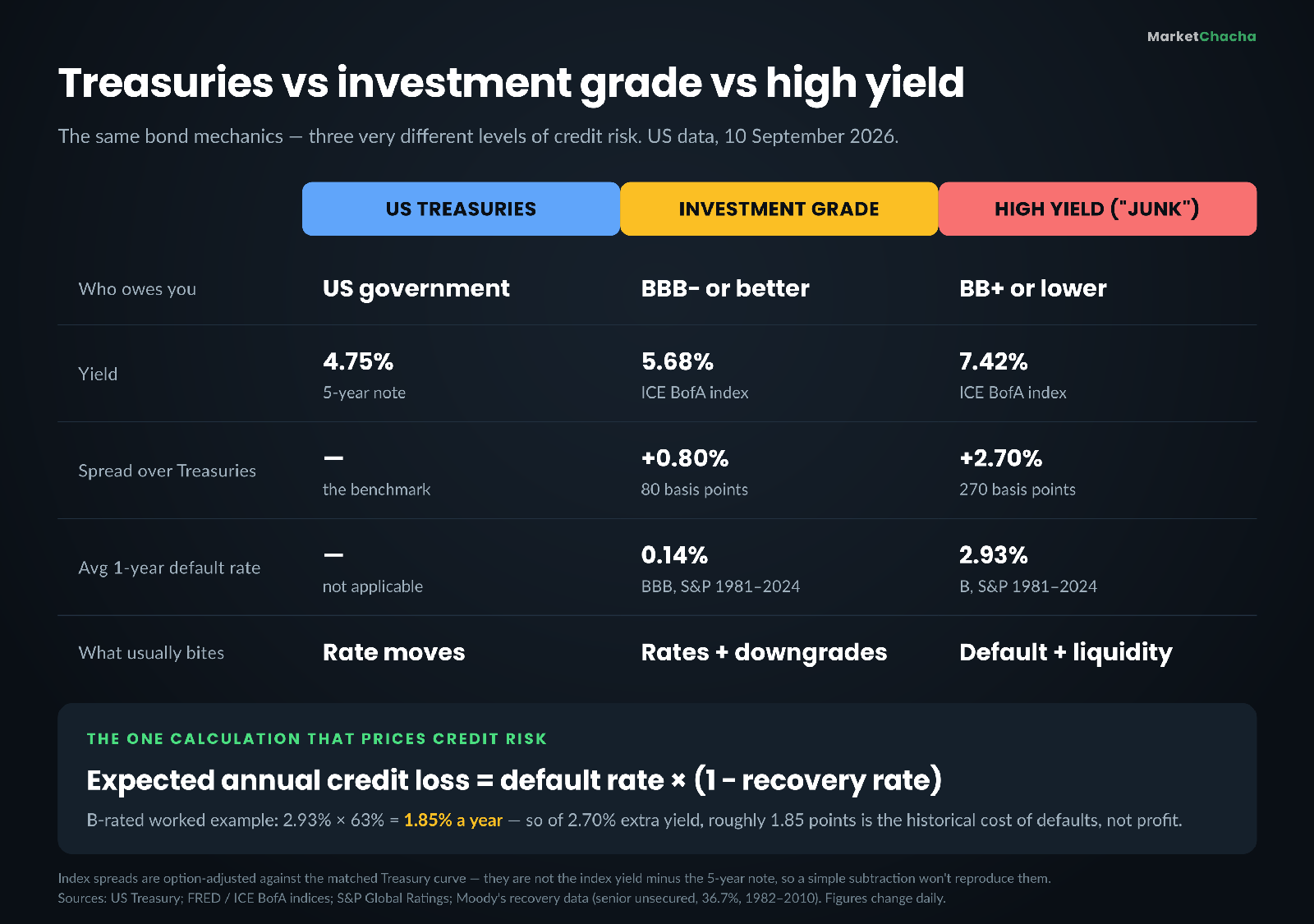
- The whole investment-grade index: 0.80% over (80bp) — effective yield 5.68%
- The whole high-yield index: 2.70% over (270bp) — effective yield 7.42%
One technical point that saves confusion: an index spread is measured against the matching point on the Treasury curve, maturity by maturity — it is not the index yield minus the 5-year Treasury yield. So 5.68% minus 4.75% will not give you 0.80%, and it is not meant to.
Spreads move constantly and widen violently in a crisis, because that is when companies are most likely to fail. For context, 2.70% on high yield was narrow by recent standards — tighter than on roughly 90% of the 787 trading days in the three years to 10 September 2026, when the average was 3.12% (calculated from FRED series BAMLH0A0HYM2). A narrow spread means you are being paid less than usual for the same risk.
Worked example: is 2.70% enough? Here's the arithmetic
This calculation turns "corporate bonds pay more" into a decision. Suppose you have $10,000 and two five-year choices:
- A 5-year Treasury note at 4.75% → $475 of interest a year.
- A 5-year single-B rated corporate bond at 7.45% — 270bp over, the same extra yield the high-yield index was paying on 10 September 2026 → $745 a year.
The corporate pays you $270 more per year. Now price the risk you took to get it:
Expected loss = probability of default × (1 − recovery rate)
Both inputs have long histories. S&P Global's 2024 Annual Global Corporate Default and Rating Transition Study puts the average one-year default rate for a B-rated issuer at 2.93% over 1981–2024. And a defaulted bond is not worth zero — Moody's puts the average recovery on senior unsecured corporate bonds at 36.7% of face value over 1982–2010, so the loss is roughly 63 cents on the dollar. (The Reserve Bank of Australia's March 2010 Financial Stability Review reports senior unsecured recoveries of about 38% in 2009, consistent with that range.)
- Expected loss = 2.93% × 63% = 1.85% a year
- On $10,000: 0.0293 × 0.63 × $10,000 = $184.59 a year
- Extra income $270 − expected loss $185 = about $85 a year left over
So of the $270 of extra yield, roughly $185 is not profit at all — it is the historical average cost of defaults, handed straight back. Around $85 a year, or 0.85% on your $10,000, is what actually compensates you for illiquidity, price swings and the chance that this year is worse than average. That is the real answer to the question: most of the extra is a bill, not a gift.
Two honest caveats. The 270bp index spread is an average across a mix of BB, B and CCC issuers, so an individual single-B bond typically trades wider. And — the one beginners miss — you do not personally receive the average. A single bond does not default 2.93%; it either pays you in full or it does not. Averages only show up if you hold many bonds at once.
What a credit rating actually means — and what it doesn't
A credit rating is an agency's opinion on how likely an issuer is to pay on time. S&P Global calls it "an informed opinion about an issuer's relative creditworthiness" and is equally clear on the limits: "Credit ratings do not speak to investment merits." They are forward-looking opinions — not guarantees, not buy or sell recommendations. CRISIL says the same in its own words: a rating is "not a recommendation to buy, sell or hold a rated instrument."
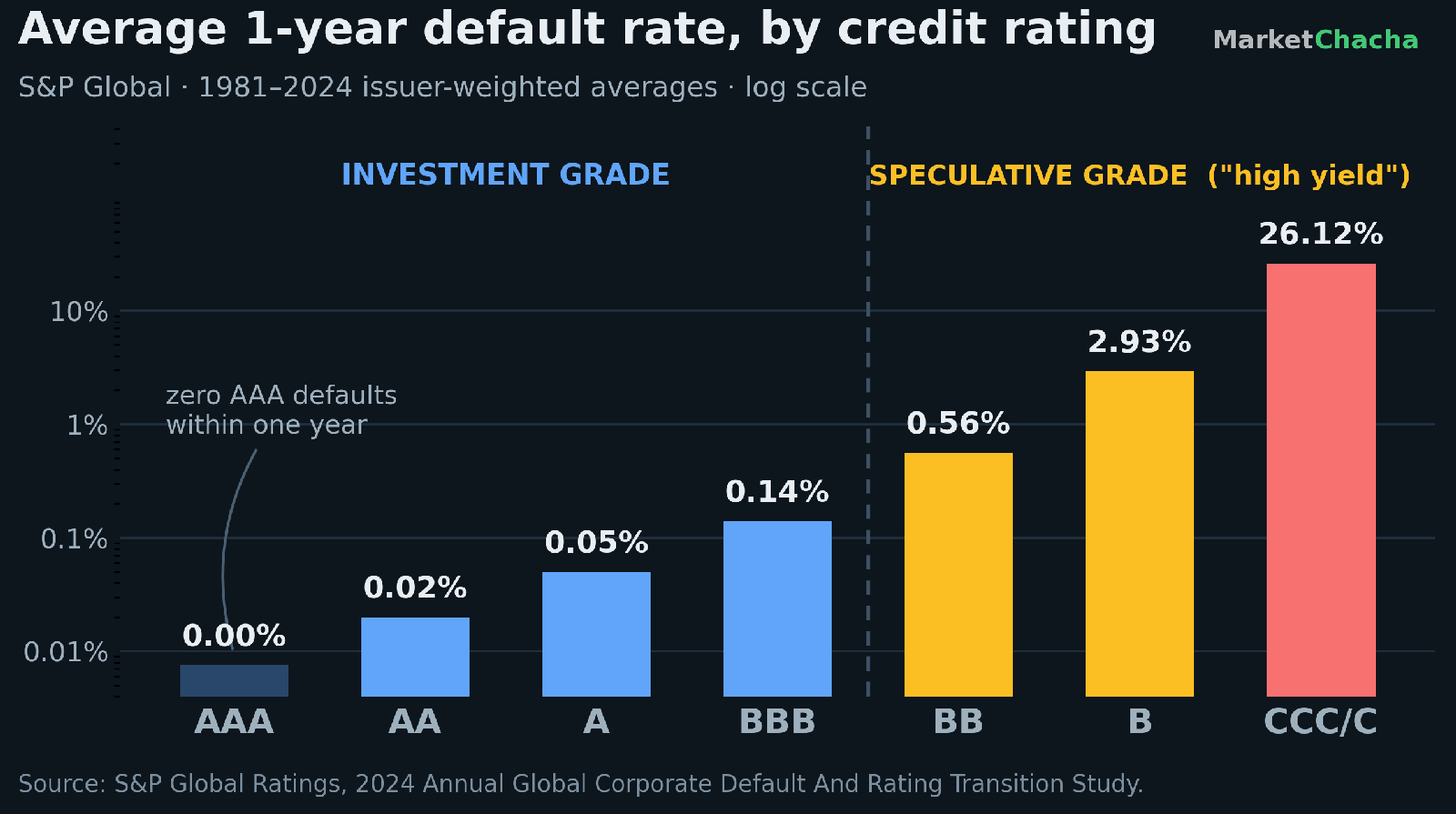
What makes ratings useful is that the letters line up with real default history. S&P's average one-year default rates over 1981–2024:
- AAA 0.00% · AA 0.02% · A 0.05% · BBB 0.14%
- BB 0.56% · B 2.93% · CCC/C 26.12%
The shape matters more than any single number. From AAA to BBB the differences are tiny in absolute terms. Then it accelerates: BB is four times BBB, B is five times BB, and CCC/C is a different universe — roughly one in four such issuers defaulted within a year, on average. Ratings are not a smooth dial; they are a cliff with a gentle approach. Agencies also use modifiers — S&P and Fitch add + and −, Moody's adds 1, 2 and 3 — so BBB+ sits above BBB, which sits above BBB−.
Investment grade vs high yield: the line that changes everything
One boundary does more work than all the others. BBB− and above is "investment grade." BB+ and below is "speculative grade" — commonly called high yield, or junk. In S&P's descriptions, a BBB issuer has "adequate capacity to meet financial commitments," while a BB issuer is "less vulnerable in the near term, but faces major ongoing uncertainties."
The line matters beyond the wording, because many pension funds, insurers and bond mandates may only hold investment-grade paper. When an issuer is cut from BBB− to BB+ — a fallen angel — forced selling can follow and the price can drop before you have had a chance to think. The default data shows why the line sits there: of the 421 corporate defaults S&P recorded in the five years to end-2024, 97.7% were speculative grade.
The AAA end is thin. Very few companies anywhere hold the top rating from both S&P and Moody's; in recent years the US-listed short list has been down to about two names — Microsoft and Johnson & Johnson. Ratings change, so treat that as a snapshot and check current ratings with the agency. Most of the investment-grade market lives in the A and BBB buckets, which is why the BBB spread (98bp) is a better read on what corporate credit costs than the AAA spread (42bp).
What it costs you: the catch behind the extra yield
Beyond default itself, four things quietly eat the spread:
- You get an outcome, not an average. Expected-loss maths works across a diversified pool. One issuer is a single event, not a statistic.
- Downgrade without default. A bond can be downgraded, lose a chunk of its price, and still pay every coupon. If you must sell before maturity, that loss is real.
- Liquidity. Individual corporate bonds trade over the counter in large lots; buying $5,000 of one bond often means a worse price than an institution buying $5m.
- Call risk. Many high-yield bonds are callable. Heads, rates fall and the company repays you early; tails, rates rise and you are stuck.
One structural point too: recovery is not immediate. That 36.7% average is what defaulted bonds were worth after default, and the workout can take years.
How to actually buy corporate bond exposure
- 1. Decide diversified or single-issuer. For almost every beginner the honest answer is diversified, because the expected-loss maths above only holds across many bonds.
- 2. Pick the wrapper. A corporate bond fund or ETF holds hundreds of issues. Understand first that most bond funds and ETFs never mature — there is no date on which you get your money back, so the value keeps moving with rates. (A small category of defined-maturity or "target maturity" bond ETFs is the exception; check the fund's own documents.) That distinction is covered in bond funds vs holding a bond to maturity.
- 3. Check what is inside. Read the rating breakdown and average credit quality. "Corporate bond fund" covers everything from an AA-heavy portfolio to a CCC-laden one.
- 4. Look at the spread, not just the yield. A 7% yield when Treasuries pay 4.75% is a very different proposition from a 7% yield when Treasuries pay 2%.
- 5. For individual bonds, check the rating, the seniority (senior secured recovers more than subordinated), whether it is callable, and the minimum lot. Read the prospectus, not the marketing sheet.
- 6. Match maturity to when you need the money, so you are never forced to sell into a wide-spread market.
Common mistakes beginners make
- Treating yield as return. A 9% yield is a promise, not an outcome. Return is yield minus losses.
- Reading "high yield" as high income rather than high risk. The name was invented to sound better than "junk."
- Buying one company's bond for the yield. Concentrating credit risk in a single issuer is how an average turns into a total loss.
- Ignoring the spread level. Buying credit near its tights means taking the same risk for less pay.
- Confusing the stock story with the bond. A bondholder gains nothing if the company triples — you get your coupon and your principal. Your upside is capped; your downside is not.
How this works in India
The structure is identical: government paper — G-secs and T-bills, issued by the Reserve Bank of India on the government's behalf — sets the benchmark, and corporate bonds and non-convertible debentures (NCDs) pay a spread above it. Retail investors can buy G-secs and T-bills directly through the RBI's Retail Direct platform, or through a broker.
Ratings are regulated more tightly than most beginners realise. SEBI standardised the symbols and their definitions for all registered rating agencies — CRISIL, ICRA, CARE, India Ratings and others — in a circular dated 31 October 2022, effective 1 January 2023. On that scale AAA means the "highest degree of safety regarding timely servicing of debt obligations," BBB "moderate degree of safety," BB "moderate risk of default," B "high risk of default," C "very high risk of default" and D "in default or expected to be in default soon." Modifiers + and − apply from AA down to C, and BBB− is the investment-grade floor, as in the US.
Two India-specific traps are worth internalising. First, suffixes change what the letters mean. CRISIL explains that a (CE) suffix marks a rating that depends on external credit enhancement — a guarantee from someone else — and (SO) marks a structured obligation. A "AAA (CE)" is not a standalone AAA; you are partly rating the guarantor. Second, ratings here have moved very fast under stress: in September 2018, agencies cut IL&FS group debt to default grade within weeks of it carrying top-tier ratings, as reported at the time by Bloomberg and Business Standard — a reminder that a letter is an opinion, and a dated one.
Access has improved sharply. SEBI cut the face value of privately placed listed debt securities from ₹1,00,000 to ₹10,000 in a circular dated 3 July 2024 — subject to conditions including the appointment of at least one merchant banker and the instrument being plain-vanilla interest-bearing — explicitly to widen non-institutional participation. That lowers the ticket size; it does not lower the credit risk, and the same diversification logic applies. For most Indian beginners, a debt mutual fund with a published rating profile does the job a single NCD cannot.
FAQ
Why do corporate bonds pay more than government bonds? Because a company can default and the US Treasury, in practice, does not. The extra yield — the credit spread — compensates you for expected default losses plus illiquidity and price volatility. On 10 September 2026 that spread was 0.80 percentage points for the US investment-grade index and 2.70 points for high yield.
What is a credit spread in simple terms? It is the difference between a corporate bond's yield and the yield on a Treasury of similar maturity, quoted in basis points (100bp = 1%). If the corporate yields 6.75% and the Treasury 4.75%, the spread is 200bp.
What does a BBB rating actually mean? BBB is the lowest investment-grade rung; S&P describes the issuer as having "adequate capacity to meet financial commitments." Historically, BBB-rated issuers defaulted at an average of 0.14% a year over 1981–2024 (S&P). One notch lower, BB+, is speculative grade.
Are junk bonds always a bad idea? Not inherently — they are a different risk, not automatically a mistake. But "high yield" describes the compensation, not the outcome: 97.7% of the corporate defaults S&P recorded in the five years to 2024 were speculative grade. Held in a diversified fund and bought when spreads are wide, they behave very differently from a single junk bond bought for its coupon.
How much do you get back if a bond defaults? Not zero, usually. Moody's put the average recovery on senior unsecured corporate bonds at 36.7% of face value over 1982–2010, with senior secured recovering more (50.8%) and subordinated less (30.7%). Recovery is lower in recessions and the workout can take years.
Is a AAA rating a guarantee I'll be paid? No. S&P states plainly that ratings are forward-looking opinions and "do not speak to investment merits" — not guarantees. Ratings also get revised, sometimes very quickly, as the September 2018 downgrades of IL&FS group debt in India showed.
Educational content only — not investment, tax or insurance advice, and not a recommendation of any product or issuer. Rates, spreads, yields and ratings change constantly — always check current figures and terms with the provider or agency. [Sources: SEC Investor.gov, US Treasury Daily Yield Curve, FRED / ICE BofA index data, S&P Global Ratings, S&P Global 2024 Annual Global Corporate Default and Rating Transition Study, Moody's Corporate Default and Recovery Rates 1920–2010, Reserve Bank of Australia, SEBI, CRISIL Ratings]. Always do your own research.
This article is for educational and informational purposes only. It is not financial advice, investment recommendation, or a solicitation to buy or sell securities. Investing involves significant risks. I am not a SEBI-registered investment advisor. Readers should consult their own financial advisor and conduct their own research before making any investment decisions.
Comments
Join the conversation
Sign in to join the conversation.
Follow replies, add your view, and take part in the discussion.
Sign in to commentLoading comments...