

What does renters insurance actually cover — and what isn't covered?

Renters insurance is a policy that pays to repair or replace the things you own inside a home you don't own — and, just as importantly, covers you if you injure someone or damage their property. Your landlord's policy insures the building, not your belongings. The National Association of Insurance Commissioners (NAIC) puts it bluntly: "Your landlord's insurance will not cover your personal belongings. Only a renters policy will protect your possessions if they are damaged or stolen." In the US this cover is sold on a standardised form called the HO‑4. Below: the four coverage parts, a worked claim with the actual arithmetic, the gaps that catch people out, what it costs, how to buy it — and how the same idea works in India.
What renters insurance is, and what "HO-4" means
Insurers sell homeowners-type cover on numbered standard forms. The NAIC defines the HO‑4 — the renter's form — as one that "covers unscheduled personal property on a broad named perils basis."
That definition is worth unpacking, because both halves matter:
- Unscheduled personal property means the general pile of stuff you own — sofa, clothes, laptop, kitchen things — insured as one lump sum rather than item by item. "Scheduled" items are ones you list individually and pay extra to cover properly.
- Broad named perils means the policy pays only for causes of loss it lists. If the cause of your loss isn't on the list, there is no claim — however genuine the damage. Worth knowing: this is the same basis on which a homeowners HO‑3 covers personal property. Where the HO‑3 is more generous is on the building, which the NAIC describes as covering "all perils except those explicitly excluded" — and the building isn't yours to insure anyway. So on your possessions a renter isn't getting a weaker deal than a homeowner; both are reading a list.
There is a second, separate idea bundled into the same policy: liability. That part isn't about your possessions at all. It follows you, not your apartment.
The four things an HO-4 actually buys you
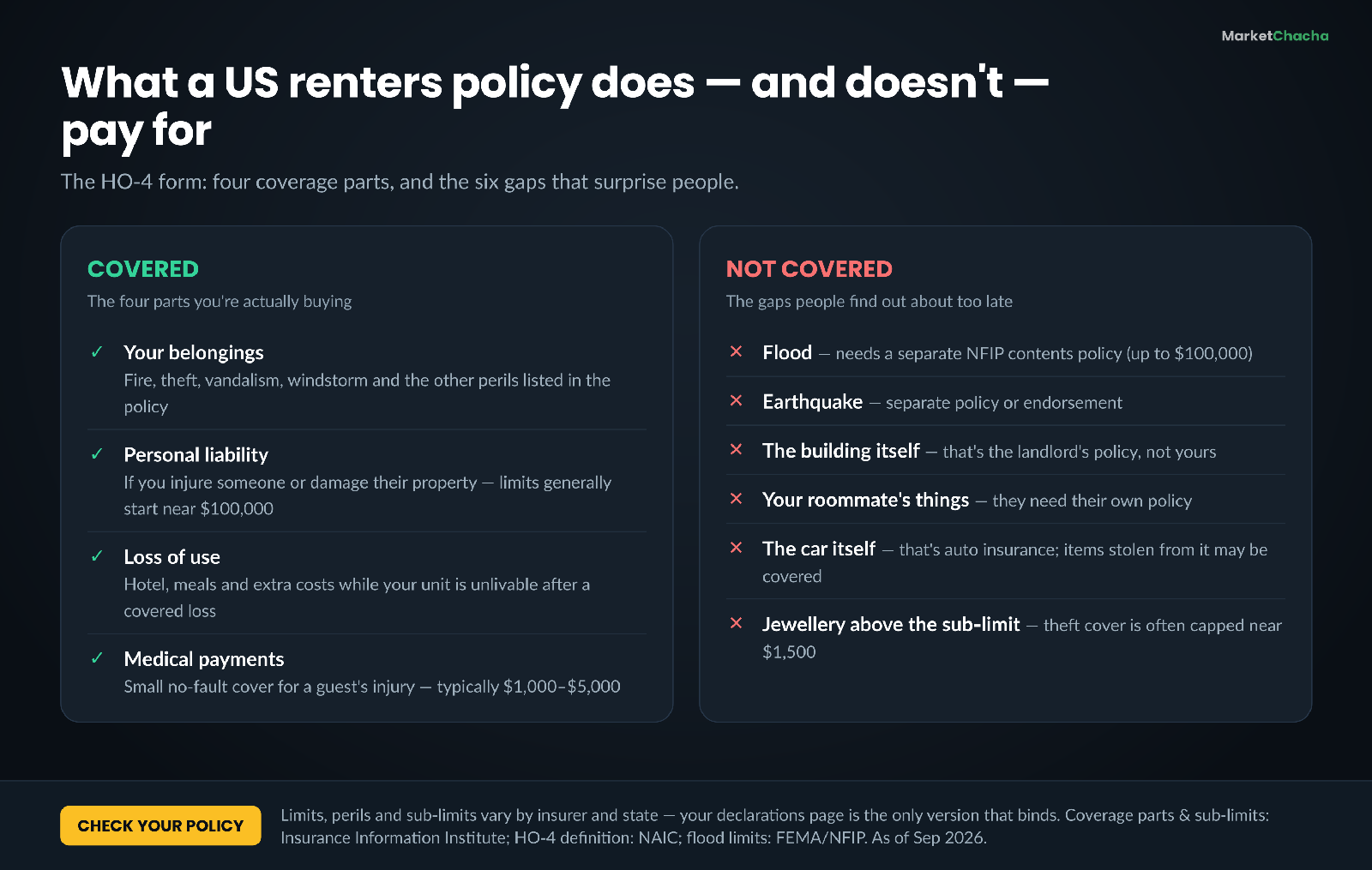
According to the Insurance Information Institute (Triple‑I), a renters policy has four working parts:
- Personal possessions. Damage "from fire, smoke, lightning, vandalism, theft, explosion, windstorm, water and other disasters listed in the policy."
- Liability. Protection against "lawsuits for bodily injury or property damage that you or your family members cause to other people." Limits, Triple‑I says, "generally start at about $100,000." This is the part that matters if your dog bites a visitor or your overflowing bath ruins the flat below.
- Additional living expenses (loss of use). "Hotel bills, temporary rentals, restaurant meals and other expenses" if a covered loss makes your home unlivable.
- Medical payments. A small no-fault amount — typically "$1,000 to $5,000" — to cover a guest's minor injury without anyone arguing about blame.
Most people buy the policy for the first part and end up grateful for the second.
A worked example: a $5,900 burglary claim
This is where renters insurance stops being abstract. Say you have a $30,000 contents limit, a $500 deductible, and someone breaks in and takes three things:
- A three-year-old laptop. An equivalent new one costs $1,200 today; its depreciated value is about $500.
- A TV. New: $700. Depreciated: $300.
- Jewellery worth $4,000.
You claim $5,900. Here is what you actually get, on a replacement cost policy:
- Laptop: $1,200 (no depreciation deducted).
- TV: $700.
- Jewellery: not $4,000. Policies typically cap theft of jewellery and similar valuables at a special sub-limit, separate from your overall contents limit — Triple‑I puts it at "up to $1,500," though the exact figure depends on your form and your insurer. Take $1,500 here. So: $1,500.
- Subtotal: $1,200 + $700 + $1,500 = $3,400. Minus the $500 deductible: $3,400 − $500 = $2,900 paid.
On an actual cash value policy, the same burglary pays: $500 + $300 + $1,500 = $2,300, less the $500 deductible = $1,800. Same break-in, same policy limit, $1,100 less in your account.
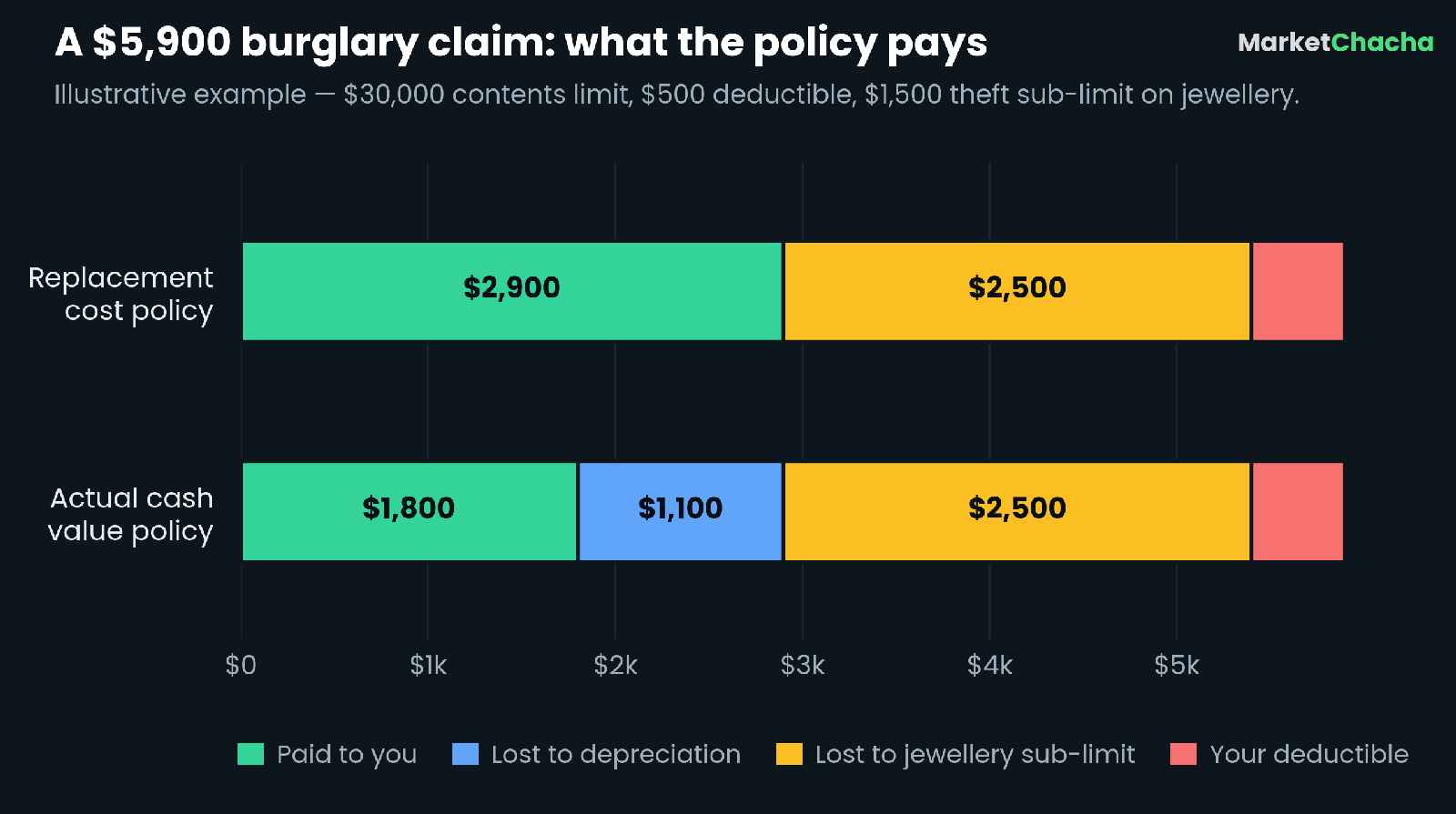
Two lessons fall straight out of the arithmetic. The deductible costs you a fixed $500 either way. The jewellery sub-limit costs you $2,500 — far more than the deductible — and most people have never heard of it.
Replacement cost vs actual cash value: the one choice that matters most
Actual cash value (ACV) pays what your item was worth on the day it was destroyed — purchase price minus depreciation. Replacement cost value (RCV) pays what it costs to buy an equivalent new one. Triple‑I estimates replacement cost coverage costs "about 10 percent more" (as of Sep 2026).
Ten percent more premium to remove the single biggest discount on your payout is, for most renters, the easiest decision in the whole policy. We covered this trade-off in depth in actual cash value vs replacement cost — it is the same mechanic that drives home and auto claims.
One caveat worth knowing: many RCV policies pay the depreciated amount first and release the rest only after you've actually replaced the item and sent the receipts. That is normal, not a trick — but it means you may need cash on hand to bridge the gap.
Named perils, and the two disasters that are never included
Because the HO‑4 is a named-perils form, the cause of a loss decides the claim. Two causes are famously absent. Triple‑I states it plainly: "Floods and earthquakes are not covered."
For flood, the fix is a separate policy. A renter can buy contents-only cover through the National Flood Insurance Program: per FEMA's NFIP, a contents-only policy insures a renter's belongings for up to $100,000 (as of Sep 2026). For earthquake, cover is usually a separate policy or an endorsement, depending on your state and insurer.
Your things are generally covered away from home as well, but with a ceiling: Triple‑I describes off-premises cover as "generally 10 percent of the total," giving the example of $2,500 on a $25,000 policy — on the $30,000 limit used above, that would be $3,000. The NAIC notes belongings are typically still covered "if they are stolen by someone who breaks into your car or if they are damaged while not on your property" — note that this is your belongings, not the car itself, which is an auto-insurance matter. Exactly what counts as off-premises varies between policies, so read that clause rather than assuming.
What it costs, and what it costs you
Renters insurance is unusually cheap. NAIC data reported by Triple‑I put the average US renters premium at $170 for 2021 — about $14 a month. The NAIC's current consumer guidance describes an average policy at "between $15 - $30 a month" (as of Sep 2026). The gap between the two is mostly time: one is a 2021 average, the other is today's guidance. Either way, what you pay depends on your state, your limits and your deductible.
The catch is the deductible. Triple‑I notes that raising it to $1,000 "may get as much as 25 percent off your premium" (as of Sep 2026). Moving from the $500 deductible used above to $1,000 would, on a $200 policy, save about $50 a year — in exchange for self-insuring an extra $500 on every single claim. If you don't have that $500 sitting in an emergency fund, a high deductible is not really a saving. The same reasoning applies to deductibles on a car policy.
How to actually buy it, step by step
- Photograph everything. Walk the apartment with your phone, open drawers and closets, film it all. Note serial numbers on the expensive items. This inventory is what turns a disputed claim into a paid one.
- Add up a contents limit. Total the cost to replace your things, not what you paid. Most renters badly underestimate: furniture, clothing and kitchen equipment add up faster than the electronics you think of first.
- Choose replacement cost, not actual cash value.
- Pick a liability limit. $100,000 is where Triple‑I says limits generally start. Ask your insurer to quote a higher limit alongside it and compare the two prices yourself.
- Set a deductible you can actually pay tomorrow.
- Schedule your valuables. If your jewellery, camera gear, bike or instrument is worth more than the sub-limit, list it separately and pay the extra premium. This is the step that would have recovered the missing $2,500 in the example above.
- Ask specifically about flood and earthquake if you're in an exposed area.
- Read the declarations page when it arrives. It is the only version of your policy that binds.
Common mistakes beginners make
- Assuming the landlord's policy covers you. It covers their building and their liability. Nothing of yours.
- Relying on a roommate's policy. The Texas Department of Insurance is direct: "Your roommate's policy won't pay for your stuff if it's lost in a robbery or fire. Their policy covers only their belongings." Its advice is that roommates "should each buy your own renters insurance."
- Ignoring sub-limits. A high contents limit does nothing for jewellery if a separate theft sub-limit — often around $1,500 — caps that whole category.
- Choosing ACV to save a few dollars. Roughly 10% of premium, for a much larger share of every payout.
- Assuming flood is included. It never is, on a standard policy.
- Having no inventory. A missing proof of ownership is one of the most common reasons a legitimate claim stalls — see why insurance claims get denied and how to appeal.
How this works in India
India has the same idea in a different shape. From 1 April 2021 the IRDAI has required general insurers writing fire and allied perils business to offer a standard home product, Bharat Griha Raksha. Its proposal form lets you tick "Home Contents Only" — which is exactly the tenant's route: you insure your belongings without insuring a building you don't own.
The peril list is the striking difference. Where a US HO‑4 excludes flood and earthquake, the IRDAI's standard wording includes "Earthquake, volcanic eruption, or other convulsions of nature" and "Storm, Cyclone, Typhoon, Tempest, Hurricane, Tornado, Tsunami, Flood and Inundation" among the covered perils. Two further features stand out. Bharat Griha Raksha has no underinsurance clause — the wording says "Underinsurance does not apply to the Bharat Griha Raksha Policy", so an under-declared sum insured doesn't cut your payout proportionally. And where you insure both building and contents, general contents are automatically covered at 20% of the building sum insured, capped at ₹10 lakh.
Jewellery needs care, though, because the base policy does not cover it at all. The wording is explicit: "Valuable Contents of Your Home are not covered under this Policy unless You have purchased the optional cover for the Valuable Contents." Jewellery, silverware, art and antiques are covered only if you buy that optional section and pay the extra premium. If you do, you normally submit a valuation certificate — that requirement is waived only where "the Sum Insured opted for is up to ₹5 Lakh and Individual item value does not exceed ₹1 Lakh." That ₹5 lakh is a paperwork threshold, not a ceiling: you can insure for more, you simply have to produce the certificate.
The trap runs the other way, though. Bharat Griha Raksha is a fire-and-allied-perils product. Theft is covered only "within 7 (seven) days of and caused by" an insured peril, so an ordinary break-in on an ordinary Tuesday is not covered. That applies to the valuable-contents section too, which means a straightforward jewellery burglary pays nothing under this policy, however much cover you bought for it. There is also no personal or public liability section (personal accident cover is a separate optional add-on). A US renters policy gives you theft and liability as standard; India's standard home product gives you neither.
For those, Indian renters generally look at a Householder's Package Policy, the older modular product most general insurers still sell, where burglary and liability are separate tick-box sections. As one published example, Bajaj General's Householder Package Policy lists "Burglary and Theft" and "Public Liability" as distinct sections and states that "if you are a tenant, you can take a Householder Insurance Policy for household contents, electronics, and valuables" (insurer product page, as of Sep 2026). Sections, limits and pricing differ by insurer and change over time — compare the actual policy wordings rather than a brochure, and check what each section excludes.
FAQ
Does my landlord's insurance cover my belongings? No. The NAIC states that a landlord's insurance "will not cover your personal belongings" — it insures the building and the landlord's own liability. Only your own renters policy covers your possessions.
How much does renters insurance cost per month? NAIC consumer guidance describes an average policy at roughly $15–$30 a month (as of Sep 2026); NAIC data reported by Triple‑I put the average annual US premium at $170 for 2021, about $14 a month. Your price depends on your state, your contents limit and your deductible.
Does renters insurance cover flood damage? No. Flood is excluded from standard renters policies. Renters can buy contents-only flood cover through FEMA's National Flood Insurance Program for up to $100,000 of belongings.
Does renters insurance cover my roommate's stuff? No. The Texas Department of Insurance says a roommate's policy "covers only their belongings" and recommends that roommates each buy their own policy.
Is my jewellery fully covered if it's stolen? Usually not. Policies typically apply a special theft sub-limit to jewellery and similar valuables — Triple‑I puts it at up to $1,500, though the figure varies by form and insurer — regardless of your overall contents limit. To cover more, you schedule the items individually.
Should I choose replacement cost or actual cash value? Replacement cost pays for a new equivalent item; actual cash value deducts depreciation first. Triple‑I estimates replacement cost costs about 10% more in premium, which is small relative to the difference it makes to a payout.
Educational content only — not investment, tax or insurance advice, and not a recommendation of any product. Rates, fees and rules change — always check current terms with the provider. [Sources: Insurance Information Institute — Renters Insurance, NAIC — Renting Your Home? Protect Your Belongings, NAIC — Homeowners Form Definitions, Triple-I — Facts + Statistics: Renters Insurance, FEMA NFIP — Flood Insurance for Renters, Texas Department of Insurance, IRDAI — Bharat Griha Raksha standard policy wording, Bajaj General — Householder Package Policy, Outlook Money — IRDAI standard home insurance from 1 April 2021]. Always do your own research.
This article is for educational and informational purposes only. It is not financial advice, investment recommendation, or a solicitation to buy or sell securities. Investing involves significant risks. I am not a SEBI-registered investment advisor. Readers should consult their own financial advisor and conduct their own research before making any investment decisions.
Comments
Join the conversation
Sign in to join the conversation.
Follow replies, add your view, and take part in the discussion.
Sign in to commentLoading comments...