

India inflation decoded: retail 4.82%, wholesale 9.92% — the gap is the story
India's markets were shut for Ganesh Chaturthi, so nobody got to trade this. Two inflation prints landed anyway, and read together they say something neither says alone.
The numbers
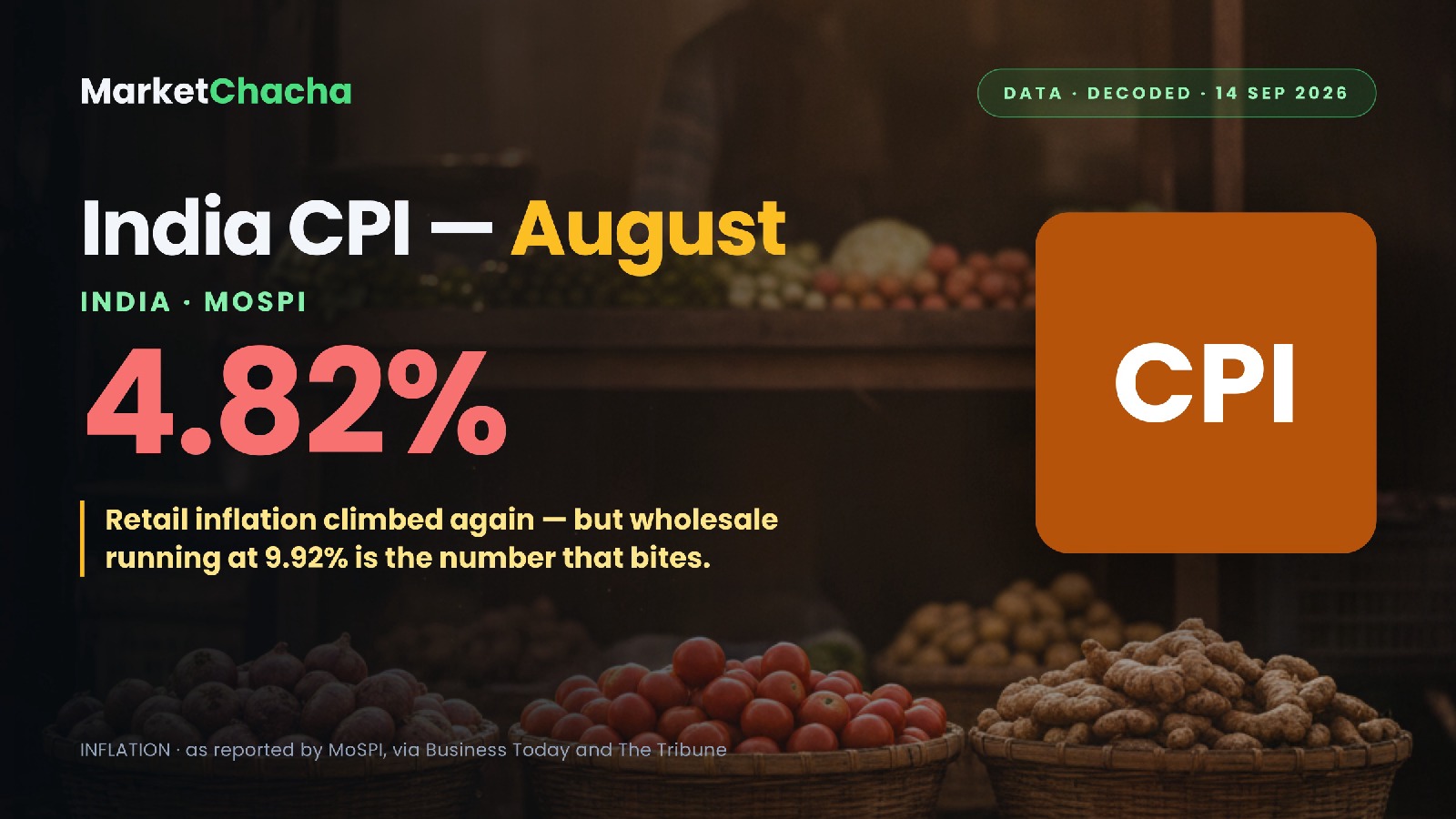
Retail inflation (CPI) rose to 4.82% year-on-year in August from 4.45% in July, as reported by MoSPI — a shade above the 4.8% consensus Trading Economics tracked. The food index (CFPI) did the lifting, climbing to 5.95% from 5.52%.
Rural inflation hit 5.23% (from 4.84%), urban 4.31% (from 3.96%). Inside food it was a vegetable story — onion +48.27%, ginger +73.82%, garlic +43.60%, offset by tomato −31.09% and potato −13.14%. One non-food category ran hottest of all: personal care and miscellaneous at +15.17%, on silver jewellery +107.11% and gold, diamond and platinum +35.53%.
Earlier the same day, wholesale inflation (WPI) printed 9.92% against 9.78% in July, per the Ministry of Commerce & Industry. Fuel and power ran at 22.93% (from 20.05%), manufactured products 8.37%, food articles 7.05%. Primary articles cooled, to 7.76% from 8.52%.
What it means
Here's what the headline won't tell you: wholesale inflation is running near 10% while retail sits under 5%. That five-point gap is the story.
Two gauges can disagree that violently because they measure different baskets. WPI is priced at the factory gate and the mandi — heavy on fuel, metals and manufactured goods, with no services in it at all. CPI is what you hand over at the counter, and its biggest block is food, then rent, school fees, doctors, phone bills. So when energy rips — fuel and power at 22.93% — it floods the wholesale index and only trickles onto the shop shelf.
Somebody absorbs that difference, and it's producers. If your inputs inflate at 8–9% and you can only pass 4–5% to the customer, the rest comes out of gross margin — and it shows up in company results a quarter or two later, not in today's CPI headline.
One more thing the headline hides: part of that 4.82% is jewellery, not demand. Silver at +107.11% is a global metals move that says nothing about whether Indian households are spending.
Who it touches
- Banks and rate-sensitives. The RBI held the repo at 5.25% with a neutral stance in August. With CPI climbing in a 2–6% band and WPI near 10%, the case for a near-term cut got harder — which shapes margin math at HDFC Bank, ICICI Bank and SBI, and funding costs at Bajaj Finance.
- FMCG. Wholesale food articles up 7.05% while rural inflation at 5.23% eats the same customer's wallet. Cost up, volume pressured — the squeeze HUL, ITC, Nestlé India and Dabur have to talk about.
- Jewellery. Gold +35.53% and silver +107.11% lift the value of every gram on the shelf at Titan — while making the same necklace harder to afford.
- Crude-linked manufacturers. Fuel and power at 22.93% flows into solvents, resins and freight for Asian Paints and into refining economics at BPCL; ONGC sits on the other side of the same barrel. Financing costs staying put matters to demand at Maruti Suzuki.
What to watch
The sequence is tight. Sep 15: August trade balance, forecast −$33.0B against −$31.98B — a costlier oil import bill shows up here first. Sep 28: IIP, forecast +6.7%, testing whether the margin squeeze is denting output. Oct 7: the RBI MPC decision, where the calendar carries a hold at 5.25%. Oct 12: the next CPI, which decides whether 4.82% was a vegetable-and-energy blip or a trend.
Same trade, different currencies elsewhere — US CPI held at 3.4% but lifted Fed hike odds, the ECB hiked to 2.50%, US producer prices hit 5.4%.
Full schedule: MarketChacha calendar
As of 6:40 PM IST, 14 September 2026. Sources: Business Today, The Tribune, ANI, Trading Economics, Forbes India. All figures as reported by those sources. For discussion and education only — not investment advice. Verify before acting.
This article is for educational and informational purposes only. It is not financial advice, investment recommendation, or a solicitation to buy or sell securities. Investing involves significant risks. I am not a SEBI-registered investment advisor. Readers should consult their own financial advisor and conduct their own research before making any investment decisions.
Comments
Join the conversation
Sign in to join the conversation.
Follow replies, add your view, and take part in the discussion.
Sign in to commentLoading comments...