

Why is my paycheck smaller than my salary? Gross vs net pay, FICA and the W-4 explained

Your paycheck is smaller than your salary because four different things come out of it before the money reaches your bank: pre-tax deductions (retirement, health premiums), Social Security and Medicare tax (together called FICA, 7.65% of your wages), federal income tax withholding, and state and local tax where you live. Your salary is the number you negotiated; your take-home pay is what survives that list. For a single filer earning $70,000 in 2026 with modest benefits, roughly 76 cents of every dollar reaches the bank.
Below: each deduction in order, a full example line by line, the one rule almost everyone gets wrong about “pre-tax” money, how to read your own pay stub — and a closing section mapping all of it onto the Indian salary slip.
The four things standing between your salary and your bank account
Payroll runs in a fixed order, and the order matters because each step changes the base for the next one.
- Gross pay — your salary divided by the number of pay periods. Paid every two weeks, that is 26 cheques a year; paid twice a month, 24.
- Pre-tax deductions — traditional 401(k), health and dental premiums, FSA and HSA contributions. These come out first and shrink the wages that get taxed.
- FICA — 6.2% for Social Security plus 1.45% for Medicare, a flat 7.65% on your FICA wages. Your employer pays the same again on top, which you never see.
- Income tax withholding — federal, plus state and local if your state levies them. This is an estimate of what you will owe, not the final bill.
What is left is net pay. Everything below is that sequence with real numbers attached.
A worked example: a $70,000 salary in 2026, line by line
Take a single filer earning $70,000, paid every two weeks, who puts 5% into a traditional 401(k) and pays $200 a month for health cover through work. To keep the arithmetic readable this example uses 2026 federal rules only and ignores state tax.
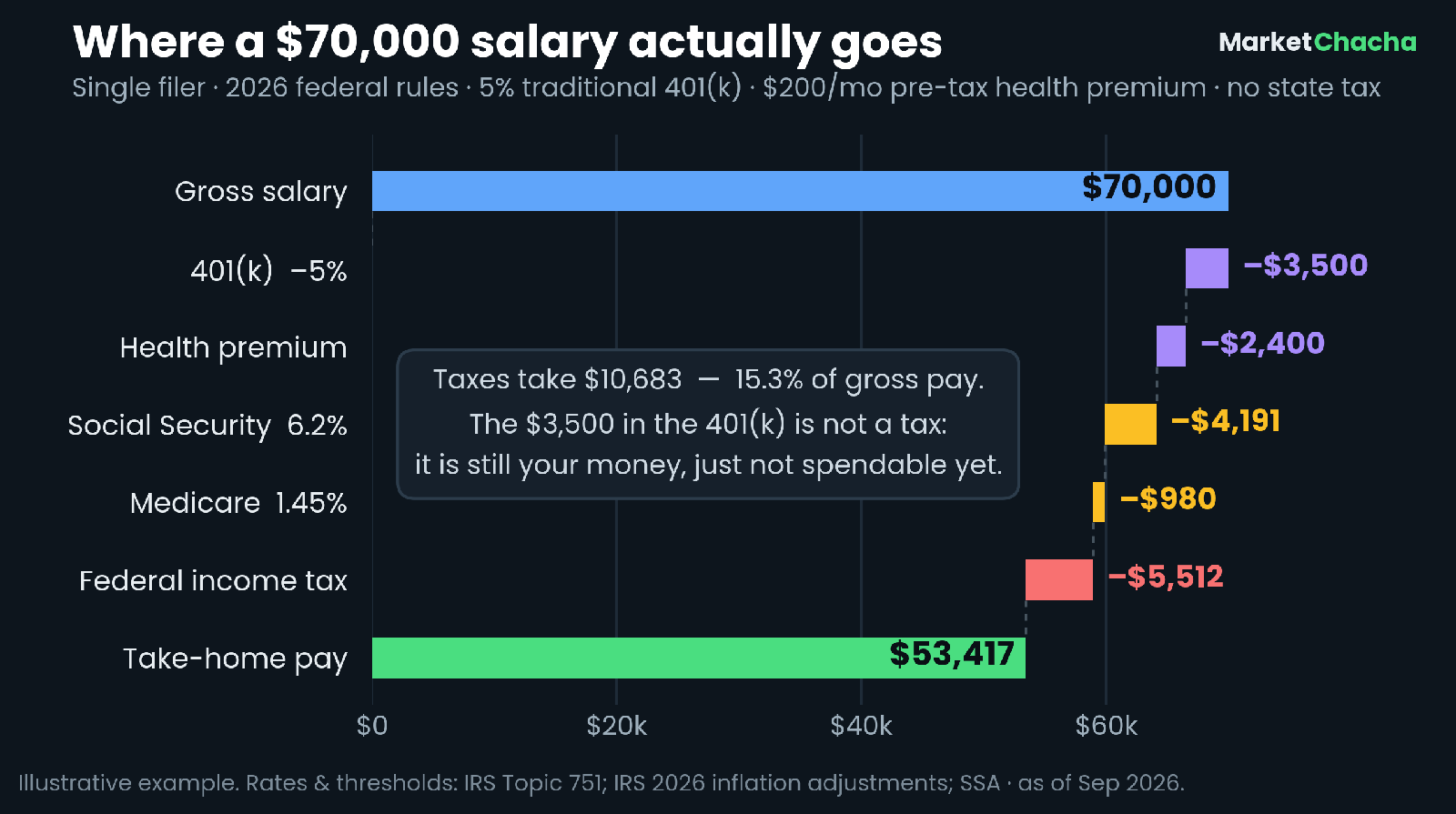
- Gross salary: $70,000 — that is $2,692.31 every two weeks.
- Traditional 401(k), 5%: −$3,500.
- Health premium: −$2,400 ($200 × 12).
- Social Security, 6.2%: −$4,191.20, charged on $67,600 — not $70,000 and not $64,100. The section “Pre-tax is not pre-every-tax” below explains why.
- Medicare, 1.45%: −$980.20, on the same $67,600.
- Federal income tax: −$5,512.00.
- Take-home pay: $53,416.60, or $2,054.48 every two weeks.
The federal income tax line comes from a short calculation. Wages subject to income tax are $70,000 minus the $3,500 deferral minus the $2,400 premium, which is $64,100. Subtract the 2026 standard deduction for a single filer, $16,100, and taxable income is $48,000. The first $12,400 is taxed at 10% ($1,240) and the remaining $35,600 at 12% ($4,272), for $5,512 in total. The calculation stops at 12% because the 12% band runs to $50,400 for a single filer in 2026, and $48,000 sits inside it.
Notice what that does and does not say. The marginal rate is 12%, but the tax actually paid is 11.5% of taxable income and just 7.9% of gross salary. That gap is the single most misunderstood idea in personal tax, and it is worth reading our full explainer on marginal versus effective tax rates if the distinction is new.
Adding up the genuinely lost money: $5,171.40 of FICA plus $5,512.00 of income tax is $10,683.40, or 15.3% of gross pay. The $3,500 sitting in the 401(k) is not a tax at all — it is still your money, simply not spendable this year.
FICA: the 7.65% that ignores your tax bracket
Social Security and Medicare tax behave nothing like income tax. There is no standard deduction, no bracket, and no personal circumstance that reduces them. Per the IRS, the employee rate is 6.2% for Social Security and 1.45% for Medicare, with the employer matching both, so 12.4% and 2.9% flow to the government in total.
Two thresholds are worth knowing. Social Security applies only up to an annual wage ceiling — the contribution and benefit base, which the SSA set at $184,500 for 2026. Earn above it and the 6.2% simply stops for the rest of the year, which is why some high earners see their paycheck grow in the autumn. Medicare has no ceiling at all; instead an extra 0.9% Additional Medicare Tax is withheld on wages above $200,000 in a calendar year.
For most people neither threshold is ever reached, and FICA is a flat 7.65% haircut on every dollar earned.
Federal withholding is an estimate, not your final tax bill
This is the distinction that makes tax season make sense. The federal tax deducted each payday is withholding — your employer's running guess at your annual liability, spread across the year. Your actual tax is settled only when you file a return. If withholding overshot, you get a refund; if it fell short, you write a cheque.
The guess is driven by the Form W-4 you filed when you joined. Since its 2020 redesign the W-4 no longer uses “allowances”. Instead it asks for your filing status, and then for dollar amounts: Step 2 if you hold more than one job or your spouse works, Step 3 for dependent credits, and Step 4 for other income, extra deductions, or a flat additional amount you want withheld each period.
A refund therefore is not a bonus and not a reward. It is the return of an interest-free loan you made to the government by over-withholding.
“Pre-tax” is not pre-every-tax
Here is the rule almost nobody is told, and it is worth getting exactly right because the two taxes move independently.
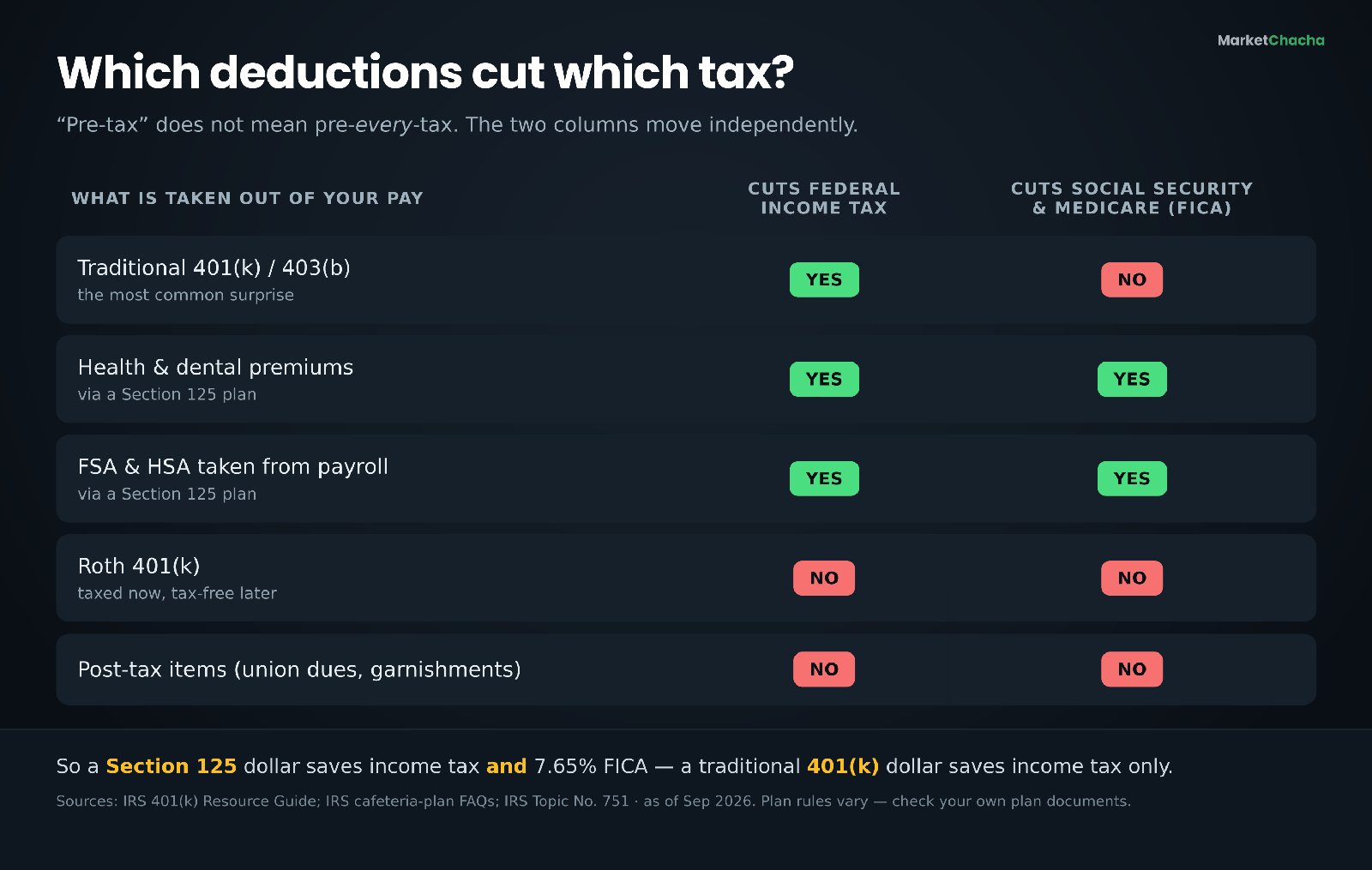
A traditional 401(k) deferral escapes federal income tax withholding now — but the IRS is explicit that elective deferrals “are included as wages subject to Social Security (FICA), Medicare, and federal unemployment taxes.” You pay the 7.65% on that money anyway.
A health premium taken through a Section 125 cafeteria plan is different: the IRS states that qualified benefits under such a plan are not subject to FICA, Medicare, or income tax withholding. It cuts both.
That is exactly why the worked example has two different bases. FICA was charged on $67,600 — gross minus the health premium only — while income tax was charged on $64,100, gross minus the premium and the 401(k). Same paycheck, two bases. If your employer offers an HSA through payroll, the same double saving applies; we cover the mechanics in our guide to the HSA's triple tax advantage.
How to actually read your pay stub in five minutes
Pull up your most recent stub and work through it in this order.
- Find gross pay for the period and confirm it equals your salary divided by your number of pay periods. If you are hourly, check the hours and rate.
- Separate the deductions into two blocks. Most stubs label them “pre-tax” (or “before-tax”) and “post-tax”. Retirement and health belong in the first; things like union dues and Roth contributions belong in the second.
- Check the FICA lines. They may be labelled OASDI or FICA-SS and Medicare or FICA-Med. Divide each by your FICA wages; you should get very close to 6.2% and 1.45%.
- Look at the year-to-date column. This is the most useful part of the stub and the part people skip — it shows what you have actually earned and paid so far.
- Sanity-check the withholding. Multiply the federal tax line by your number of pay periods and compare it with a rough estimate of your annual bill. Large gaps mean your W-4 needs attention.
- Budget from net, never gross. Any budgeting framework, including the 50/30/20 rule, is meant to be applied to take-home pay.
What it costs you: the catch
Getting this wrong is expensive in both directions. Under-withholding is the painful one: you can owe a large sum at filing time, and the IRS can add an underpayment penalty. It most often hits people with a second job, significant freelance income, or a working spouse, because each employer withholds as though its paycheck were your only income and each one applies the low brackets again.
Over-withholding is gentler but not free. A $3,600 refund is $300 a month that sat with the government instead of in a savings account or paying down a card balance.
There is also a real cost to skipping pre-tax benefits. If your employer matches 401(k) contributions and you contribute nothing, you are declining part of your own compensation — the arithmetic is in our piece on how the employer match actually works. For 2026 the IRS caps employee 401(k) deferrals at $24,500.
Common mistakes beginners make
- Budgeting off the salary figure. The offer letter number is not money you will ever see in full.
- Believing a raise into a higher bracket cuts take-home pay. Only the dollars inside the higher band are taxed at the higher rate.
- Assuming pre-tax means FICA-free. For a traditional 401(k) it does not.
- Filing the W-4 once and forgetting it. Marriage, a second job, or a new baby all change the right answer.
- Treating a big refund as a win. It usually means your W-4 is mis-tuned.
- Forgetting state and local tax. The example above assumes none; in many states and a few cities it is a further meaningful bite.
How this works in India
The Indian salary slip follows the same logic but with different machinery, and the first gap to close is CTC versus in-hand. Cost to Company includes items that never reach you as cash: the employer's provident fund contribution, gratuity provisioning, and often insurance premiums. Comparing an Indian CTC with a US gross salary is not like for like.
There is no direct FICA equivalent. The closest analogue is the Employees' Provident Fund: the employee contributes 12% of basic pay plus dearness allowance, and the employer contributes another 12%, of which 8.33% is routed to the Employees' Pension Scheme (on wages capped at ₹15,000) and 3.67% to the EPF account. The crucial difference is that your EPF contribution is not a tax — it is your own retirement savings, much closer in spirit to a 401(k) deferral than to Social Security. Alongside it sits professional tax, a small state-level levy constitutionally capped at ₹2,500 a year, which some states do not levy at all.
Income tax arrives as TDS — tax deducted at source. Your employer estimates your annual liability and deducts roughly a twelfth each month, which is the same withholding idea seen in the US, with the return reconciling the estimate afterwards. One thing to note as of 2026: the Income-tax Act, 2025 came into force on 1 April 2026, and salary TDS now sits in Section 392, replacing the familiar Section 192 of the 1961 Act. The rates themselves were not changed by the renumbering.
Under the new regime for FY 2026-27, income up to ₹4 lakh is nil, then 5% to ₹8 lakh, 10% to ₹12 lakh, 15% to ₹16 lakh, 20% to ₹20 lakh, 25% to ₹24 lakh and 30% above that. Salaried taxpayers get a ₹75,000 standard deduction, and the Section 87A rebate of up to ₹60,000 means taxable income up to ₹12 lakh carries no tax at all. So an Indian reader on ₹12 lakh of taxable salary sees EPF and professional tax on the slip but, on these rules, no TDS — a structurally different picture from the US example above, where the tax starts from the first dollar above the standard deduction.
FAQ
Why is my paycheck less than my salary divided by 26? Because gross pay is only the starting point. Pre-tax deductions, FICA at 7.65%, federal withholding and any state or local tax all come out before the deposit. In the example above, $2,692.31 of gross became $2,054.48 in the bank.
What is FICA on my pay stub? FICA is Social Security and Medicare tax: 6.2% and 1.45% of your wages, or 7.65% combined. Your employer pays an identical amount on top. It may appear as OASDI and Medicare, or as FICA-SS and FICA-Med.
Does contributing to a 401(k) reduce my Social Security and Medicare tax? No. Traditional 401(k) deferrals reduce the wages subject to federal income tax, but the IRS treats them as wages subject to Social Security, Medicare and federal unemployment taxes. Health premiums run through a Section 125 plan do reduce both.
Is a tax refund free money? No. A refund means you had more tax withheld during the year than you owed, so it is your own money coming back without interest. Adjusting your Form W-4 moves that money into your paychecks instead.
Why did my paycheck get bigger later in the year? Most commonly because your year-to-date wages passed the Social Security wage base — $184,500 for 2026 — after which the 6.2% stops until January. It can also happen when an annual deduction such as an FSA finishes.
What is the difference between CTC and in-hand salary in India? CTC is everything the employer spends on you, including its own EPF contribution and gratuity provisioning. In-hand is what remains after your EPF contribution, professional tax and TDS. The two can differ substantially.
Educational content only — not investment, tax or insurance advice, and not a recommendation of any product. Rates, fees and rules change — always check current terms with the provider and confirm your own position with a qualified tax professional. Figures are as of September 2026. [Sources: IRS Topic No. 751, IRS 2026 inflation adjustments, SSA contribution and benefit base, IRS 401(k) Resource Guide, IRS 401(k) limits for 2026, EPFO, Income Tax Department, India] Always do your own research.
This article is for educational and informational purposes only. It is not financial advice, investment recommendation, or a solicitation to buy or sell securities. Investing involves significant risks. I am not a SEBI-registered investment advisor. Readers should consult their own financial advisor and conduct their own research before making any investment decisions.
Comments
Join the conversation
Sign in to join the conversation.
Follow replies, add your view, and take part in the discussion.
Sign in to commentLoading comments...